
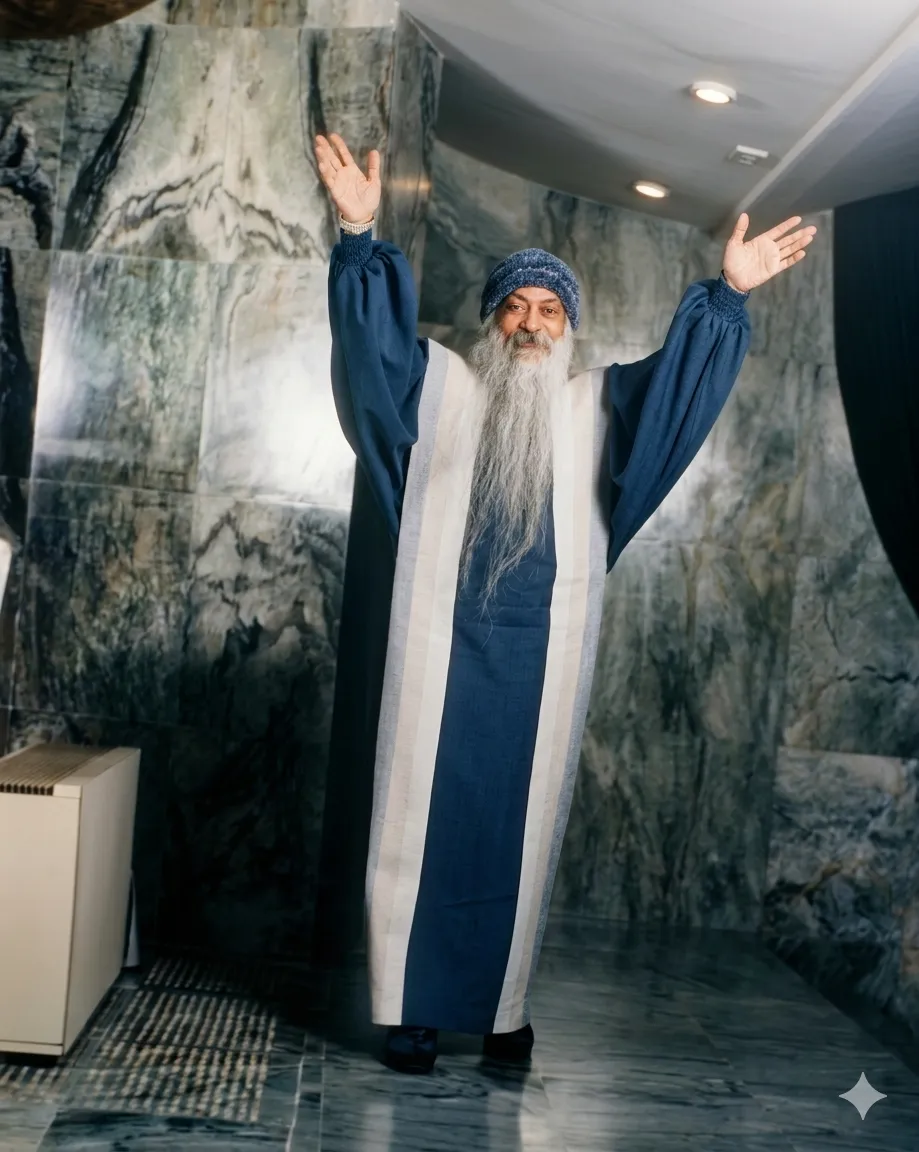
Osho says the Gita is about fixing the mind’s knots, not describing the soul itself.
From the Discourses
Passages where Osho speaks to this question — each links to the complete discourse.
Questioner: the other day you said that a soul is reborn within a year of its leaving its former body, and just now you said that a certain ghost lived in the bodiless state for eleven hundred years. Please explain the contradiction.
Yes, there are a few people who have extraordinary memory. People with ordinary memory don't take much time for being born. But those of extraordinary memory, who are few and far between, do take time. Curzon, a former British viceroy of India, has mentioned an event in his memoirs. A man of extraordinary memory was once brought to his court from Rajasthan. Even the word "extraordinary" does not rightly describe his memory; it was really incredible. The man did not know any language other than his mother tongue -- Rajasthani. Thirty persons speaking thirty different languages were called to the Viceroy House in Delhi to test this man's memory. Each one of them was asked to formulate a sentence in his own language and keep it in his mind. The Rajasthani man, a villager who knew no other language than his own, went to each of the thirty persons, one…
Today psychology recognizes that the tendency to torture oneself is sick, diseased. It is not a symptom of a healthy mind. Krishna recognized this thousands of years ago. He tells Arjuna what modern psychology is saying today—that higher than the ascetic is the yogi. Why? Because the ascetic only indulges—in what we can call—superficial tricks and useless externals, and takes a relish in giving himself pain. And since a man who relishes giving himself pain is also given respect by others, why do others respect him? If a man stands on the street whipping himself, what reason have you to respect him? If you ask a deep knower of the mind, he will say: the reason is that you are a sadist and he is a masochist. He is enjoying tormenting himself, and you are enjoying someone being tormented.
But regarding the diseases of the mind, one must be made to confess; there is no other way. One must get the patient himself to admit. Freud did one sort of work—Krishna is doing almost the same. Freud and the psychoanalysts following him do this: they lay the patient on a couch behind a screen and say: Speak whatever comes to you. Hide nothing. Whatever arises in your mind, go on speaking. At times he sings; at times he abuses; at times he utters hymns. Whatever comes to your mind, give it words—do not worry whether it is right or wrong. The psychologist sits hidden behind the screen; the man, beyond the screen, speaks in a flow that appears nonsensical from outside—though within there is his own coherence. Just as we all speak within, if it were spoken aloud, it would be like that. He goes on speaking.
Osho, you once said that, at the most, within a year of leaving the body the soul takes another birth. Today you said that for eleven hundred years a ghost kept demanding blood?
Yes, these are people with exceptional memory. I was speaking about ordinary memory; these are people of special memory. And among us, too, there are people with special memory. Curzon has written an incident in his memoirs. He writes that a man with extraordinary memory was brought to him from Rajasthan—extraordinary is too small a word for his memory. He knew no language except Rajasthani. Thirty people who each spoke a different language were seated in Lord Curzon’s Viceroy’s House—thirty speakers of thirty languages. Each of the thirty was asked to hold in mind one sentence in his own language. Then that Rajasthani rustic, a simple villager, would go to the first person, and that person would tell him the first word of his sentence in his language. Then a loud bell would be rung. He would go to the second person, who would give him the first word of…
ओशो, आपने कहा था कि ज्यादा से ज्यादा एक साल तक शरीर छोड़ने के बाद आत्मा दूसरा जन्म ले लेती है। आज कहा कि ग्यारह सौ साल तक खून करवाती रही एक प्रेतात्मा?
कर्जन ने अपने संस्मरणों में एक घटना लिखी है। कर्जन ने लिखा है कि उसके पास एक विशेष स्मृति का आदमी राजस्थान से लाया गया। विशेष शब्द भी छोटा पड़ जाता है उसकी स्मृति के लिए। वह सिर्फ राजस्थानी के अतिरिक्त कोई भाषा नहीं जानता है। तीस भाषा बोलने वाले लोग लार्ड कर्जन के वाइसराय भवन में बिठाए गए--तीस भाषा बोलने वाले लोग। और उन तीसों से कहा गया कि वे एक-एक वाक्य अपनी-अपनी भाषा का खयाल में ले लें। फिर वह राजस्थानी, ठेठ गंवार, गांव का आदमी, पहले आदमी के पास गया और वह अपनी भाषा के वाक्य का पहला शब्द उसे बताएगा। फिर एक जोर का घंटा बजाया जाएगा। फिर वह दूसरे के पास जाएगा, वह अपनी भाषा के अपने वाक्य का पहला शब्द उसे बताएगा। फिर जोर का घंटा बजाया जाएगा। ऐसा वह तीस लोगों के तीस वाक्यों का पहला शब्द लेकर पहले आदमी के पास वापस लौटेगा। अब वह दूसरा शब्द बताएगा, फिर घंटा, और ऐसा चलेगा। ऐसा घंटों की लंबी यात्रा में वे तीस आदमी अपने तीस वाक्य बता पाएंगे, और हर शब्द के बाद तीस शब्दों का अंतराल होगा। …
Question: Osho, can spirituality and materialism be reconciled? Science says the soul is not a thing at all: in fact, “soul” is just another name for thought. There is no such entity as a soul—only an empty word. No one has seen the soul; it is only “experienced,” and you can’t transfer an experience to someone else. It’s just a theory. Whoever claims to have experiences ends up with a private, different notion of the soul; everyone who believes themselves to be a soul has their own idea. That’s what these scientists say, and the mind gets confused about who is telling the truth. We talk about the soul though no one has seen it to this day. And Marxism says there are two united elements. We take there to be only one; nothing else exists. But Marxism posits two: energy and matter—conjoined, inseparable.