
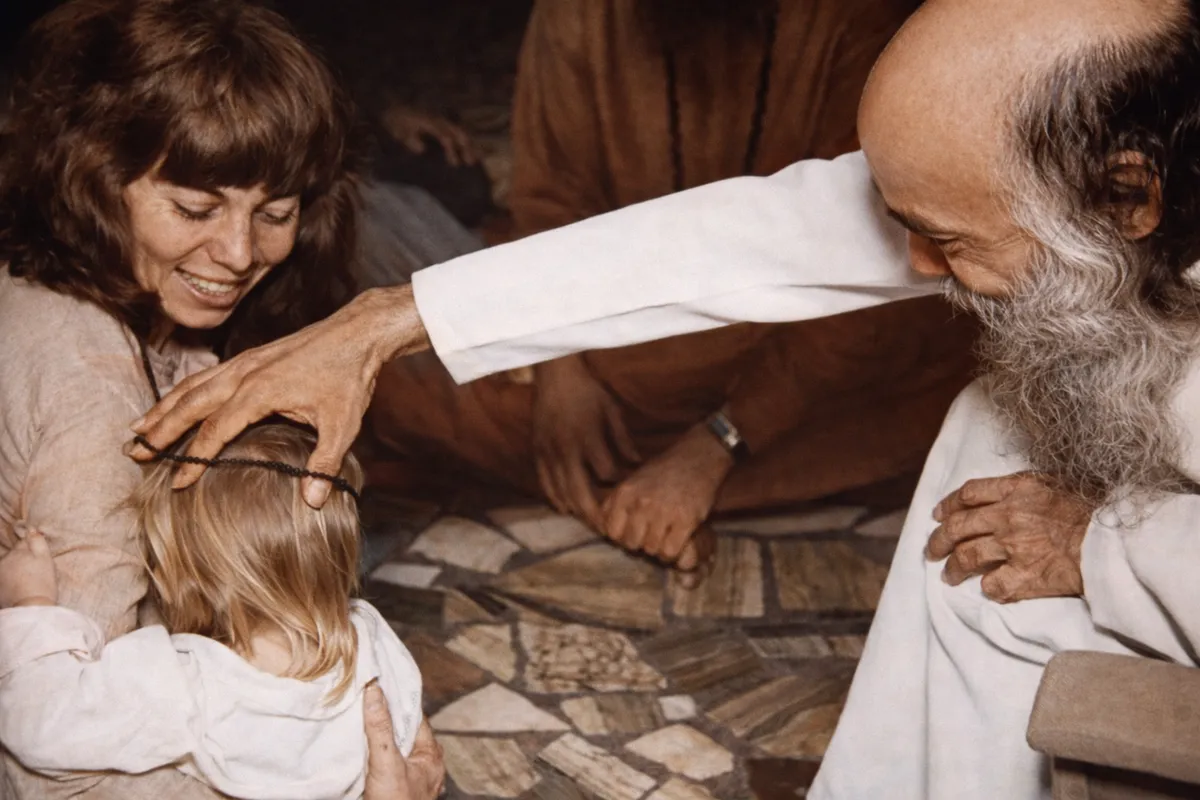
At first your ‘me-first’ might bring you to a teacher, but real love for the teacher melts that ‘me-first’ away, so they can’t stay together.
From the Discourses
Passages where Osho speaks to this question — each links to the complete discourse.
Osho, can a disciple’s love for his true Master and the disciple’s ego both persist together?
Ego is the stair you have used till now; surrender is your foot—searching for the new. Until your foot rests on the new, you cannot lift it from the old—nor should you, else you will fall flat on your face. Once the foot has found its grip on the new step, then lift it; then there is no fear. Once your foot settles in surrender, there will be little difficulty in lifting it from the ego. But there is no need to hurry. Let things happen in their natural way, patiently. Do not be anxious: “If I have ego, how will surrender happen?” When a room is dark, do you ask, “There is so much darkness here, and not of a day or two, but of lifetimes—who knows since when! If I light a little lamp here—will it burn? Will it burn in such great darkness?” You don’t ask this,…
To be a disciple is a great art. One can even say the greatest, because Its requirement is the surrender of the ego Which is the hardest thing in life. One can do everything for the ego: One can climb mountains and go to the moon. Everything is easy if it is for the ego. But to drop the ego is really an uphill task It goes against our natural instinct. But it is the beginning of real spirituality. The first requirement for a disciple Is to surrender, to say to the master 'Now I am no more, only you are!' A total yes to the master, an absolute trust -- That's what makes a disciple. There are many students but very few disciples. And only disciples can be transformed Students can only be informed.
Osho, you say the same thing in countless ways. But when I listen to you, it feels as if I am hearing it for the first time. And I feel so much joy that I don’t feel like going back home. What should I do—what can I do—so that I can just keep listening to you!
You will feel as if you have been made to rise out of season, before time—as if you were not yet to go and yet had to go. And if you go in that way, your home will become even more desolate than before. I do not want to make your home desolate; I want to make your home a temple. I want that when you go home, your home’s new form is revealed. I do not want to tear you away from home, from the world, from family life. That is the newness of my sannyas: I do not want to sever you from the world; I want to join you to the world in such a way that your connection with the world becomes a connection with the Divine. Let the world no longer be a barrier between you and the Divine; let it become a means. If…
Osho, the witness, the seer, consciousness is always separate—virginal and unbound. And the whole play of life is nothing but the movement of the gunas within themselves. In such a situation, if a person’s qualities of sattva, rajas, and tamas are calmed in a scientific or chemical way, or if a person is made sattvic, will he then attain that ever-free witness? If the witness is forever free and present, then by chemically altering the three gunas will it not be revealed? Would the person not then become religious? What is the fundamental difference between solving the problem arising from the
Sadhana means we are dissolving the current itself, not breaking the bulb. There is no point in breaking the bulb. In fact, the bulb is useful; it tells you whether the current is flowing or not, whether there is current or not. Your anger within tells you you are still sunk in ignorance. Lust tells you your life energies have not yet become aware. If we remove these elements, anger will stop manifesting and you will also stop knowing that you are in deep ignorance. It is as if a man is sick and we snatch away the symptoms of his disease so that he doesn’t even come to know he is ill. And keep in mind, anger is an opportunity. Only the unwise say anger is simply bad; I do not say so. Anger is an opportunity; you can use it badly or well. Anger is a chance. In…
You ask, “How should I come for the Master’s darshan? When a disciple goes to the Master, how should he go? How should a disciple live with the Master—what should he do, and what should he not do?”
It happened—You must have heard the name Nandalal Bose, a great Indian painter. He was a disciple of Abanindranath Tagore, Rabindranath’s uncle, himself a master painter. One day Rabindranath was sitting with Abanindranath when young Nandalal came with a painting of Krishna. Rabindranath writes in his memoirs: “I had never seen such a beautiful Krishna.” Rabindranath himself was a great poet and a painter; his judgment is beyond doubt. He says, “I was spellbound.” But I was shocked—Abanindranath glanced once and threw the painting outside the door. He said to Nandalal, “You consider this fit to show? The pat-painters of Bengal who sell two-paise pictures of Krishna on Janmashtami make better than this. Go, learn from the pats.” It was severe—merciless. Rabindranath too felt he should stop his uncle: “This is going too far. I have not seen a better Krishna.” He was ready to say, “Even you have painted…