
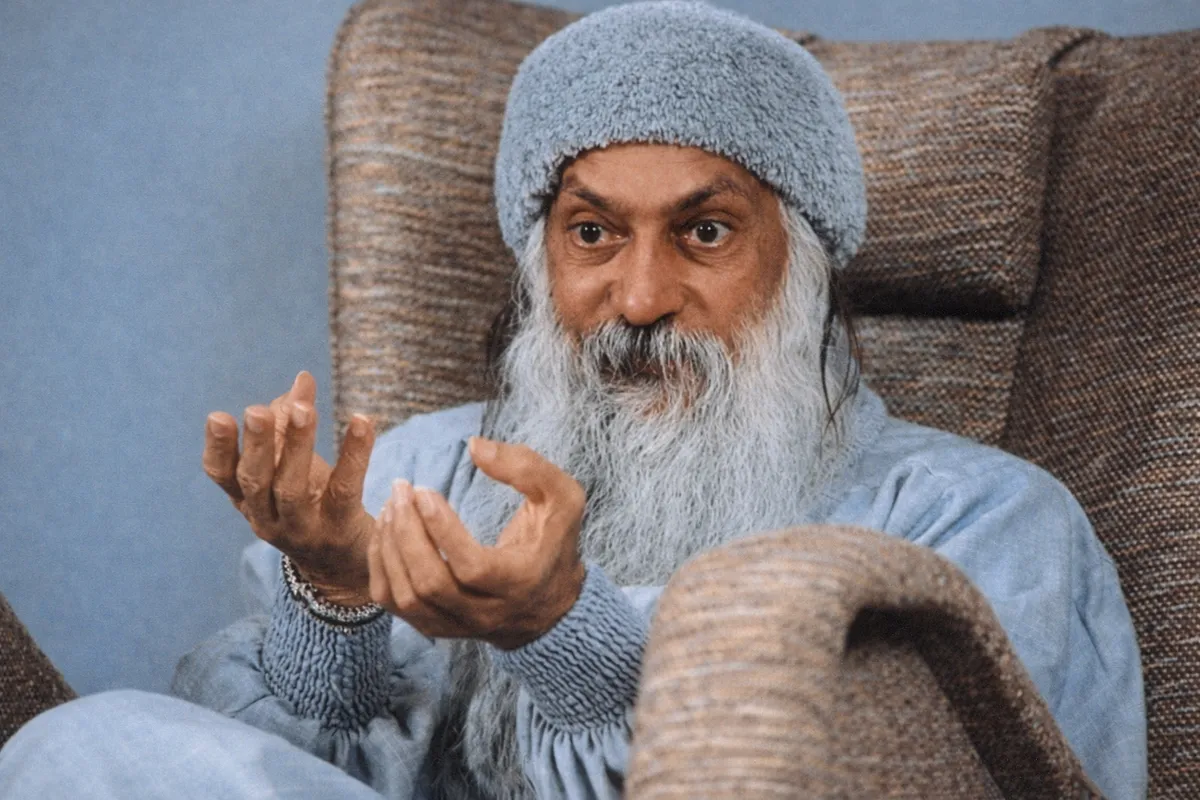
Your real self doesn’t store memories; only the mind does—when you stop adding feelings and stories through meditation, the hurt fades and only clear facts remain.
From the Discourses
Passages where Osho speaks to this question — each links to the complete discourse.
Beloved Osho, are there two kinds of memories, a factual memory, and a spiritual memory? If yes, is there a connection between them?
It seems there is an automatic reversal process. You have to reverse a tape, but your brain reverses immediately. When you put the needle on the dream center again it starts from A B C, not from the point where it has stopped. If you take the needle away again, it reverses so quickly that no time is lost. Put the needle back and it starts from A B C again. If the man was saying, "I am Alexander the Great..." -- if you have touched his past life memory center and he was saying, "I am Alexander the Great," and if you take the needle away and put it back again, he will again start with, "I am Alexander the Great." Your brain contains all the memories, psychological memories of your past lives. But the more you meditate, the more you go on erasing all psychological memories. Begin first…
Osho, in a sequence-bound life and in a spontaneous life, will memories come to an end?
No. In a sequence-bound life, your very being will emerge from your memory. In a spontaneous life, your being will use your memory. That is the difference. In a spontaneous life you will be new every moment; if you wish, you will use memory! Memory will remain stored in the treasury of your consciousness—present, not erased; it will remain. But it will be like the basement of your house filled with many things: when needed, you take something out. That is why Buddha gave it a name; he called it agara—an abode. Smriti-agar: a storehouse, the storehouse of consciousness. A repository of consciousness, set aside. When you need it—even your spontaneous existence will need memory—you will use it. If you have to return home, you will need the memory of your home; you will use it.
Osho, when it happens—when the leap takes place—will memory completely vanish, go far away? But words should still be remembered, right? Technical words, technical education—these should remain in this process.
So today when you come, I will see you—not the one who abused me yesterday. Where is he now? Much water has flowed down the Ganges. For all I know, you may be coming to ask forgiveness, and I am thinking you are the same man who abused me. Who knows what you have become in twenty-four hours! In twenty-four hours one has no certainty about oneself—how can one have certainty about another? So memory is a corrupting element. If you identify yourself with it, you are finished. In the end you will go mad if you are completely caught in its corruption. But if you stand entirely outside it and memory remains only a mechanical device that serves you—where the house is, where the shop is, where what you have read is kept—then it is merely a mechanical device you use. Soon enough, we have already made small computers…
You implore us constantly to give up memory, to live in the herenow. But in giving up memory I must also give up my greative imagination, for I am a writer and all that.I write about has its root.s in what I remember. I wonder -- what would the world be like without art and the creative imagination that makes art possible? A tolstoy could never become a buddha, but then could a buddha write war and peace?
That does not mean that your past cannot be remembered, because past is part of the present. Whatsoever you have been in the past, whatsoever you have done in the past, is PART of your present, it IS HERE. Your child is in you, your young man is in you... all that you have been doing is in you. The food that you have eaten, it is past, but it has become your blood; it is circulating herenow; it has become your bone, it has become your marrow. The love that you went through may be past, but it has transformed you. It has given you a new vision of life; it has opened your eyes. Yesterday you were with me -- it is past, but is it really totally past? How can it be totally past? You were changed by it; you were given a new spur, a new…
Nirvitarka samadhi is attained when the memory is purified, and the mind is able to see the true nature of things without obstruction. The explanations given for the samadhis of savitarka and nirvitarka, also explain the higher states of samadhi, but in these higher states of savichara and nirvichara samadhis, the objects of meditation are more subtle
THE PROVINCE OF SAMADHI THAT IS CONNECTED WITH THESE FINER OBJECTS EXTENDS UP TO THE FORMLESS STAGE OF THE SUBTLE ENERGIES. But those who have worked in the inner world know that there are phenomena which are uncaused. Not only that, that they know this, they know that the whole existence is uncaused. It is a different, totally different world from the scientific mind. Whatsoever you see, even before you have seen it, the interpretation has entered. Continuously I watch people; I am talking to them -- if it fits, even they have not said anything, they have given me an inner nod, "Yes." They are saying, "Right." If it doesn't fit with their attitudes, they have not said anything, the "no" is written on their face. Deep down they have started saying, "No, it is not true." Just the other night I was talking with a friend. He has…