
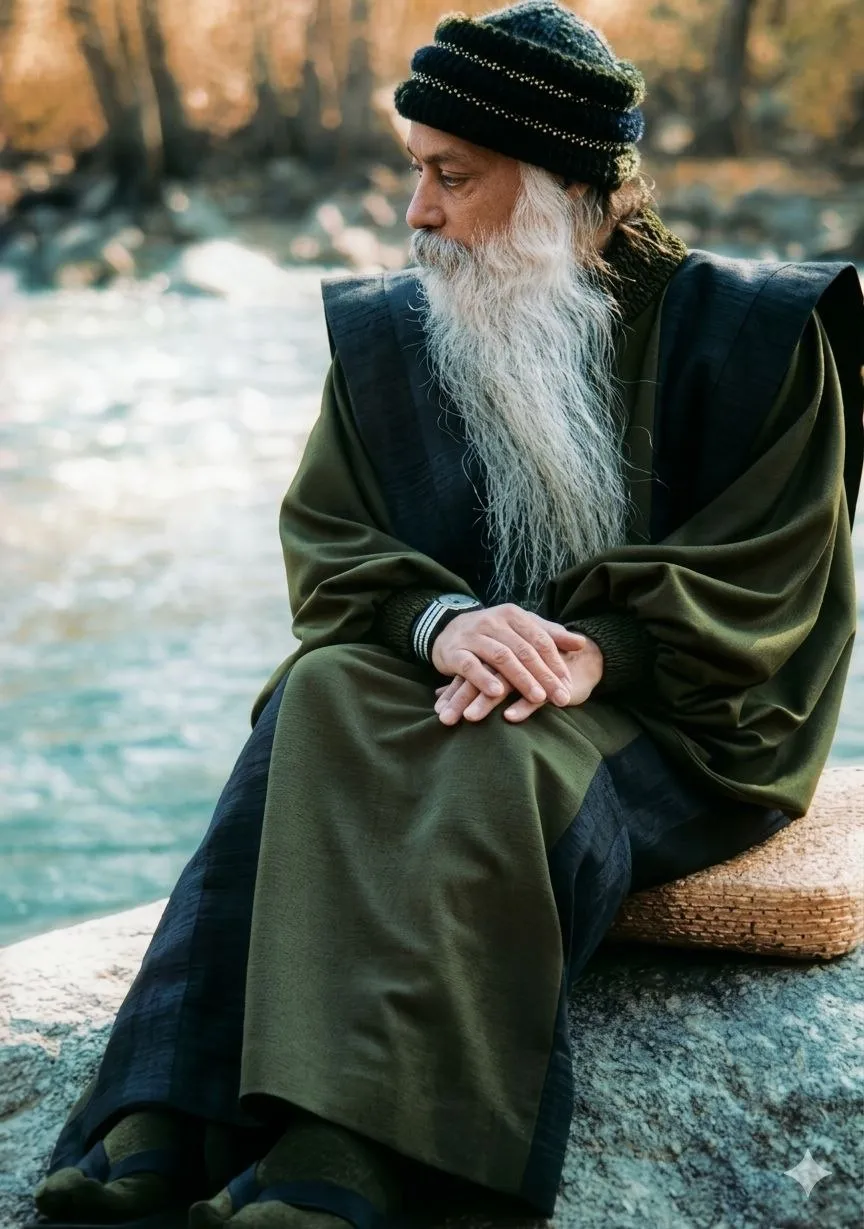
Let memory be your toolbox, not your boss: remember what helps, but let the living moment decide what you do.
From the Discourses
Passages where Osho speaks to this question — each links to the complete discourse.
Questioner: what is the place of memory in what you call a sequential life and in a life of spontaneity?
While a life with sequence follows its memory like a slave, a spontaneous life uses it like a master. This is the difference. If you live a natural life, if you are renewed from moment to moment, it does not mean your memory is wiped out -- it is rightly stored in your mind, and you can use it as you like. It is as if many things are stored in the basement of your house and you can take out anything you need from this store. That is why Buddha has called it an agaar, a storehouse of memories, of consciousness. One who lives spontaneously also needs his memory. If he is in town and wants to return to his house in the evening, it is his memory of the house and the way to it that will enable him to do so. And he will use it rightly.
Osho, in a sequence-bound life and in a spontaneous life, will memories come to an end?
No. In a sequence-bound life, your very being will emerge from your memory. In a spontaneous life, your being will use your memory. That is the difference. In a spontaneous life you will be new every moment; if you wish, you will use memory! Memory will remain stored in the treasury of your consciousness—present, not erased; it will remain. But it will be like the basement of your house filled with many things: when needed, you take something out. That is why Buddha gave it a name; he called it agara—an abode. Smriti-agar: a storehouse, the storehouse of consciousness. A repository of consciousness, set aside. When you need it—even your spontaneous existence will need memory—you will use it. If you have to return home, you will need the memory of your home; you will use it.
Beloved Osho, you said that to live moment to moment one must throw away one's dead past and memories. Does it mean that all the memories have to be dissolved and destroyed to transcend the mind? But one needs a strong mind and an intense and sufficient accumulation of memories to function in this world.
The atom bomb is not such a great danger as these secrets are because the very soul of man can be enslaved through them. If Jesus is born now in Soviet Russia or communist China, they will not crucify him; first they will try to destroy his memory. They cannot be successful with Jesus but they can be successful with you. They cannot succeed with Jesus because he is already unidentified with the memory. If you destroy the memory nothing is really lost because he lives in his consciousness, not in his memories. You don't really have any consciousness separate from the memories, so if your memory is destroyed your consciousness is destroyed. You don't know how to function without the memories. So for the new generation, the coming world, meditation is a must because only that can protect you from political dictatorship -- nothing else. They will not put…
Osho, when it happens—when the leap takes place—will memory completely vanish, go far away? But words should still be remembered, right? Technical words, technical education—these should remain in this process.
So today when you come, I will see you—not the one who abused me yesterday. Where is he now? Much water has flowed down the Ganges. For all I know, you may be coming to ask forgiveness, and I am thinking you are the same man who abused me. Who knows what you have become in twenty-four hours! In twenty-four hours one has no certainty about oneself—how can one have certainty about another? So memory is a corrupting element. If you identify yourself with it, you are finished. In the end you will go mad if you are completely caught in its corruption. But if you stand entirely outside it and memory remains only a mechanical device that serves you—where the house is, where the shop is, where what you have read is kept—then it is merely a mechanical device you use. Soon enough, we have already made small computers…
Another friend has asked: Osho, what is the relationship between the method of meditation and jati-smaran (recollection of past lives)?
But the one who becomes skilled in this—who can fully awaken any day’s memory up to the age of five—will find that the memories begin to awaken completely. And you should test it. As today passes, note down some events and lock them up. After two years, try to recall today. Most of it will have been forgotten. Then remember—and after remembering, break the lock and compare whether what you recalled matches what you had written. You will be amazed—astonished—that besides what you wrote, many more details have come back which you did not even note at the time. They will all be there in memory. Buddha called this alaya-vijnana. There is a corner of the human mind he called the storehouse of consciousness. Like a junk room in the house where we keep all the odds and ends, there is a storehouse that collects memories—where everything from birth after…