
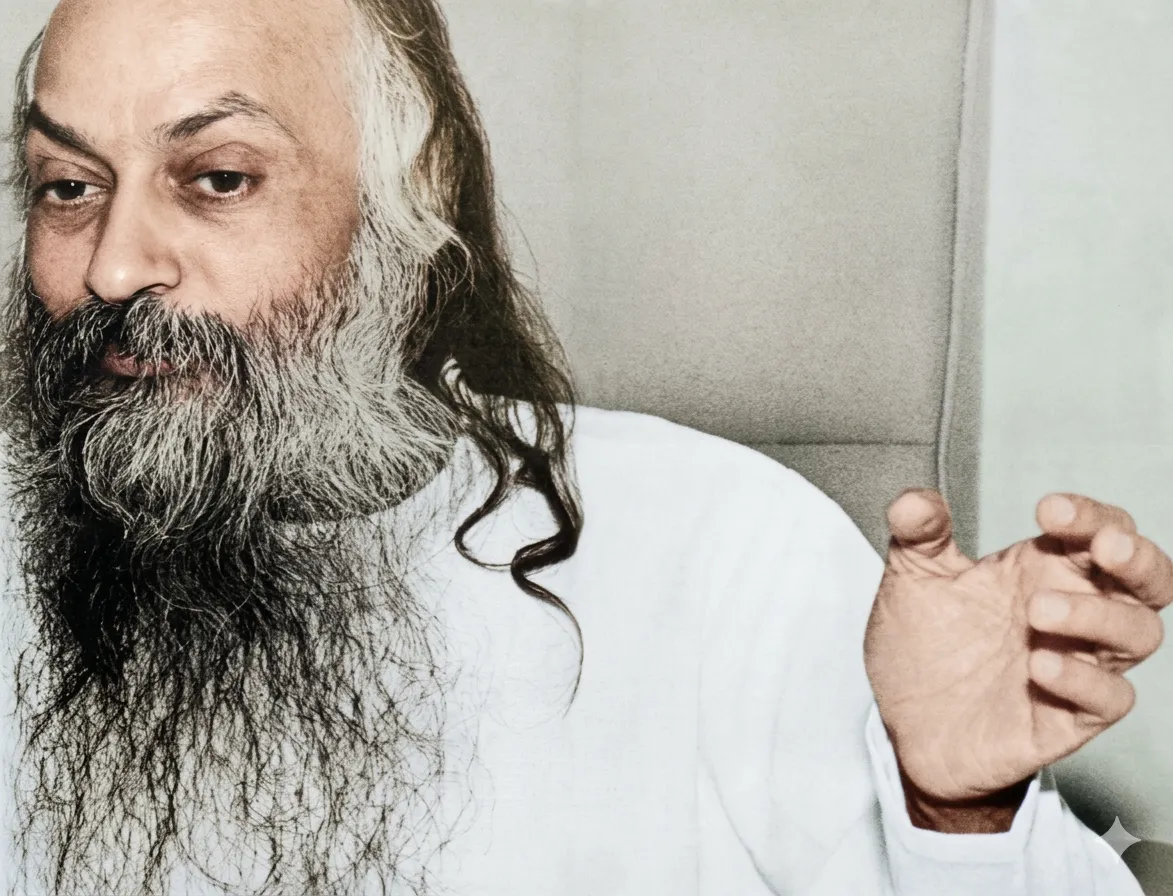
Osho's perspective on Upanishads
When Osho Spoke About Upanishads
Passages from the discourses where this theme comes alive.
Beloved Osho, what is the difference between the emptiness of the child before the formation of the ego and the awakened childlikeness of a buddha?
Whether you are for it or against it doesn't matter -- your concern shows where your ego is hanging. And I will include the capitalist in it also: his whole concern is how to gather money, hoard money -- because money has power over matter. You can purchase any material thing through money. You cannot purchase anything spiritual, you cannot purchase anything that has any intrinsic value; you can purchase only things. If you want to purchase love, you cannot purchase; but you can purchase sex. Sex is the material part of love. Through money, matter can be purchased, possessed. Now you will be surprised: I include the communist and the capitalist both in the same category, and they are enemies, just as I include Charvaka and Mahatma Gandhi in the same category, and they are enemies. They are enemies, but their concern is the same. The capitalist is trying…
Beloved Osho, the most fundamental upanishidic statement is aham brahmasmi. Is it connected in any way to sachchidanand?
You will be surprised to know that the idea of involution has not appeared at all in the Western mind, only the idea of evolution, only the idea of progress. But the mystics of the UPANISHADS have a more perfect and more comprehensive approach. Nothing can go on evolving forever. Evolution has been conceived by the UPANISHADS as a circle and, in fact, in existence everything moves in a circle. Stars move in circles, the sun moves in a circle, the earth moves in a circle, the moon moves in a circle, climates move in a circle, life moves in a circle. The whole existence knows only one way of movement and that is circular. So that which seems to be going up one day will soon be going down. Again it will come up -- it is just like a wheel and the spokes of the wheel. The same…
A friend has asked: Osho, the soul cannot be seen. Why is so much importance given to what cannot be seen? And why are you also speaking about this same unseen soul?
A tree is visible; its roots are not. The roots are hidden in the earth. But that does not reduce the value of the unseen roots. In fact, the visible tree depends entirely on those invisible roots. And whoever wastes time caring only for the tree and ignores the roots, his tree is bound to dry up. That tree will bear neither leaves nor flowers nor fruit. The life of the tree is hidden in its unseen roots. Whatever is truly important in life is hidden. What appears is only the outer shell. What remains unmanifest is the inner life-breath. The body is visible because it is the outer shell. What is within the body is not visible. But the value of what is unseen does not diminish for that reason. Rather, precisely because it is not visible, its search becomes all the more necessary. Let it not happen that…
एक मित्र ने पूछा है: ओशो, आत्मा दिखाई नहीं देती है। और जो नहीं दिखाई देती, उसका इतना महत्व क्यों माना जाता है? और आप भी उसी न दिखाई पड़ने वाली आत्मा की बात क्यों कर रहे हैं?
वृक्ष दिखाई पड़ता है, जड़ें दिखाई नहीं पड़तीं; जड़ें जमीन के भीतर छिपी होती हैं। लेकिन इस कारण नहीं दिखाई पड़ने वाली जड़ों का मूल्य कम नहीं हो जाता है। बल्कि जो वृक्ष दिखाई पड़ता है, वह उन्हीं जड़ों पर निर्भर होता है, जो दिखाई नहीं पड़तीं। और वृक्ष की ही देख-सम्हाल में जो समय गंवा देगा और जड़ों की फिकर नहीं करेगा, उसका वृक्ष सूख जाने वाला है। उस वृक्ष पर न पत्ते आएंगे, न फूल आएंगे, न फल लगेंगे। नहीं दिखाई पड़ने वाली जड़ों में ही वृक्ष के प्राण छिपे हैं।
Osho, your discourse on the isa upanishad was so beautiful. I have heard it said that the upanishads are commentaries on or extensions of the vedas. Is this true? I bow to you.
Knowledgeability is not wisdom; knowledgeability is, on the contrary, a hindrance to wisdom. The more knowledgeable you become, the less is the possibility of attaining your own experience, because knowledge deceives -- it deceives others, it deceives you. It goes on giving you the sense as if you know, but that "as if" has not to be forgotten. That "as if" can easily be forgotten and one can be deceived. Remember one very significant saying in the Upanishads: Those who are ignorant, they are bound to be lost in darkness; and those who are knowledgeable, they are bound to be lost in a far more and far bigger darkness than the ignorant ones. The ignorant person is at least sincere: he knows that he does not know; at least this much truth is there. But the knowledgeable covers up his wounds, his ignorance, his black holes. He covers them by…
Profound Quotes on Upanishads
Explore our structured collection of meaning-mapped quotes regarding Upanishads.