
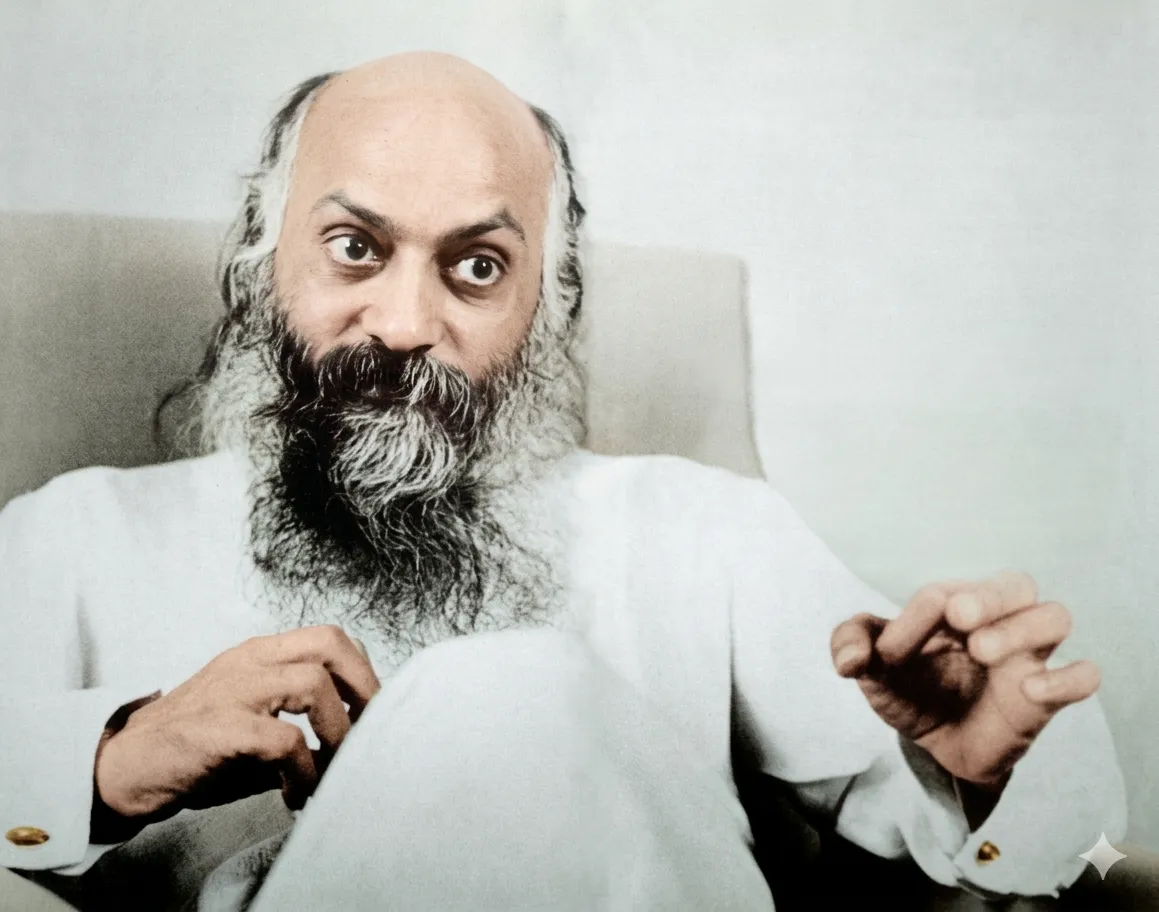
It means the real you is the same as the ultimate truth—felt inside as being here, aware, and joyful.
From the Discourses
Passages where Osho speaks to this question — each links to the complete discourse.
Beloved Osho, the most fundamental upanishidic statement is aham brahmasmi. Is it connected in any way to sachchidanand?
You will be surprised to know that the idea of involution has not appeared at all in the Western mind, only the idea of evolution, only the idea of progress. But the mystics of the UPANISHADS have a more perfect and more comprehensive approach. Nothing can go on evolving forever. Evolution has been conceived by the UPANISHADS as a circle and, in fact, in existence everything moves in a circle. Stars move in circles, the sun moves in a circle, the earth moves in a circle, the moon moves in a circle, climates move in a circle, life moves in a circle. The whole existence knows only one way of movement and that is circular. So that which seems to be going up one day will soon be going down. Again it will come up -- it is just like a wheel and the spokes of the wheel. The same…
Osho, according to the Paingala Upanishad there are four mahavakyas. First: tat tvam asi, That thou art; second: tvam tadasi, Thou art That; third: tvam brahmasmi, Thou art Brahman; and fourth: aham brahmasmi, I am Brahman. Osho, kindly explain the meanings and the subtle differences among these mahavakyas.
Kabir has said: the Master is a dyer. But before he dyes, he cleans; he washes, he brightens, he removes the grime from the cloth. Only when the cloth is clean can it be dyed; only then will the colors reveal their fullness. When these two points are complete—when it is clear that the disciple has understood: “I am not; Existence is”—then he is told the second point: do not fear, you too are that Existence. Yet the word “That” is still used. When it is understood that Existence, That, is all, the matter can be taken a little deeper, into the most subtle. “Tvam brahmasmi.” You are not only That; you are Brahman. Brahman means: now we have given “That” a face, personhood. We have endowed That with consciousness, with life. Now it is no longer an object, no longer a mere idol in a temple; now there is…
पहला प्रश्न: ओशो, पैंगल उपनिषद के अनुसार चार महावाक्य हैं। पहला: तत्वमसि, वह तू है; दूसरा: त्वं तदसि, तू वह है; तीसरा: त्वं ब्रह्मास्मि, तू ब्रह्म है; और चौथा: अहं ब्रह्मास्मि, मैं ब्रह्म हूं। ओशो, इन महावाक्यों के अर्थ और अर्थभेद बताने की अनुकंपा करें।
कबीर ने कहा है, गुरु तो रंगरेज है। मगर इसके पहले कि वह रंगे, सफाई करेगा, धोएगा, निखारेगा, गंदगी वस्त्र की दूर करेगा। साफ-स्वच्छ हो जाए वस्त्र तो ही रंगा जाए; तो ही रंग अपनी परिपूर्णता में प्रकट होंगे। जब ये दो बातें पूरी हो गईं, यह बात साफ हो गई कि शिष्य समझ गया कि वह नहीं है, स्वयं नहीं है, अस्तित्व है, तो उससे दूसरी बात कही कि भय मत कर, तू भी वह अस्तित्व है। मगर अभी वह का प्रयोग किया जा रहा है। जब यह भी बात समझ में आ गई कि अस्तित्व, वह सब कुछ है, तो अब बात को थोड़ा और गहराया जा सकता है। अब थोड़ा और भी सूक्ष्मातिसूक्ष्म में प्रवेश कराया जा सकता है। ‘त्वं ब्रह्मास्मि।’ वह ही नहीं है तू, ब्रह्म भी तू है। ब्रह्म का अर्थ होता है: अब हमने वह को व्यक्तित्व दिया। वह को चेतना दी, वह को जीवन दिया। अब वह कोई वस्तु न रही, कोई मंदिर की प्रतिमा न रही, अब तटस्थ रहने की कोई जरूरत न रही, अब तैयारी इतनी है कि हम उसको व्यक्ति की भांति स्वीकार कर सकते हैं। …
Soham bhavo namaskarah "the feeling of I am that -- so-aham -- is the salutation."
So if there is a God, Jains say, then man is not really a spirit. He is just a created thing, not a soul, because then he does not have any freedom. If God is the Creator, then man is not free and then everything becomes meaningless: whether you are good or bad, it is meaningless. God remains the supreme power. He can do anything, He can undo anything. And He is not responsible to you. If you have created a mechanical device you can destroy it: you are not responsible to your mechanical creation. A painter creates a painting; he can destroy it. The painting cannot say, "You cannot destroy me." And if God is the Creator and man is just a created thing, how can the created thing evolve and become Divine? That is impossible. So Jains say that there is no God. Only then can man become…
Beloved Osho, is not the inquiry into `sachchidanand' the same as badarayana's "athato brahma jigyasa"?
When he became absolutely certain of it, he thought for a moment -- just in the middle of millions of corpses -- "Is it worthwhile? What will be the point? Killing these brave people and just becoming victorious over a country of the dead ... You will feel repentant your whole life, because you have destroyed so much life. And not the life of ordinary people, but people of tremendous courage, who have given you absolute alternatives: `Either we will live in freedom or we will die in freedom. Slavery is not acceptable. You may be a great king, you may have great power, but we have at least the power to die -- you cannot take it away from us.'" The country was poor. It was not in any way comparable to the vast empire of Ashoka. Ashoka's empire was the biggest India has ever been -- from Afghanistan,…
Osho, Krishna repeatedly uses the expression satchidanandghan Paramatma. What is this satchidanandghan Paramatma?
You! Krishna is pointing toward you. To that which is your consciousness, from where you are hearing me; from where you are seeing me; to that inner seat within you, the empty space, the void. One is me here, speaking. And one is you, listening. Your ears are not listening; the ears only carry the words to where you are listening. One is me, sitting here, and you are seeing me. Your eyes are not seeing me; the eyes only carry my reflection to that within you where you are seeing. That which is hidden within, amidst all the senses; that which is the center among all the senses, which itself is not a sense; that inner center of consciousness from which all awareness arises, because of which the senses look out and recognize—Krishna is pointing to that. That is satchidanandghan Paramatma. Understand the word. Satchidananda—sat, chit, ananda—is made of…
तीसरा प्रश्न: ओशो, कृष्ण ने कई जगह सच्चिदानंदघन परमात्मा शब्द को दोहराया है। यह सच्चिदानंदघन परमात्मा क्या है?
आप! आपकी तरफ इशारा कर रहे हैं कृष्ण। वह जो चैतन्य है आपका, जहां से आप मुझे सुन रहे हैं; जहां से आप मुझे देख रहे हैं; वह जो आपके भीतर बैठी हुई जगह है, खाली जगह है, शून्य है। एक तो मैं हूं यहां, बोल रहा हूं। और एक आप हैं, जो सुन रहे हैं। आपके कान नहीं सुन रहे हैं। कान तो केवल शब्दों को वहां तक ले जा रहे हैं, जहां आप सुन रहे हैं। एक तो मैं हूं, जो यहां बैठा हूं। और आप मुझे देख रहे हैं। आपकी आंखें मुझे नहीं देख रही हैं। आंखें तो केवल मेरे प्रतिबिंब को वहां तक ले जा रही हैं, भीतर आपके, जहां आप देख रहे हैं। वह जो भीतर छिपा है सारी इंद्रियों के बीच में; वह जो केंद्र है सारी इंद्रियों के बीच में; जो स्वयं कोई इंद्रिय नहीं है। …