
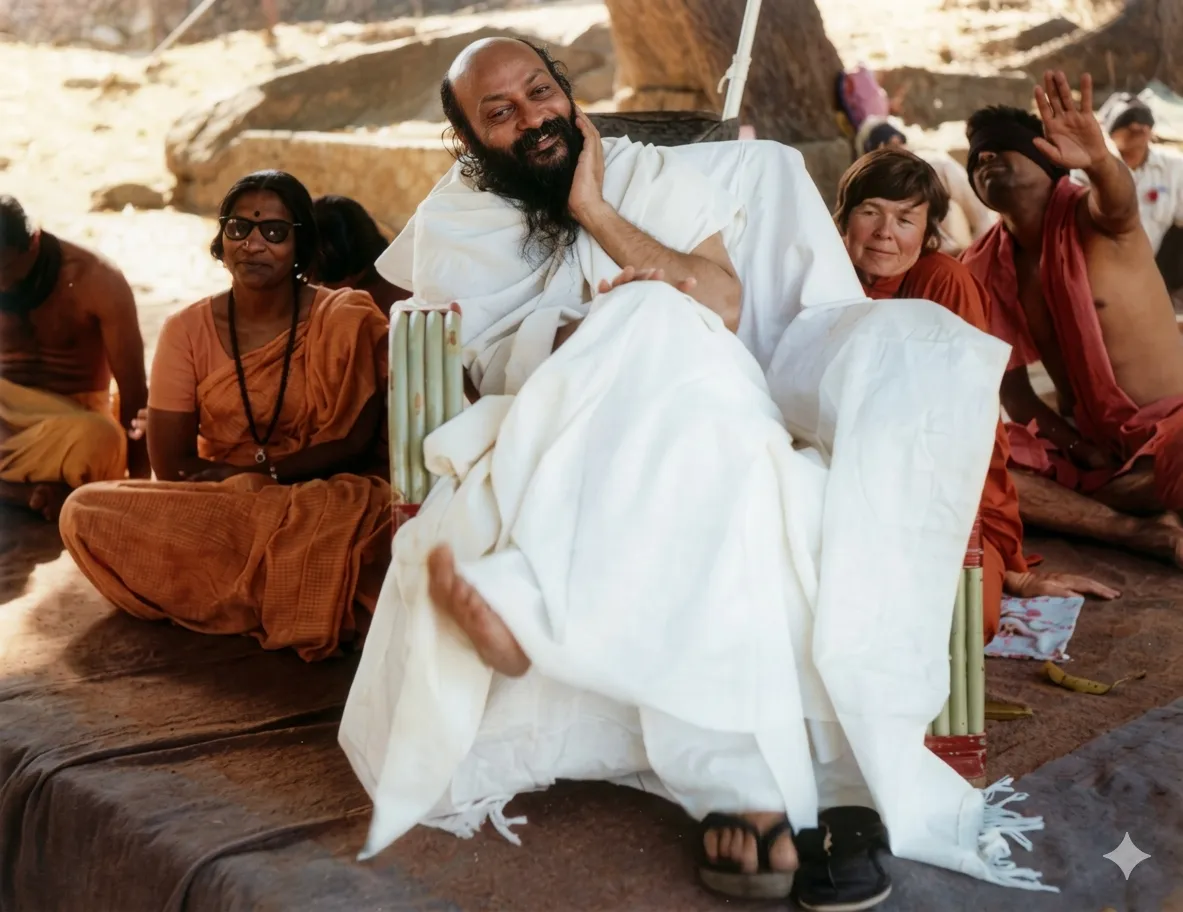
"Tao Upanishad," a series of discourses by Osho, delves into the profound spiritual philosophy of love, non-possessiveness, and living in the present. Osho elaborates on the intrinsic human yearning for security, which often manifests as the desire to possess material goods as a substitute for love. He argues that true love naturally dissolves the compulsion to hoard, freeing individuals from the shackles of possession and fear of the future. Osho emphasizes that the preoccupation with tomorrow stems from a lack of fulfillment in the present moment. Through exploring the contrast between happiness and sorrow, he elucidates how one's perception of time is intrinsically linked to their state of mind—happiness leads to the dissolution of time, while suffering elongates it. This series challenges the constructs of time and materialism, urging seekers to embrace love and joy as liberating forces. Osho's unique perspective invites a transformative realization that living fully in the present without concern for past regrets or future anxieties fosters a truly blissful existence. Each discourse serves as a revelation, encouraging individuals to transcend mundane attachments for a more spiritually enriched life.
-
Chapter 1
Words kill the formless Truth; Tao is an unbounded, self-arising Way—more lawless law or cyclical Rit—discoverable only by living, not by speech.
-
Chapter 2
Naming fragments the One; words birth things and ownership. Lao Tzu’s leap to the wordless urges dropping names to reveal undivided Existence.
-
Chapter 3
Uproot craving; doors to life's mystery open through emptiness. Lao Tzu is not escapist—he demands understanding, not methods; showing joy and fearless depth.
-
Chapter 4
The One pervades all opposites; intellect splits, but dissolving the I reveals dense Mystery, the subtle and miraculous where birth and death are one.
-
Chapter 5
One root energy fuels lust, anger, greed and ego; with awareness and cathartic witnessing (pillow work), recognize and exhaust it to transcend duality.
-
Chapter 6
Opposites are companions, not enemies; embracing duality (life/death, health/illness) dissolves conflict and births a cooperative, Tao-based science of harmony.
-
Chapter 7
Non-action and silent presence are the sage's power: being arranges affairs while speech and doing engender opposites; few can accept the loss required for truth.
-
Chapter 8
All things happen by themselves: stop claiming, stop striving; float instead of swimming. Sadhana becomes habit - understand non-doing or exhaust into surrender.
-
Chapter 9
Human anxiety arises because ambition and rank poison our roots; accepting nature (no status for ability) dissolves competition and inner conflict.
-
Chapter 10
Empty the mind and strengthen the body: surrender your will, absorb attacks like judo, cooperate rather than fight, and discover true power in non-resistance.
-
Chapter 11
Information inflates the ego; true knowing dissolves it — masters strip borrowed knowledge and desire so presence awakens and effortless action follows.
-
Chapter 12
True perfection is emptiness: drop every filling — possessions, knowledge, even renunciation — and like an empty pot Tao manifests; how to attain dharma?
-
Chapter 13
Grind sharp points, untie knots and live in insecurity so ego softens into harmless asmita; even then the mystery of existence remains unfathomable.
-
Chapter 14
Emptiness remains unknowable; even pure self-awareness sees only a reflection—perhaps of what existed before God; Pilate's 'What is truth?' stays unanswered
-
Chapter 15
True understanding must reach the inner root, not merely the intellect; only when understanding touches the center does revolution happen, not by argument alone.
-
Chapter 16
Nature and saints are impersonal—neither benevolent nor cruel; we are straw‑dogs whose egos project meaning onto an indifferent existence, so joy and suffering are ours.
-
Chapter 17
Emptiness (Shunya) is the wellspring of infinite power: like Lao Tzu’s bellows, dying and letting go make rebirth and creativity possible—how to become Shunya?
-
Chapter 18
Existence is feminine: the valley-spirit of non-doing, receptive darkness births and dissolves all. How to meet the Divine? By passive, gentle waiting.
-
Chapter 19
Feminine consciousness is the eternal, intuitive ground—like ocean to the wave—embracing surrender, space and trust; the masculine is transient, logical struggle.
-
Chapter 20
Ego is a transient shadow fed by others’ attention; stop demanding attention and give it instead—then sleep, love and selfless living reveal timeless freedom.
-
Chapter 21
Where is the abode of excellence? True excellence is inner, like water: it seeks the lowly, embodies humility, silence and doerless action, not outward acclaim.
-
Chapter 22
Revive Lao Tzu now: after masculine mind's failure, life needs feminine humility—descent like water, dropping ego and ordinariness bring true ascent.
-
Chapter 23
Life is a riddle, not straight math; pursue half-fullness, avoid clutching success and ego, vanish at triumph to keep life's edge and joy.
-
Chapter 24
Nonduality requires uniting body and Atman: breathe from the navel, emphasize exhale, accept sensuality, dissolve inner division and reclaim childlike life.
-
Chapter 25
Life's purpose is an illusion; living purposelessly—moment to moment, like a child or through receptive invitation—makes life its own goal and dissolves ego.
-
Chapter 26
The ultimate is both present and absent: beyond senses, it creates without claiming, granting freedom and responsibility; why evil and inequality persist.
-
Chapter 27
Visible fullness rests on invisible emptiness: opposites cooperate, not oppose. Embrace shunya—create inner space and let negation reveal life’s true utility.
-
Chapter 28
Senses die by overuse; preserve them to awaken inner perception and taste death as Amrit; shift consciousness to the navel to know who you are.
-
Chapter 29
Ascent or return—both lead beyond the intellect; find and remember the navel center, letting action happen without a doer, and truth arises.
-
Chapter 30
Ego is a borrowed house built from others' praise and blame; honor births its opposite—seeing both sides dissolves craving and frees one from others' control.
-
Chapter 31
Ego causes fear - know 'I am not' through inquiry; happiness is misery, so insight not renunciation frees desire; desirelessness ends rebirth and suffering.
-
Chapter 32
Language and intellect split reality; the ultimate is invisible, unheard, untouchable—seen only when all images and the seeker vanish, through pure non-being.
-
Chapter 33
Beauty and Being are indefinable: Existence is a birthless, deathless continuity beyond forms and faces; love and abiding in the eternal present reveal this Tao.
-
Chapter 34
True saintliness is interior awareness, not outward conduct: living alert, undecided and guestlike, their ego melts like ice, leaving them beyond understanding.
-
Chapter 35
Embrace inner emptiness and stop the race to fill; sit by a muddy stream until impurities settle—who can find repose in a muddy world? Through right action.
-
Chapter 36
Waiting must be paired with sitting on the mind's bank - witnessing - so impatience stops; ego (ahamkara) and I-amness (asmita) must melt into pure being.
-
Chapter 37
Sky behind clouds: eternal passivity (Tao) underlies fleeting activity; shift attention to the witness to meet Atman—how to attain passivity today?
-
Chapter 38
Knowing the Eternal witness beyond change yields tolerance, impartiality and inner sovereignty - can one transcend sorrow and death by witnessing?
-
Chapter 39
Non-doing (shunyata) is supreme power: true presence leaves no trace, awakens acceptance; everything is right when the watcher dissolves into the whole.
-
Chapter 40
Life balances opposites: every effort to enforce virtue breeds its opposite; drop imposed goodness, trust nature’s spontaneous Tao for true harmony
-
Chapter 41
Drop knowledge, wisdom, doctrines to reveal the Simple Self (swabhava): love the near, forsake justice and utility, be rather than do—how to know it?
-
Chapter 42
Drop outer props and spiritual bargains; break taste and attenuate vasanas so attention turns inward to unveil the sahaj Self—desirelessness reveals true being.
-
Chapter 43
Running is the fundamental mistake; stopping into desirelessness is liberation. 'Spiritual' wanting is futile; become ordinary, practice non-doing to see truth.
-
Chapter 44
Drop learned knowledge and labels; unlearning reveals blank, natural essence. Expectations make yes/no, pleasure/pain into suffering; live preconception-free.
-
Chapter 45
Mass blindness to false wealth and wisdom; Lao Tzu’s satire shows true wealth is inner, rooted in Nature’s spontaneity, simply not goals or plans.
-
Chapter 46
Supreme conduct arises from Tao/svabhava within - non-clinging, purposeless, born of being, not bargaining; petty morality collapses when gain is lost.
-
Chapter 47
Winning arises from striving; true safety is yielding, emptiness and readiness to be broken—only by non-resistance does life renew and fear dissolve.
-
Chapter 48
The sage refuses self-revelation and justification; surrendering the ego and abandoning the need for others' recognition preserves inner radiance and security.
-
Chapter 49
Silence and prana reveal Tao: align your life-force behind senses, follow your own nature, or be trapped by mere codes—freedom brings both grace and consequence.
-
Chapter 50
Tao is indefinable; it must be lived—dive into oneness beyond words. Practice, not definition, reveals the law; freedom is nondual liberation.
-
Chapter 51
Tension corrupts the sacred: forced virtue, ambition or display turns nectar to poison; authenticity and effortless naturalness alone allow true blossoming.
-
Chapter 52
Naming deceives: the Supreme is nameless Tao — a silent, maternal mist and impersonal law; true liberation comes by shedding labels and aligning with that law.
-
Chapter 53
Tao, heaven, earth, emperor teach moving from ego-grasping to trust in life: stop striving, enter swabhava; the key question: how to attain Tao?
-
Chapter 54
Perceived opposites—joy and sorrow, light and dark, samsara and moksha—are two poles of one reality; Lao Tzu's nonduality shows their complementarity and unity.
-
Chapter 55
Realization is "stealing light": seek truth secretly; public virtue feeds the ego, while hidden goodness remains authentic and free from self-deception.
-
Chapter 56
Good and bad exist as inner states; everything is a mirror — learn from the bad, see its hidden hell; discipleship needs humility and self-observation.
-
Chapter 57
True faith is judged by its transformative fire, not its object: if trust purifies and frees it's faith; if it enslaves or stagnates, it's blind belief.
-
Chapter 58
Feminine is the root, masculine the branch; true peace arises when the inner male and female unite—becoming the valley of innocence and enduring inner wholeness.
-
Chapter 59
True power is surrender, not aggression: transcend honor and ego, return to the uncarved self by choicelessness and inner sufficiency—where is real power?
-
Chapter 60
Human meddling spoils nature and self; true transformation comes by radical acceptance rather than trying to remake the world—can we stop interfering?
-
Chapter 61
Living with Nature means renouncing force: coercion destroys both victim and doer; true strength is skillful, nonviolent action and inner freedom.
-
Chapter 62
Violence arises from human weakness and habit; soldiers are ill-omened instruments of mechanized killing; only calm, restrained will can transform humanity.
-
Chapter 63
Human violence springs from inner life- and death-urges; true beauty and victory arise only when both are transcended—can man be freed from violence?
-
Chapter 64
Rituals for the dead express the living’s love; true harmony with nature yields joy, not sorrow. Drop others’ molds, find your own path and be authentic.
-
Chapter 65
Reject imposed ideals; return to nameless Tao by non-doing, acceptance and inner emptiness—when heaven and earth embrace, sweet rain of grace falls.
-
Chapter 66
Tao is the source; true wisdom arises by dying to the outer—silencing senses and thought to know the inner center; how to know oneself: be still.
-
Chapter 67
Where to find God? Tao is not a place but an all-pervading, flowing wholeness; accept life without judgment, dissolve yourself into the river of existence.
-
Chapter 68
True change arises from silent presence and living your swabhava; insistence breeds hypocrisy or revolt—can being natural transform others without harm?
-
Chapter 69
Birth and death are one rhythm; drop choosing between opposites to find non-dual bliss. Gentleness, inner depth and relinquishing power free one from suffering.
-
Chapter 70
All is happening; the sense of 'I am the doer' is humanity's illness. Stop manufacturing ego by deeds, let Tao flow through you, and peace will arise.
-
Chapter 71
New religions sprout in the West’s affluence while ancient streams like Tao need India’s deep soil; true transformation begins with sustained inner self‑work.
-
Chapter 72
Why is man unhappy? Thought creates vedana; transcendence reunites us with nature. True character is unaware, spontaneous, acting without external purpose.
-
Chapter 73
Spirituality springs from inner spontaneity, not outer morality or ritual; when Tao is lost, humanity, justice and ritual rise and invite sectarian exploitation.
-
Chapter 74
Nietzsche's 'God is dead' means humanity lost contact with the One; Lao Tzu shows realizing the Nameless restores inner wholeness, joy and true life.
-
Chapter 75
Behind every opposition lies the One: accept complementaries—life and death, rich and poor—as two threads of one cloth; drop choice to realize unity.
-
Chapter 76
Return to the root: life is circular not linear; true completion is reversion into childlike womb-silence, where death is received as a new birth.
-
Chapter 77
Our vision shapes truth; the deepest virtue appears empty because true being is silent and subtle - cultivate inner receptivity, not outer publicity.
-
Chapter 78
Bliss is our birthright-stop seeking it outwardly; witness suffering without identifying, dive into the present, and let full awareness reconnect you to nature.
-
Chapter 79
Tao is the primordial void; dropping the 'I' reveals svabhava—rhythm of opposites births love, harmony, and freedom from violence and false worth.
-
Chapter 80
True power is the soft and formless: non-action, silence and love penetrate hardness; lose to win, melt ego into love and rise to prayer.
-
Chapter 81
Love dissolves possessiveness; bliss multiplies by sharing, so innerness outranks reputation and possessions—whom do you love, name or yourself?
-
Chapter 82
Opposites converge: emptiness and fullness, birth and death, motion and stillness; true mastery is simplicity and inner stillness that guides the world.
-
Chapter 83
All suffering springs from wanting to be otherwise; acceptance (Swabhava/Tathata) conserves energy, calms anger and lets natural growth replace forced ambition.
-
Chapter 84
Eastern self-knowledge reveals the world and the Tao: inner witnessing liberates from identification, exposing universal human patterns and the source of bliss.
-
Chapter 85
True non-ability is supreme non-doing, not laziness but inner rest and radiant energy; only by dropping doing does self-knowledge and meditation arise.
-
Chapter 86
True knowing is un-knowing: drop acquired knowledge and doership to rediscover the inner sky; can forgetting what we learn reveal who we truly are?
-
Chapter 87
Knowing is like a mirror-empty, impartial and without belief: let go of fixed opinions and insistence to meet truth. How can one truly know truth?
-
Chapter 88
Life hides death; seeing death awakens the timeless Self beyond life and craving. Stop the 'more' race, cultivate gratitude, and taste the deathless.
-
Chapter 89
See virtue beyond morality: recognize the good even in the bad; Tao births virtue, character nourishes it, meditation transforms glimpses into living conduct.
-
Chapter 90
Steal back the lost Source: move like a thief in the darkness, return to the Mother-origin, plug desire's openings and recover inner light for liberation.
-
Chapter 91
Truth is simple: walk Tao - drop ego, footpaths, haste and show; patience, surrender and ordinary living reveal God; why chase difficulty now?
-
Chapter 92
Knowers cannot prevent sects; better to guide inevitable followers close to the royal road so remembrance can lead to true dharma, and guide desire wisely.
-
Chapter 93
Deep character arises from swabhava, not social masks; transform anger and greed into compassion and generosity; true firmness is tested in the world.
-
Chapter 94
Return to a childlike nonduality by inner rebirth: witness impulses, avoid extremes of indulgence or renunciation, and let consciousness rejoin its source.
-
Chapter 95
True knowing is wordless silence and inner unity; words only point. Close the senses, blunt desires, untie knots—method awakens seeing, not proof.
-
Chapter 96
Ideals are an illness: live your ordinary, natural self; let awareness, not imposed rules or heroic models, shape morality and society through ordinary acts.
-
Chapter 97
Government is a necessary evil; Lao Tzu - 'lazy and dull' rule lets people remain unspoiled. True governance is saintly, invisible, freeing the individual.
-
Chapter 98
Fewer rules and more freedom: human order blooms when guidance is suggestion, love replaces prohibitions, and parenting or governance supports rather than controls.
-
Chapter 99
Drop striving; non-doing reveals the already accomplished Self, bow the ego and consent to what is—awakening descends without practice for seekers.
-
Chapter 100
Transform opposites into harmony: don't repress anger, sex or desire but transmute their energy via the Middle Way - fry the small fish; govern without extremes.
-
Chapter 101
Empty yourself-become low, receptive like the ocean or a womb; lose ego and clutching. Through feminine surrender Paramatma fills you, love and power arise.
-
Chapter 102
Mystery: knowing that dissolves the knower—unutterable, lived not taught. Stop searching, be still; love, meditation and silence reveal the Tao, not intellect.
-
Chapter 103
Non-doing is sacred restraint, not laziness: cease futile craving, seal energy leaks so power can rise to the divine; answer hatred with virtue.
-
Chapter 104
Prevent problems before they grow: awareness dissolves the seed of anger, lust or habit—don't postpone or fight, witness early at Gangotri now.
-
Chapter 105
Awareness alone guards the pilgrim: non-doing and non-grasping dissolve ego so the sage witnesses, assists Nature, and avoids spoiling others' journeys.
-
Chapter 106
Each person is unique; awaken your own inner lamp, refuse blind following, live moment-to-moment with awareness, and discover your own middle.
-
Chapter 107
Drop knowledge and ego; love and inner non-doing reveal the near Paramatma; cultivate balance, moderation and humility—love opens the door to God.
-
Chapter 108
Love is the soul’s bridge to the Paramatman; open the door despite fear—love becomes the only lasting wealth, armor and the path beyond life and death.
-
Chapter 109
True wisdom is unlearning—emptying the mind to return to childlike ignorance and a circular, heart‑led life; how to find truth? By living, not knowing.
-
Chapter 110
Inferiority stems from the will to power; liberation comes by bending, becoming a humble hollow so life’s energies flow into you and heal comparison.
-
Chapter 111
Authenticity dissolves maya: pretending begets self-deceit, violence masks cowardice; non-contention births love and courage—why pretend to be what you're not?
-
Chapter 112
Ego's baited pleasures entrap us; consent to be erased - receive attack, surrender desire, and let energy return inward to awaken lasting joy. Now.
-
Chapter 113
Reject imitation and self-condemnation; awaken from mechanical repetition by watching, become your own unique self, and make each moment newly alive.
-
Chapter 114
Life is simple: presence, not thought, reveals the Divine; drop methods and accept life unconditionally—how to live? By simply being here now.
-
Chapter 115
Part cannot know the whole; true knowing arises when the ego dissolves, becoming the ocean rather than measuring it. How can the part know the whole?
-
Chapter 116
Two kinds exist - those living in darkness of fear and those in light of self-knowledge; self-recognition dissolves fear, births love, true prayer and abhay.
-
Chapter 117
Society protects the fearful and kills the fearless; true religion transforms inner being beyond mere acts, while the Tao lets actions bear their own fruits.
-
Chapter 118
Fear as society's foundation breeds repression or rebellion; only love and inner remembrance of death produce fearlessness and true transformation.
-
Chapter 119
Excessive government crushes individuality and life; a minimal state should protect freedom and livelihood so people can transcend to mind and soul.
-
Chapter 120
Conscious evolution, earned not given, moves body→mind→soul; Western comfort stalls at the mind, breeding melancholy—deliberate practice and an inner leap are needed.
-
Chapter 121
Observe like Lao Tzu: be soft and weak—pliancy is life, hardness is death; abandon force, power and scripture, and let loving, open attention reveal truth.
-
Chapter 122
Becoming first requires dropping the race to be first: willingly stand last, reclaim the Divine within; Heaven (Tao) so balances excess and lack.
-
Chapter 123
Softness like water, not hardness of ego, is true strength: yield, flow and absorb—become weak to conquer; how to win? By surrendering and melting into life.
-
Chapter 124
Take total responsibility for your errors; blaming others reinforces the ego and prevents inner revolution—only owning fault frees the soul.
-
Chapter 125
Accept nature and drop impossible ideals; true spirituality arises from natural living, savor needs not desires, smallness and simplicity reveal the Paramatma.
-
Chapter 126
Truth feels bitter to the untrue; only an emptied, surrendered heart tastes it as nectar. Will you welcome the pain of awakening or cling to sweet lies?
-
Chapter 127
Love can be a prison or a temple: unconscious possession binds, while awareness and meditation transform desire into freedom and a ladder to the divine.