
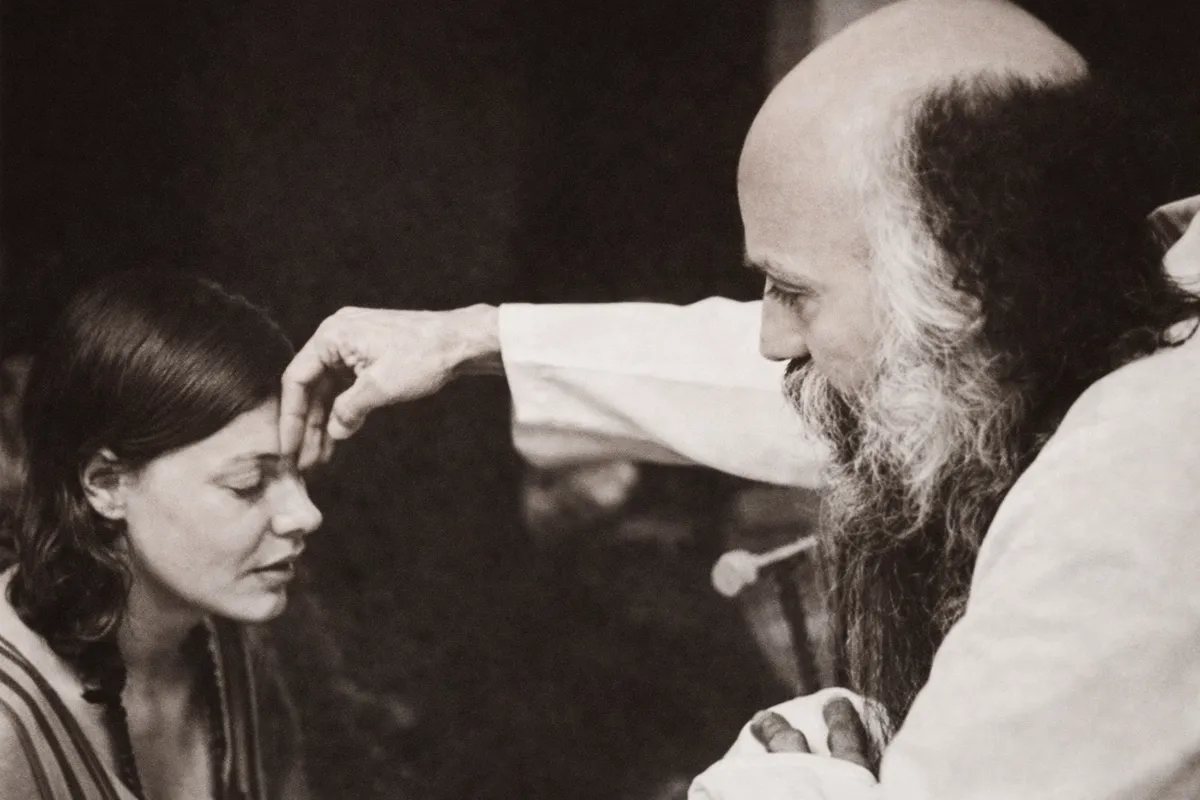
When you stop trying to be strong and admit you can’t do it alone, your heart opens and you meet the Divine.
From the Discourses
Passages where Osho speaks to this question — each links to the complete discourse.
Osho, I have no worthiness at all, and yet a thirst for the Infinite has arisen! I have set out, stumbling—will there not be union? The question has been asked by the elderly sannyasin, Sita.
First thing: No one has ever met the Divine through strength. Strength is arrogance. Strength itself is the obstacle. Strength means ego. Strength means making a claim. Has anyone ever attained by claiming? Has a claimant ever found love? The claimant is defeated; he misses the goal at the very first step. If you know you have no strength, then union is certain. Union happens in helplessness—where it seems nothing you do will work; where your defeat is total; where you wonder, “How can anything happen by my doing?”; where your ego has crumbled to dust in every way; where you no longer even have the strength to breathe on your own—let alone to travel; where you cannot even rise; where, even if you wish to lift your foot, it will not lift. When such helplessness surrounds you, prayer is born. Prayer is the sigh of a helpless heart. Only…
Osho, I have heard that a seeker has to pass through four stages of sadhana: tariqat, shari’at, marifat, and haqiqat. The last is haqiqat, where the seeker meets his beloved and comes face to face with Truth. Osho, please explain the first three states.
These words are from the Sufis—very significant, and very straightforward. The first is tariqat. Tariqat means: the way, the method, the discipline, the means, the yoga. Tariqat means: something has to be done; only then will you attain—without doing, you will not receive. One has to walk a path; find the way; make a footpath. One has to bring some discipline into life, give it an order. Tariqat means learning the way to become worthy of it. When you go to have an audience with an emperor, you learn the etiquette of his court. You don’t just walk in. If you do, you will not be accepted. You learn how to sit there, how to stand there, how to bow there. If you are going to meet an emperor, you must taste something of the flavor of the emperor’s way of life. If you are going to meet the Divine,…
Beloved Osho, the gift of being here with you is overshadowed by a sense of unworthiness. It troubles me because I don't feel as available to you as I could be. Can you help me to dissolve this?
It is something very essential to understand, that people who are really worthy always feel unworthiness, and the people who are really unworthy never feel it. Not feeling it is part of unworthiness; feeling it is part of worthiness. The question is from Kirtan. It is good that one feels it, because there are no limits to unworthiness -- you can go as high as you desire; it is just like the sky. And to feel it means the ego is dissolving. The ego never feels unworthy; it wants to prove that everybody else is unworthy and only it is worthy. It is humbleness that feels unworthiness and pain which can give birth to a new life. So don't take it as a problem. Accept it as a blessing. Let the ego completely dissolve. It cannot stand the feeling of unworthiness. There are a few things in life which function…
Osho, when such incredible happiness descends, why do I feel so unworthy?
That's why all the religions emphasize: God is compassionate -- RAHIM, RAHMAN! -- God is compassion. This is just to give you an alternative gestalt so you become focused on His compassion, not on your unworthiness. You may be unworthy -- that is irrelevant -- but God is compassionate. You may be a sinner -- that is irrelevant -- God is compassionate. He gives for no reason at all; He is simply a giver, He knows only giving. And He does not give conditionally, He gives unconditionally. Jesus tells a parable again and again. A rich man called forth a few laborers to work in his garden in the morning. The fruits were becoming ripe and they had to be collected soon. But by the afternoon it was felt that the laborers were not enough; more were needed, so more laborers were called. By the evening it was felt that…
Beloved Osho, in your presence, I feel showered with your unconditional love and compassion. My hungry heart is opening, and I have experienced a lot of joy and stillness here in your buddhafield. But my feelings of unworthiness still dominate my life, and I'm clinging to them so tightly that I despair of ever letting go. It has been a long and serious road so far. Dear Osho, will you please help me?
But people are such that even when they have come here and they have been listening to me, they are managing what to listen to, what not to listen to. Whatever gives nourishment to their prejudices, they are open to, very happy that their convictions are being supported. The moment I say something that goes against their convictions -- and those convictions are their misery, the foundation of their suffering and their hell -- immediately they close themselves. But how long can you keep yourself closed? I go on hitting you from every dimension, every direction. Sooner or later you have to listen. Then too, such is human stupidity that people start defending themselves. I sometimes wonder why you are wasting your time. If you are here to defend yourself, that you can do very well wherever you are. It will be easier to defend yourself somewhere else; here it…