
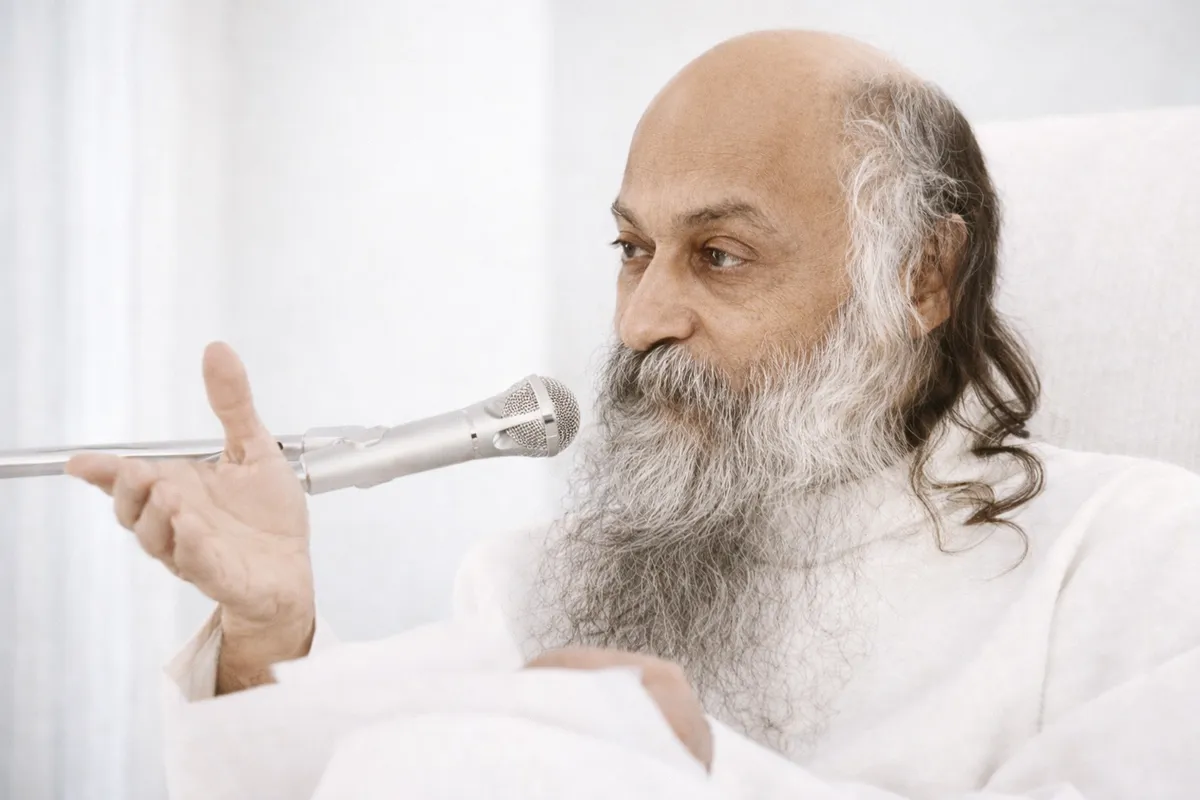
According to Osho, truth can be dimly recognized before enlightenment—like glimpsing a figure through morning mist—enough to become a disciple and feel the 'faraway call.' This vagueness demands trust, not doubt, to keep moving; trust connects, doubt separates. As meditation deepens, clarity grows, but absolute, unmistakable recognition arises only with enlightenment, when knowing who the Master is coincides with knowing who you are.
You can sense truth before you’re fully awake, but it’s fuzzy—so trust and keep practicing until the fog lifts and certainty comes.
From the Discourses
Passages where Osho speaks to this question — each links to the complete discourse.
Question: OSHO, WILL I ONLY RECOGNIZE YOU WHEN I AM ENLIGHTENED? RECOGNITION IS POSSIBLE even before enlightenment, but it will remain vague; it will remain hidden behind a mist. Just as in the early morning, a winter morning, you can see that somebody is coming, but who he is you cannot exactly say. Something you can figure out, that a man is coming or a woman, but the mist is thick and it is difficult to figure out who the person is exactly. This type of recognition is possible; without it there will be no possibility of a Master and a disciple. How does one become a disciple? A vague recognition, a fragrance that has touched you, a love that has moved your heart, something of the beyond. It is a feeling, it is not knowing. You cannot be absolutely certain about it; it is mysterious.
Beloved Osho, although nothing is really clear to me, how can it be so clear to me that the truth is in you? I don't know it, but I see it in your eyes. I feel it in your being.
It is one of the most fundamental questions. One does not know what truth is. But when one comes across it, a few things become clear: that whatever he has believed up to now was not truth, because it has not given him this depth in the eyes, this silence in his presence, this authority in his words, this poetry to his life. The false is barren. So although you do not know what is true, when you come across truth, you immediately know what is false. And if you understand what is false, a vague insight into truth starts arising in you. Because the truth that you see in my eyes is also in your eyes, just asleep. You have never awakened it. Let the false go, and your eyes will have the same truth. Your words will have the same music, your presence will have the same charisma.…
Osho, you said that when consciousness is emptied of all notions, the reality that appears is the truth, or God. But in that emptiness of consciousness, how will there be the recognition, the knowing that this is the truth?
There is no need for recognition; no need for identification. What is, is the truth. In the depths of meditation there is no recognition arising that “what is, is the truth.” What is, simply is; there is nothing other than that. I am saying even this only to make it understandable to you. In front of a mirror a bird flies by, or a flower blossoms. The mirror has no recognition. The mirror does not identify: “This is a flower, a real flower, not an artificial one.” Its very being is its reality. There is no need to recognize it separately. And if you set out to recognize it separately, you will go astray. Understand this: you are on a road; in the distance, in the dark, you see a policeman standing. As you come near, it is not a policeman—there has been a misperception; it is a tree stump.…
Osho, kindly explain—what is the way to recognize enlightened ones?
If you go near an enlightened one, you will recognize. How could it be otherwise! It may be that a blind man cannot see the sun, but when the morning sun spreads its rays, he feels its touch. He experiences its warmth, its heat. He comes to know that night has gone. Birds have begun to sing, the morning hymn has begun. He knows that a moment ago all was silent, asleep, dead; now life has revived, a hum is there. The sun may not be seen, but its warmth is felt. Even the blind senses the sun. He knows when night has passed and day has come. Granted you do not yet have the inner eye—but if you go near an enlightened one, that gust from the Malaya will touch you. You will bathe in it. You will be freshened. That piece of moonlight will shower upon you. You…
The Western mind lives in time-consciousness, the Eastern approach is towards timelessness; hence our definition of truth is that which is beyond time. So unless you go beyond time you know nothing of truth. In time you only see a film on the screen -- it can be beautiful and for the moment you may become enchanted with it, but deep down you know that it is just a fiction. You may become engrossed in it, you may completely forget that it is just a fiction, you may start taking it for real -- and if it is a three-dimensional film it can give you the notion, the feeling, that it is real. But then the end comes, and the screen is left behind and then suddenly there is the realization that for the whole time only the screen was real and the film was just a projection.