
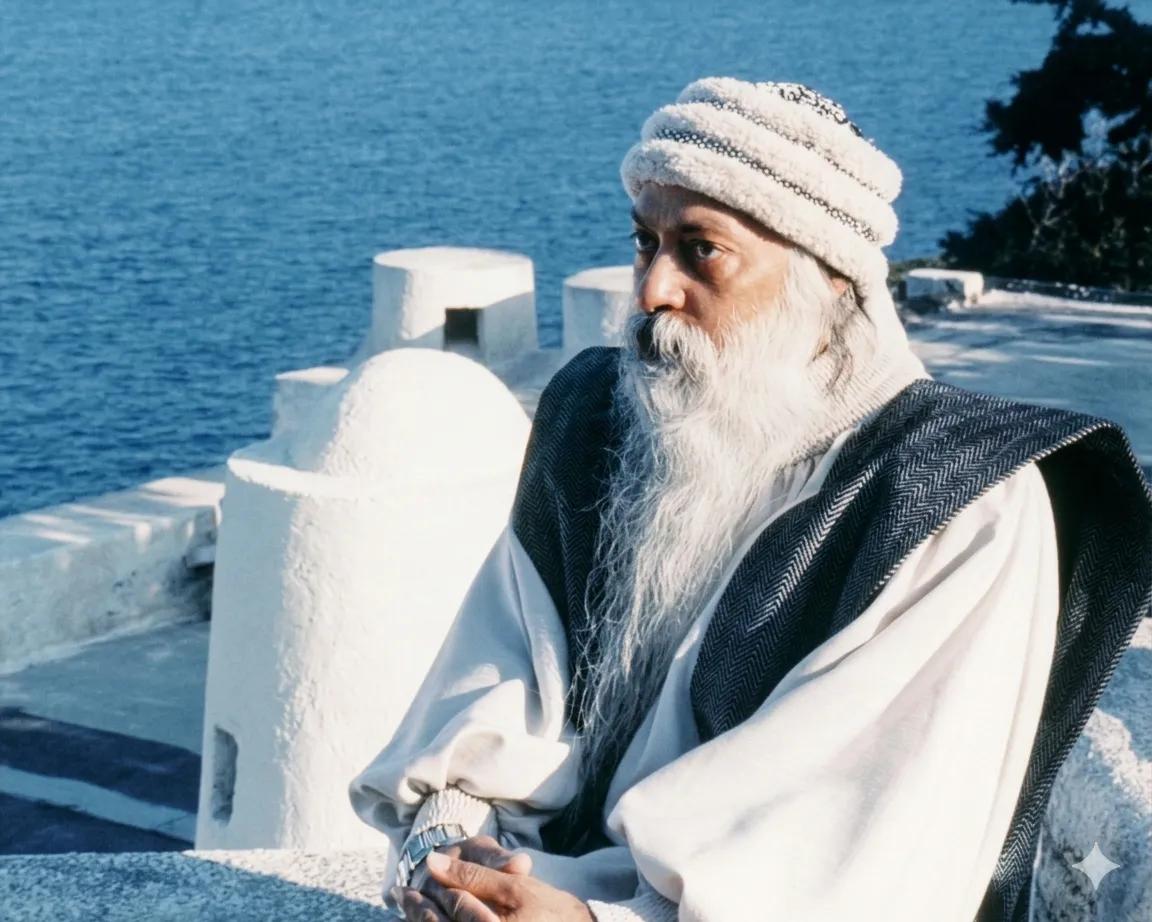
He opposes organized labels and rules that divide people so we can be free to find our own inner spirituality.
From the Discourses
Passages where Osho speaks to this question — each links to the complete discourse.
Osho, I am the son of your old acquaintance, the late Professor Lali Prasad Srivastava, whom you used to call Lallu Babu. I want to ask you why you speak against religions?
Man is the victim of religion and culture. Some are the sons of civilization, some the sons of creed; those meant to dwell in oceans are imprisoned in bubbles. And you ask me why I speak against religions! I want to burst the bubbles so you become the ocean. There is no need to be confined in bubbles. It is a lesson to behold—this narrowness of man. Labels of different faiths are stuck upon every chest. On every person’s chest a label is pasted—Hindu, Muslim. Are you a human being or boxes of shoes for sale in the market—Flex shoes, or Bata shoes, or “Monkey Brand” black tooth powder? What are you? A person, or merchandise? Labels are stuck on everyone. Man roams about, lost, astray; some label or another hangs from every forehead. Why does a human being get cast into tight molds? Why does one feel ashamed to…
A friend has asked: Osho, why should we think about death at all? We have life—let us live it. Be in what is present. Why allow the thought of death to come in between?
Just as there can be fear of sleep. Sleep is, in a way, a daily death. The day is life; the night is death. It is a piecemeal death. Every day we die a little, we sink within; in the morning we return fresh again. Then after seventy or eighty years the whole body gets tired—work, work, work—the body wears out. Then full death takes hold; the entire body changes. But we are very afraid of that. It is a deep sleep. Yet we are very afraid of it. Have you noticed that the body changes every morning too? It changes a little, which is why you don’t notice. It does not change completely; there is a partial transformation. When you go to sleep in the evening, your body is in one condition; when you wake in the morning, your body is in another. By morning the body has become…
Beloved Osho, are you against all religions? Isn't religion something essentially needed by man?
So I said to the Sufi, "Come into the house. Don't be angry. That tree is not strong enough, and that tree is very special; don't destroy it. I became enlightened under a maulshree tree, so my people have brought that tree from the original maulshree tree, as a seed. They have grown it, and it is still not strong enough for your hug. You come inside." He came inside, and he started talking in the same way he must have been talking to his disciples: "I see God everywhere, only God and nothing else." I said, "If you see only God and nothing else, then to whom are you talking? If there is only God and nothing else then to whom are you talking and for what purpose? God must know it. Keep silent!" When all his disciples had gone I told him, "I know what has happened to…
Osho! Basically, you are a herald of religion—of the original, essential religion. You yourself seem to be religion. But the surprising thing is that right now your strongest opposition comes from the religious establishment itself! The recent statements by two Shankaracharyas are fresh examples. Would you kindly shed some light on this?
The death of his father shook Shankaracharya utterly. But the mother, already in grief, would be left alone if Shankara took sannyas. She refused. The story says: Shankara went to bathe in the river, and a crocodile caught his leg. A crowd gathered on the ghat; the mother came running. Shankara said, “The crocodile says it will let go if you allow me to take sannyas.” What could the mother do? With tears she said, “All right, then become a sannyasin—at least live. If you live, even as a sannyasin, I will see you some day.” And the story says the crocodile let go. That is just a story; crocodiles were not that wise then, nor now! If man is not so wise, what of crocodiles! I spoke of Mulla—he did marry. Fourteen-year-old girl, eighty-year-old groom. The next day friends asked, “How was the wedding night?” “Don’t ask—great joy! Only…
Question: Osho, I have read your writings and listened to you. Your voice is very captivating and your words very clear. Sometimes you speak on Mahavira, sometimes you discuss Krishna, sometimes you talk about Buddha, and sometimes you say much about Christ and Mohammed as well. You offer an exceptionally powerful exegesis of the Gita; you do not miss analyzing the Vedas and Upanishads; you even go and preach in churches. And yet you say from the outset that you are not influenced by any of the above figures—that you have nothing to do with them, that you do not “accept” them. On the other hand, you keep striking at ancient beliefs and scriptures, you criticize religions. Then what is it—do you want to start your own sect or doctrine? Or are you wanting to declare that your knowledge is vast? Or do you want to confuse people?