
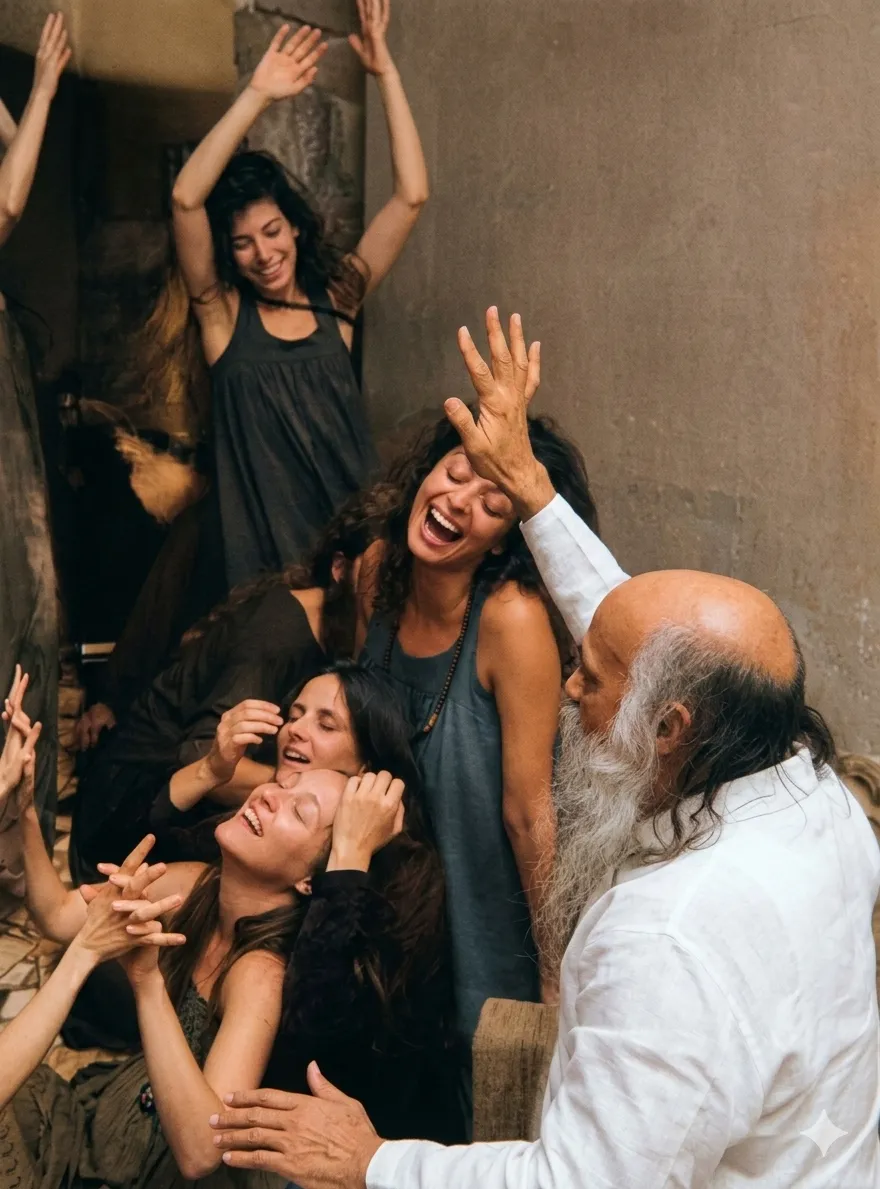
According to Osho, people think so differently because thinking is borrowed from the outside—upbringing, education, culture, and countless unique experiences—so no two individuals share the same conditioning; even twins diverge through tiny life events. Hence each person is a conflicting “crowd” of thoughts. Only in meditation, when thinking subsides into silence, do differences dissolve, revealing a shared, nonsectarian human ground.
We think differently because we were taught and experienced different things; when we quiet the mind in meditation, those differences fade.
From the Discourses
Passages where Osho speaks to this question — each links to the complete discourse.
Question: BELOVED MASTER, WHY DO PEOPLE THINK SO DIFFERENTLY FROM EACH OTHER? Govind, thinking can never be the same. Here there are three thousand sannyasins sitting around me -- three thousand sannyasins means three million minds. One sannyasin does not mean one mind -- many, thousands, a crowd. Each person is a crowd, and each person is a different crowd, because each person has been brought up in a different way. Somebody has been brought up as Christian and somebody as a communist -- how can they think in a similar way? How can they avoid being different? And not only different but antagonistic towards each other? Somebody has been brought up as an Indian and somebody as a Chinese -- how can they think in the same rhythm? Impossible. Thinking comes from the outside -- upbringing, education, conditioning, culture.
Someone asked Osho to explain the thinking mechanism.
First of all, let me tell you that most of us do not know how to think. Possibly the most subtle science is the science of thinking and we have to know about this science. We have to learn to think. At the outset, bear in mind the difference between accumulating thoughts, and developing the faculty of thinking. The notion is that collection of thoughts and the ability to think are one and the same. But accumulation of anything is not real gain; accumulation is only the means of hiding one's lack, and thereby deceiving oneself. And self-deception is self-destruction. This self-deception is universal; and because of it, though there is phenomenal worldwide increase in the number of ideas, there is, at the same time, marked decrease in the ability to think. Seldom do we come across an independent thinker.
Question: OSHO, AREN'T ALL PEOPLE REALLY THE SAME? On the circumference people are different, and they SHOULD be different, and everybody should maintain his individuality on the circumference. One should never compromise for any reason. Then only can we create a really democratic world. Real democracy means that the mob, the crowd, is no more in control of the individual life. Democracy is less a political phenomenon than a religious phenomenon; it is far more important than politics. Democracy is a totally new vision of life. It has not yet happened anywhere; it has yet to happen. Democracy means each individual has the right to live according to his light; he should not be prevented. Unless he becomes a disturbance or a nuisance to others he should be allowed every freedom in all the aspects of life. That's my vision of a really democratic world.
Osho, but in that knowing, Maharaj-ji, can there not be sameness—that as another has known, I may know the same? And may that sameness become available to me.
If you look very closely, such sameness is possible only if I am exactly as the other was. Otherwise it can never be. See the full implications: when I am knowing, my whole personality, my total being, is knowing. Only if your whole personality is exactly as mine, could the event of our knowing be one and the same. And no two persons are ever the same. In fact, forget persons—that is a far-off matter. Pick up a stone from a Delhi street; search the whole earth and you will not find another exactly like it. Pluck a flower from a garden; comb all the forests and you will not find another just like it. Here, each and every thing has its own uniqueness. And that very uniqueness is its soul. In my view, this uniqueness is its soul. A machine has no soul, because a machine is not unique.…
Regarding the discussions of the last two days, many friends have asked questions. One friend has asked:
There are Buddha and Mahavira, Epicurus and Lao Tzu, Confucius and Charvaka, the seers of the Upanishads, Nagarjuna, Shankara, Marx, Freud, astonishing modern minds, Krishnamurti, Ramana, Aurobindo, Ramakrishna, Dostoevsky, Sartre, Camus, Kafka. Such wondrous beings there are in the world. If someone thinks, he will, who knows how many times, find himself parallel to how many of them. Don’t be hasty. Do not quickly conclude: this man agrees with that man—finished. Why are we so eager to force an agreement upon someone? Because labels make things convenient. We think: now it’s sorted. “This man is a communist.” Then we needn’t think about this person any further; whatever we think about a communist will be applied to him—case closed. But even one communist is not like another communist. One communist means: communist one. Two communists means: communist two. Three communists means: communist three. Even three communists are not alike. But with…