
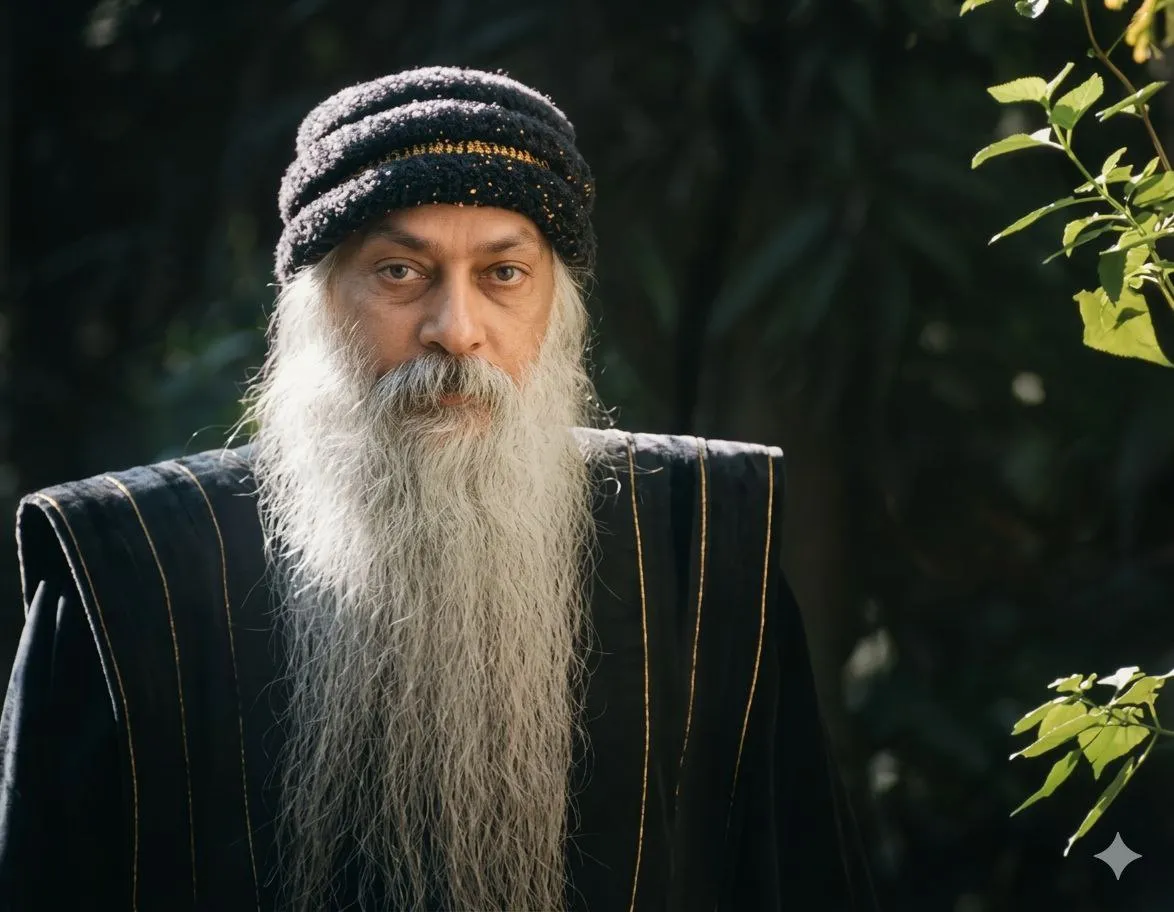
If you look for a 'me,' you see nothing; if you look openly, you feel a bright aliveness, because when the ego is absent, true presence shines.
From the Discourses
Passages where Osho speaks to this question — each links to the complete discourse.
You always.say that you're not there. Everyone else says they look into your eyes and there's no one there. How is it that I always experience the opposite, that you're there and you're the only one who's really there?
Savita, truth is always paradoxical. If it is not paradoxical it is not truth. The only way to be is not to be. Only when one is absent, presence arrives. So, both are true. Those who look into my eyes and see nobody they are right, absolutely right. And, Savita, you are also right: that when you look into my eyes you see THE ONLY ONE WHO'S REALLY THERE. And these two experiences don't contradict, they com-plement each other. If somebody is looking for an ego in me, for a personality, he will not find one. There is no personality there; the personality has disappeared. It was a dream, and I no more entertain any dreams. It was a guest; now the only one who lives inside me is the host. Those who are looking for the guest, they will not find the guest -- they will not see any…
For excample, the mind believes that you are a person, and you are not; you are only a presence, not a person. A person is a static thing, defined, well-defined, structured, with a name, form, label. A presence is an undefined, vague cloud. You can feel it but you cannot say what it is. The person is definable -- you can pinpoint it; the presence cannot be pin-pointed. This is a great experience, to know that you don't know who you are. This is the beginning of a transformation. This is what I call real knowing. It is not knowledge, it is knowing. It is not information, it is transformation. The person is dissolving and the presence is arising. The presence is vast, infinite. The person is really a false entity that we have created to cling to. It will be very difficult to live as a presence.
Osho, the presence of a person seems indispensable for the experience of bliss. But if all around is only the expansion of me, then who will experience bliss? Just as sannyas seems essential for life to become blissful, isn’t the person equally essential for the experience of bliss?
It is precisely because of the person that bliss is not happening. The person is necessary for the expectation of bliss; for the experience of bliss, he is a barrier. For the longing and the craving for bliss, the person is needed; for the realization of bliss, the person is not needed at all. When bliss happens, you are scarcely there. In fact, only when you are not, bliss is. You yourself have tasted this, at least in unpremeditated moments: whenever you were not, a glimpse flashed. Your beloved comes home; you sit hand in hand. For a moment the presence of the beloved absorbs you so totally that you disappear—no thought of yourself remains. A drop slips in, the nectar begins to flow. Have you ever watched the sun rise? You sit on the riverbank. The sun begins to climb. This morning breeze, the coolness of the water, the…
पांचवां प्रश्न: ओशो, आनंद के अनुभव के लिए व्यक्ति का होना अनिवार्य-सा लगता है। लेकिन अगर सब तरफ मेरा ही विस्तार है तो फिर आनंद को अनुभव कौन करेगा? जीवन आनंदित हो सके, इसके लिए जैसे संन्यास अनिवार्य है वैसे ही आनंद के अनुभव के लिए व्यक्ति अनिवार्य नहीं है क्या?
व्यक्ति के कारण ही आनंद नहीं हो पा रहा है। आनंद की अपेक्षा के लिए व्यक्ति अनिवार्य है; आनंद के अनुभव के लिए बाधा है। आनंद की आकांक्षा के लिए व्यक्ति की जरूरत है, आनंद की वासना के लिए व्यक्ति की जरूरत है; लेकिन आनंद की अनुभूति के लिए व्यक्ति की कोई भी जरूरत नहीं है। जब आनंद होता है तो तुम थोड़े ही होते हो! तुम नहीं होते हो तभी आनंद होता है। और इसे तुमने भी कभी-कभी किन्हीं अनायास क्षणों में पाया होगा: जब तुम नहीं होते तब थोड़ी-सी झलक मिलती है। प्रेमी घर आ गया है तुम्हारा, तुम हाथ में हाथ ले कर बैठ गये हो। एक क्षण को प्रेमी की उपस्थिति तुम्हें इतना लीन कर देती है कि तुम मिट जाते, कुछ खयाल नहीं रह जाता अपना। एक बूंद सरक जाती है। रस झरता है। कभी सूरज को उगते देखा है? बैठ गये नदी तट पर, उठने लगा सूरज। यह सुबह की हवा, यह नदी की शीतलता, यह शांति, यह खुला आकाश, यह सूरज का उठना, यह सूरज की किरणों का फैलता हुआ सौंदर्य का जाल--क्षण भर को तुम ठगे रह गये! भूल गये कि तुम हो। …
Do you know who I am?
Emptiness has the nature of bliss, has the nature of existence, has the nature of consciousness. Not that consciousness fills it: it is not like a lamp burning in a room so the light is filling the room. You can put the lamp off and the light goes; you cannot put off consciousness. It is the very nature of that inner emptiness -- it is not that it is filling it. You cannot destroy it. How can you destroy emptiness? You can destroy everything in the world; you cannot destroy emptiness. That's why you cannot be murdered, you cannot be killed. There is no possibility, because you are not. The sword can kill the wheel, but the hub? -- the hub will remain intact. It cannot be destroyed; it was not there in the first place. Is-ness is the nature of the inner emptiness; consciousness is the nature of the…
Beloved Osho, for a few moments the other morning, while watching you, I saw that nobody was there. I saw the emptiness, the hollow bamboo. Why did I find this spooky and awesome when you have been speaking of the beauty of emptiness for years?
It is just because from your very childhood you have been told that the goal is not emptiness, but fullness. Emptiness symbolizes the beggar's bowl. In the West particularly, the word `emptiness' never achieved any positive meaning. In the East the case is different. We have two words for emptiness. One -- which will translate the English word `emptiness' -- is riktata. It simply means absence of something. And the other is shunyata for which, in the Western languages, there is no equivalent because that kind of experience has not happened in the West. Shunyata is emptiness from one side, and fullness from another side. For example, this room is full of people now, furniture, things. We can empty it -- all the people can leave the room, all the furniture can be removed -- and then somebody can come and see and can say, "The room is empty." He…