
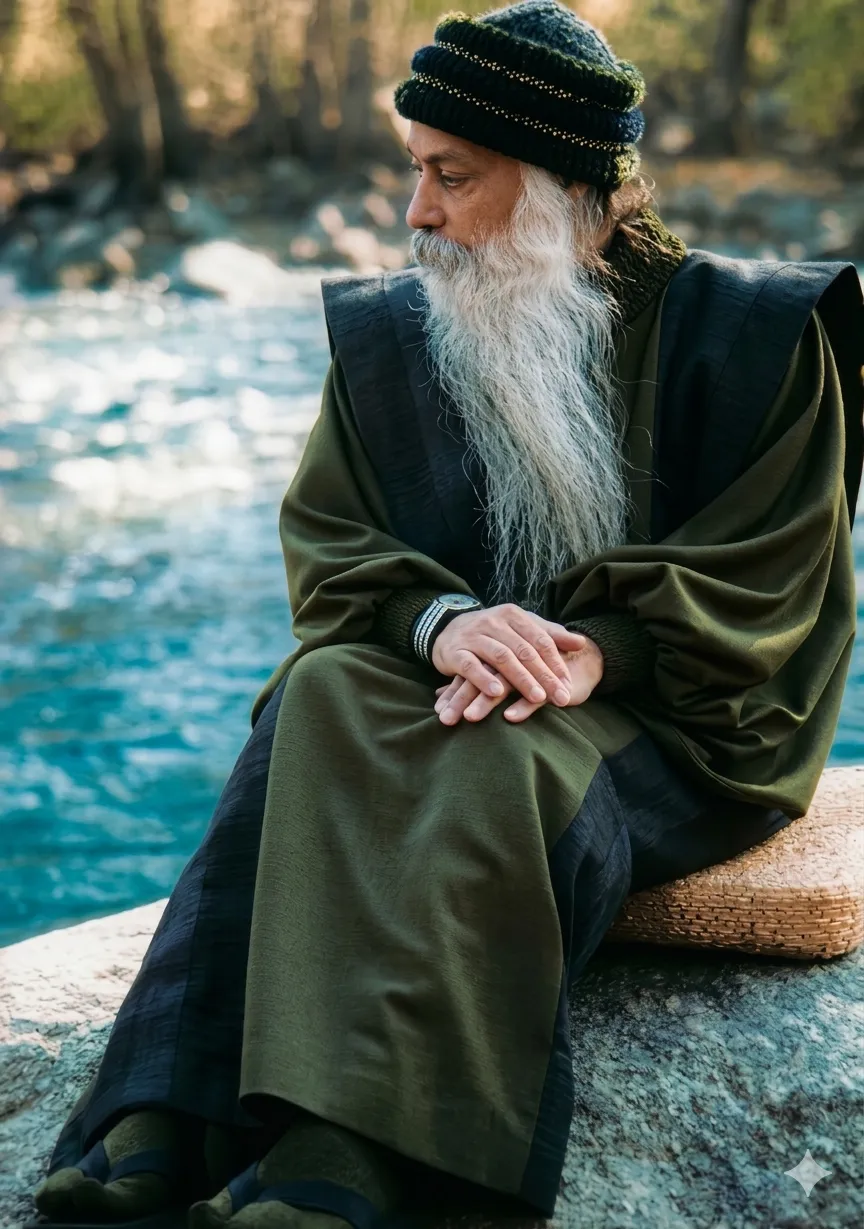
Old followers may still perform rituals, but the real wisdom has moved on, so you must go to the living teacher, not the leftovers.
From the Discourses
Passages where Osho speaks to this question — each links to the complete discourse.
Osho, in the lives of the Tirthankaras we do not see acharyas or monks from the previous Tirthankara’s tradition still present; yet in Mahavira’s time there were acharyas of Parshvanatha’s lineage—Kesi and others. That tradition continued even afterwards—what was the reason for this? A new Tirthankara is born when the ancient tradition is on the verge of extinction. When the acharyas were devotees of Parshvanatha, why was a new sangha established, or a new tirth founded? And how did the old one keep running as well?
First, understand this: a tradition forms only when the living has been lost. A tradition is the dry trace that remains in the absence of the living. A tradition can continue for millions of years and yet have no life in it. In truth, whatever is alive does not become a tradition while it is alive. A tradition is formed only when the living is gone, and what remains in our hands is merely the dead burden of the past—that is what makes a tradition. I have heard: In one household there was an old father and his small children. The father died, the mother died; the children were very young—born to him in his later years. When they grew up, they remembered that every day after eating their father would go to a wall niche and pick something up and put it back. After his death they thought, “This…
Osho, does it then mean that this state called moksha—where the soul has gone and become absorbed in the whole existence—how can any relationship be established with that soul?
Hmm, hmm—this needs a bit of understanding. Let me explain it a little. Let me complete the whole point, then I will tell you. The twenty-three Tirthankaras for this very reason seem to have become completely non-historical. There is no other reason for their appearing non-historical; they were absolutely historical persons. But because even the final thread of connection with them in the spiritual realm has grown attenuated, no relationship can now be established with them. With Mahavira, a connection can still be established. And therefore, being the last, Mahavira has become the most important—in that current. A connection can still be established with Buddha. A connection can still be established with Jesus. A connection can still be established with Krishna. To us, twenty-five hundred years seem very long because our measure of time is very small. Once free of the body, twenty-five hundred years are as if a moment…
प्रश्न: ओशो, तो इसका अर्थ यह हुआ कि यह जो मोक्ष कहलाता है, जहां आत्मा चली गई है और सारे जगत में लीन हो गई है, फिर उस आत्मा से कैसे संबंध स्थापित हो?
तेईस तीर्थंकर इसीलिए एकदम गैर-ऐतिहासिक हो गए मालूम पड़ते हैं। उनके गैर-ऐतिहासिक हो जाने का और कोई कारण नहीं है, वे बिलकुल ऐतिहासिक व्यक्ति थे। लेकिन आध्यात्मिक लोक में उनके अंतिम संबंध का सूत्र भी क्षीण हो जाने के कारण अब उनसे लौट कर कोई संबंध स्थापित नहीं किया जा सकता। महावीर से अभी भी संबंध स्थापित हो सकता है। और इसलिए महावीर अंतिम होते हुए सर्वाधिक महत्वपूर्ण हो गए--उस धारा में। बुद्ध से अभी भी संबंध स्थापित किया जा सकता है। जीसस से अभी भी संबंध स्थापित किया जा सकता है। कृष्ण से अभी भी संबंध स्थापित किया जा सकता है। हमें पच्चीस सौ वर्ष बहुत लंबे मालूम पड़ते हैं, क्योंकि हमारा कालमान बहुत छोटा है। शरीर से छूट जाने पर पच्चीस सौ वर्ष ऐसे हैं, जैसे क्षण गुजरा हो। मोहम्मद से अभी भी संबंध स्थापित हो सकता है।
Osho, the twenty-one-day ritual you have hinted at—was that practice or elemental realization in any way traditional? Because from your mode of expression it continually seems that you surely represent some teacher’s or Tirthankara’s method. Within this I also want to dare to ask: do you want to add a link to some established spiritual lineage, or, like Buddha, are you attempting to cut a new path through the mountains?
Nor is the issue one of tolerance. It is a matter of sky-like spaciousness, not tolerance. Not mere forbearance. Not that a Hindu “puts up with” a Muslim or a Christian “puts up with” a Jain. Forbearance already holds violence within it. I do not say the Quran and the Gita say the same thing. The Quran says something quite different; it has its own individual voice—that is its greatness. If it only repeated what the Gita says, it would be worth two pennies. The Bible says something else again, which neither the Gita nor the Quran says. Each has its own voice. Mahavira does not say what Buddha says; they say very different things. And yet from these differing statements one ultimately arrives at the same place. My emphasis is on the oneness of the destination, not on the oneness of the paths. My emphasis is that in the…
ओशो, जिस इक्कीस दिन के अनुष्ठान की ओर आपने संकेत किया है, क्या वह साधना या तत्वानुभूति किसी परंपरागत थी? क्योंकि आपके अभिव्यक्तिकरण से निरंतर ऐसा भास होता है कि आप भी निश्चित ही किसी टीचर एवं तीर्थंकर की पद्धति का प्रतिनिधित्व करते हैं। इसी के अंतर्गत यह जानने का साहस भी करना चाहता हूं कि आप किसी परंपरा की अध्यात्म-श्र्ृंखला की कड़ी को जोड़ना चाहते हैं, या बुद्ध की भांति किसी पहाड़ में नया मार्ग काटने का प्रयास कर रहे हैं?
इसलिए मैं कहता हूं इक्लेक्टिक! पूरी गीता को राजी हैं, फिर गीता के भी समानांतर कुछ मिलता हो कहीं कुरान में तो उसके लिए राजी हैं। इसमें राजी होने में कोई कठिनाई ही नहीं है। इसको तो कोई भी राजी हो जाएगा। मैं कहता हूं कि नहीं मैं आपसे बिलकुल राजी हूं, उतनी दूर तक, जहां तक कुरान गीता का अरबी रूपांतर है, बस। उससे इंच भर ज्यादा नहीं। वह तो कुरान वाला भी राजी हो जाता है। लेकिन यह बहुत मजेदार प्रयोग होगा कि कुरान वाले से आप गीता में चुनवाएं कि कौन-कौन सी बात का मेल है, तो आप बिलकुल हैरान हो जाएंगे। जो चीजें वह चुनेगा वे गांधी ने कभी नहीं चुनीं। वह बहुत भिन्न चीजें चुनेगा। इसको इक्लेक्टिसिज्म कहता हूं मैं। यह चुनना है। यह पूरे की स्वीकृति नहीं है। स्वीकृति तो हमारी ही है। उससे आप भी मेल खाते हो कहीं, तो आप भी ठीक हो। ठीक तो हम ही हैं अंततः। लेकिन आप भी उतने दूर तक ठीक हो, इतना कहने की हम सहिष्णुता दिखलाते हैं, जितनी दूर तक आप हमसे मेल खाते हैं। यह कोई बहुत सहिष्णुता नहीं है। …
Osho, does the ritual of twenty-one days which you indicated you were doing in your previous birth belong to any particular tradition of meditation and self-experience? Because from your speeches, it appears that you are definitely representing the methods of some great teacher or teerthanker. In view of this, may I also dare to ask whether you wish to connect a spiritual link to some traditional chain, or like buddha are you attempting to cut a new path on some mountain?
The overall perspective which I have before me is this: that I would like to help every person to move according to his capacity, his stage of evolution, his culture -- according to what has already been assimilated in his blood. Then it will be much easier for him to achieve. Therefore, I have neither any religion of my own, nor any path of my own, because now one exclusive path or religion will not work for the future, and a religious sect means a path. Nowadays, such a religion is required which doesn't insist on a particular path, which can become the crossroads for all the paths, which can say that all paths belong to it and which can ask everyone to follow the path of his liking. Such a religion would emphasize that you will reach the same place from wherever you walk, that all roads lead to…
Osho, how could the iconoclast Mahavira accept himself as the twenty-fourth Tirthankara of the most ancient Jina tradition? Please explain!
Within this revolutionary tradition, Mahavira is the most glorious, the most brilliant. Therefore his words are worth understanding and contemplating. He must have been uniquely revolutionary; for the Jainas have two sects—Digambara and Shvetambara. The Digambaras hold that not a single word of Mahavira remains, no scripture remains. That too is part of the revolution. They say, no scripture is Mahavira’s word. The words we have are from the Shvetambara compilations. The Digambaras have no compilations. It is astonishing that the Digambaras did not preserve! But that too belongs to their deep revolt: if you preserve words, today or tomorrow they become scripture; preserve them, and soon they become Veda. Hence the Digambaras did not preserve Mahavira’s words. It is an extraordinary rebellion against scripture. They revere Mahavira, but preserved no texts—only what was passed personally from master to disciple; they did not write it down. Therefore, for the Digambaras,…
पहला प्रश्न: ओशो, परंपरा-भंजक महावीर ने स्वयं को प्राचीनतम जिन-परंपरा का चौबीसवां तीर्थंकर क्योंकर स्वीकार किया होगा? कृपया समझाएं!
महावीर इस क्रांतिकारी परंपरा में सबसे ज्यादा महिमावान, सबसे बड़े मेधावी व्यक्ति हुए। इसलिए उनके शब्द समझने जैसे हैं, विचार करने जैसे हैं, क्रांतिकारी तो अनूठे रहे होंगे; क्योंकि जैनों के दो संप्रदाय हैं--दिगंबर और श्वेतांबर। दिगंबर तो मानते हैं, महावीर का कोई भी वचन बचा नहीं, कोई शास्त्र बचा नहीं। यह भी क्रांति का हिस्सा है। वे कहते हैं, कोई शास्त्र महावीर का वचन नहीं। ये जो वचन हैं, यह श्वेतांबरों के संग्रह से लिये गये हैं। दिगंबरों के पास कोई संग्रह नहीं है। यह बड़े आश्चर्य की बात है कि दिगंबरों ने बचाया क्यों नहीं! यह भी उसी गहरी क्रांति का हिस्सा है। क्योंकि अगर बचाओ शब्दों को, तो आज नहीं कल वे शास्त्र बन जाएंगे। बचाओ तो शास्त्र आज नहीं कल वेद बन जाएंगे। इसलिए दिगंबरों ने तो महावीर के वचन बचाए ही नहीं। …