
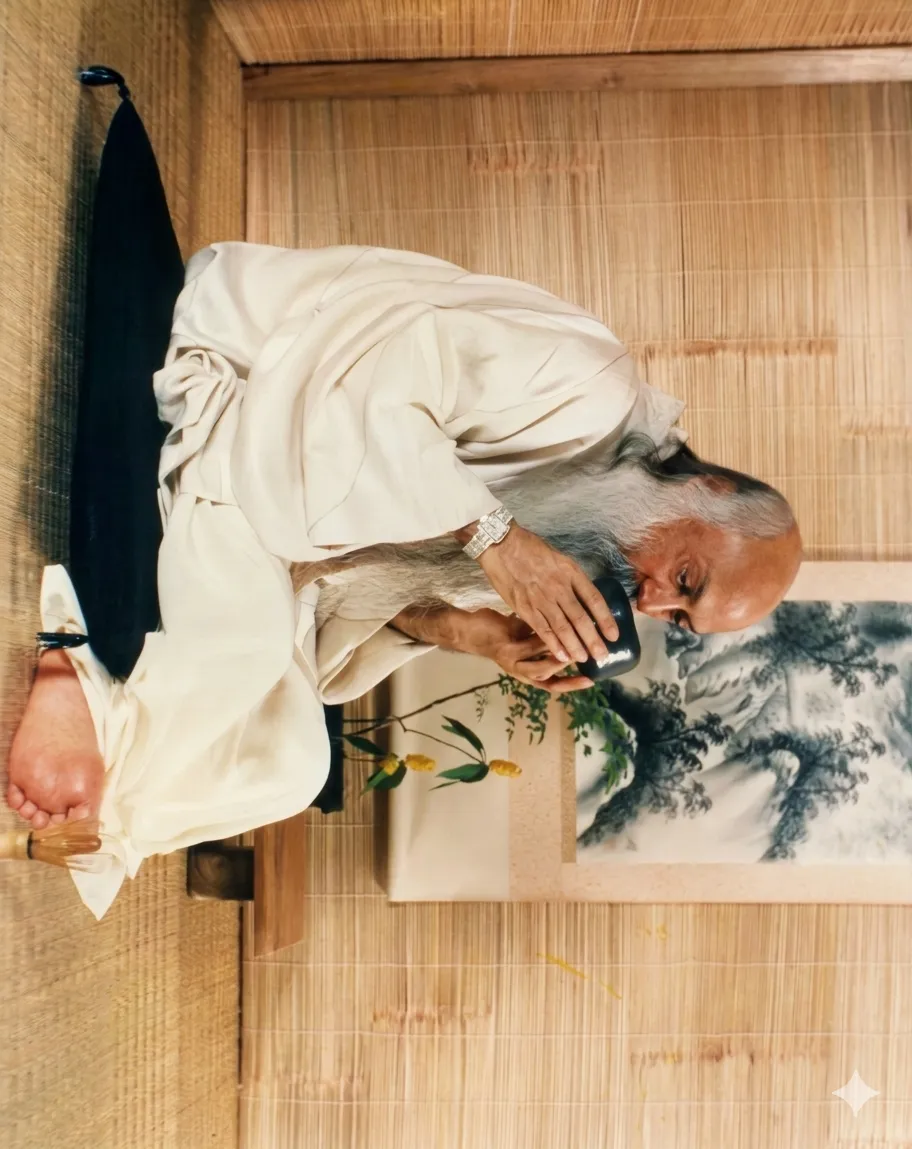
Before Mahavira, the Tirthankaras were Aryan Shramana teachers like Adinath who emphasized effort, and they weren’t yet called Jains.
From the Discourses
Passages where Osho speaks to this question — each links to the complete discourse.
Osho, before Mahavira there were twenty-three Tirthankaras. Then Mahavira’s family members must have been followers of someone—Mahavira himself was not a follower of anyone—so were they followers of Parshvanath or of someone else? How did it happen that Mahavira, who forged his own path and was not anyone’s disciple, ended up with a path that coincided with Parshvanath’s path, or with that tradition? Because that path already existed! And the name “Jain” for the sect is associated with Mahavira; before him, what were those people called?
There are two or three things to understand here. First, only with Mahavira did a stream of thought become a sect. Before Mahavira there was indeed a current of thought, but it had no separate existence from the Aryan tradition. It was a current that arose within the Aryan tradition. Its name was Shramana. It was not called “Jain” yet. And there was a reason for calling it “Shramana,” as I have said earlier. I have told you that the Brahmin current does not put faith in attaining the ultimate through effort, through sadhana, through tapas. The ultimate is to be attained in an attitude of extreme humility, in prayer, in utter meekness—where we are completely helpless, where we can do nothing; the doer is That alone. In this perfect poverty—what Jesus called “poverty of the spirit”—one who is so humble and indigent in spirit that he says, “What can…
प्रश्न: ओशो, महावीर के पहले जो तेईस तीर्थंकर रहे तो महावीर के फेमिली वाले या तो किसी के अनुयायी रहे होंगे--महावीर तो किसी के अनुयायी थे नहीं--तो वे पार्श्वनाथ के अनुयायी थे या किसी के थे, तो यह कैसे हुआ कि महावीर ने जो अपना पथ स्वतः निर्माण किया, जो किसी के अनुयायी नहीं रहे, उनका पथ पार्श्वनाथ के पथ से या उस परंपरा के पथ से मेल खा गया? क्योंकि उनका पथ तो पहले से ही था! और जैन नाम जो है संप्रदाय का, वह महावीर के साथ ही साथ जुड़ा है, उसके पहले वे जो लोग थे, वे क्या कहलाते थे?
इसमें दो-तीन बातें समझने जैसी हैं। पहली बात तो यह कि महावीर के साथ ही पहली बार विचार की एक धारा संप्रदाय बनी। महावीर के पहले विचार की एक धारा थी। उस विचार की धारा का आर्य परंपरा से कोई पृथक अस्तित्व न था। वह आर्य परंपरा के भीतर पैदा हुई एक धारा थी। उसका नाम श्रमण था। जैन वह नहीं कहला रही थी तब तक। और श्रमण कहलाने का कारण था। वह कारण यह था, जैसा मैंने पीछे कहा आपको। मैंने पीछे आपको कहा कि ब्राह्मण-धारा इस बात पर श्रद्धा नहीं रखती है कि श्रम के माध्यम से, साधना के माध्यम से, तप के माध्यम से परमात्मा को पाया जा सकता है। …
Osho, how could the iconoclast Mahavira accept himself as the twenty-fourth Tirthankara of the most ancient Jina tradition? Please explain!
Within this revolutionary tradition, Mahavira is the most glorious, the most brilliant. Therefore his words are worth understanding and contemplating. He must have been uniquely revolutionary; for the Jainas have two sects—Digambara and Shvetambara. The Digambaras hold that not a single word of Mahavira remains, no scripture remains. That too is part of the revolution. They say, no scripture is Mahavira’s word. The words we have are from the Shvetambara compilations. The Digambaras have no compilations. It is astonishing that the Digambaras did not preserve! But that too belongs to their deep revolt: if you preserve words, today or tomorrow they become scripture; preserve them, and soon they become Veda. Hence the Digambaras did not preserve Mahavira’s words. It is an extraordinary rebellion against scripture. They revere Mahavira, but preserved no texts—only what was passed personally from master to disciple; they did not write it down. Therefore, for the Digambaras,…
पहला प्रश्न: ओशो, परंपरा-भंजक महावीर ने स्वयं को प्राचीनतम जिन-परंपरा का चौबीसवां तीर्थंकर क्योंकर स्वीकार किया होगा? कृपया समझाएं!
महावीर इस क्रांतिकारी परंपरा में सबसे ज्यादा महिमावान, सबसे बड़े मेधावी व्यक्ति हुए। इसलिए उनके शब्द समझने जैसे हैं, विचार करने जैसे हैं, क्रांतिकारी तो अनूठे रहे होंगे; क्योंकि जैनों के दो संप्रदाय हैं--दिगंबर और श्वेतांबर। दिगंबर तो मानते हैं, महावीर का कोई भी वचन बचा नहीं, कोई शास्त्र बचा नहीं। यह भी क्रांति का हिस्सा है। वे कहते हैं, कोई शास्त्र महावीर का वचन नहीं। ये जो वचन हैं, यह श्वेतांबरों के संग्रह से लिये गये हैं। दिगंबरों के पास कोई संग्रह नहीं है। यह बड़े आश्चर्य की बात है कि दिगंबरों ने बचाया क्यों नहीं! यह भी उसी गहरी क्रांति का हिस्सा है। क्योंकि अगर बचाओ शब्दों को, तो आज नहीं कल वे शास्त्र बन जाएंगे। बचाओ तो शास्त्र आज नहीं कल वेद बन जाएंगे। इसलिए दिगंबरों ने तो महावीर के वचन बचाए ही नहीं। …
Beloved Osho, mahavira was the twenty-fourth tirthankara of the jaina religion. Did the jaina religion start with the very first tirthankara or with mahavira? And what is the meaning of the word `jaina'?
And they became really rich, so rich that even kings had to borrow money from them. Nobody was a beggar, nobody was uneducated. And because they were such a small minority, attacked by all kinds of philosophies, they had to protect themselves; they sharpened their intellect. They created better arguments than anybody else, because for others it was a luxury to argue, but for Jainas it was a question of life and death. They had to win the argument; otherwise they were finished. So they have developed logical systems, great philosophies, which should be made available to the whole world. But the world cares only about numbers, and they are a non-converting religion, so the question of creating great numbers like the Catholics is not possible. They are non-converting because, according to them -- and I accept the idea -- the very effort to convert somebody is ugly. You can…
Osho, in the lives of the Tirthankaras we do not see acharyas or monks from the previous Tirthankara’s tradition still present; yet in Mahavira’s time there were acharyas of Parshvanatha’s lineage—Kesi and others. That tradition continued even afterwards—what was the reason for this? A new Tirthankara is born when the ancient tradition is on the verge of extinction. When the acharyas were devotees of Parshvanatha, why was a new sangha established, or a new tirth founded? And how did the old one keep running as well?
First, understand this: a tradition forms only when the living has been lost. A tradition is the dry trace that remains in the absence of the living. A tradition can continue for millions of years and yet have no life in it. In truth, whatever is alive does not become a tradition while it is alive. A tradition is formed only when the living is gone, and what remains in our hands is merely the dead burden of the past—that is what makes a tradition. I have heard: In one household there was an old father and his small children. The father died, the mother died; the children were very young—born to him in his later years. When they grew up, they remembered that every day after eating their father would go to a wall niche and pick something up and put it back. After his death they thought, “This…
Yogis still condemning others, eating meat, drinking wine, taking drugs? By the hundreds they go to hell, shree gorakh raja speaks plain truth. Aloneness the siddha knows, needing two is sadhu, the true seeker, needing four-five the householder, ten-twenty the worldly man. Greatness is when greatness effaced, consider this word of truth: one who becomes tiny the master seeks out, lifts the load off his head.
Criticism is an exploration into what truth is, into how is truth is. Criticism can be very hard because a sword sometimes must be used to cut falsehood. There are stones of falsehood so the hammers and chisels of truth have to prepare them. Ultimately Gorakh is making blows with hammer and chisel. And after Gorakh comes Kabir who keeps a sharper blade -- on his sword there is more of an edge. Kabir's blows are such that they cut to bits. But they don't cut you to bits, they cut your falseness. When you attack a thief it is condemnation and when you attack stealing it is criticism. When you start hating the sinner it is condemnation and when you hate the sin it is criticism. A yogi cannot condemn. Only a completely unconscious person enjoys condemning. What is the psychology of condemning? Most people in the world have…