
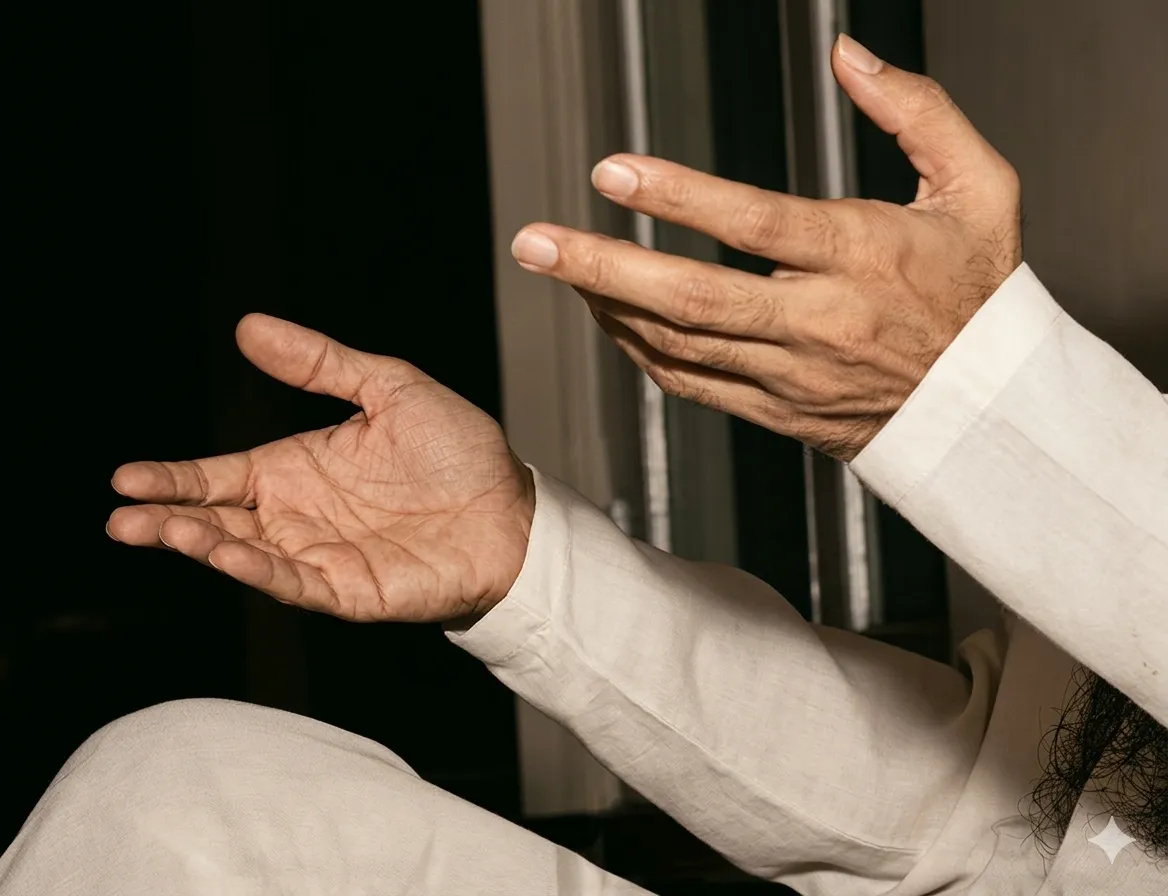
Meditation is like turning on a light inside you so the darkness of anger and sickness loses power and fades.
From the Discourses
Passages where Osho speaks to this question — each links to the complete discourse.
Osho, since evil exists, how can we eradicate it by meditation alone?
It is like someone saying: There is illness—how will we get rid of it by merely taking medicine? Show me some direct way to remove the illness. A man says, I have a cough, a cold, a fever; I have TB, cancer. The doctor hands him a bottle. The man says, Have you gone mad? Here I am dying of cancer and you hand me a bottle? What will this bottle do? He says, I am dying of cancer and you give me red-colored water to hold? What will this red-colored water do? But it does not occur to him that cancer or disease is not going to be pulled out and placed outside directly. To remove cancer or illness, to bring about a change, something opposite has to be introduced. We are ill; by applying what is opposite to the illness, the illness will be cut off. It is…
[NOTE: This is a typed tape transcript and has not been edited or published, as of August 1992. It is for reference use only. The interviewer's remarks have been omitted where not relevant to Osho's words] INTERVIEW BY SWAMI VIDEHA, RIZA MAGAZINE, ITALY QUESTION:* BHAGWAN, THE MAGAZINE IS A MEDICAL PSYCHOSOMATIC MAGAZINE, SO WE ARE SPEAKING TO PROFESSIONALS: DOCTORS, PHYSICIANS, AND PEOPLE DEALING WITH MEDICINE WHO LIKE TO KNOW ABOUT THE SCIENCE OF MEDITATION. CAN YOU INTRODUCE THIS TO THESE PEOPLE? ANSWER:* The first thing -- perhaps they may not be aware of it -- is that the words "medicine" and "meditation" come from the same root. Their meaning is the same: to heal. Medicine heals the body, meditation heals the soul. Medicine is outwardly, meditation is inwardly. And man is whole only when medicine and meditation are together in deep harmony.
They have undisturbed space, resting in a comfortable posture, clean and pure, with the neck, head, and body in one line; held erect, in a mental attitude of sannyas, having controlled all the senses, saluting one's own teacher, guru, devotedly, meditate within the lotus of the heart; the untainted, the pure, the clear and the transparent, the griefless principle of devotion.
For example, I would like to tell you: Many cultures, in different ages, different religions, different thinkings, have considered the body center to be in different places. For example, as far as this contemporary world is concerned, more or less everyone thinks that he is somewhere in the head -- not in the legs, not in the hands, not in the belly. If someone insists and asks you, "Where are you? Point it out!" Then you will begin to feel something in the head; you are in the head. But ask a Japanese and he will say that he is in the belly, not in the head -- because the whole of Japanese culture has always thought that the spirit lives in the belly. So if you think with your head, the Japanese think with their belly -- they say, "We think with our belly." They say, "The belly must…
Meditation is the art of discovering the light within, the art of digging inwards, the art of penetrating your own soul. It is one of the most difficult arts int he world because it hurts to go in. All your interests are on the outside, and when you go in many interests have to be sacrificed. All your life is extrovert, and when you go in you have to find time, space for the inward journey. It also hurts because when you dig inside you have to throw much garbage out of your being; and there are layers and layers of garbage inside. It has been accumulating for many lives. It has almost become part of you, it clings to you, and you have to cut it out and throw it away from you. It feels as if you are cutting your own limbs, hence it hurts.
Beloved Osho, during catharsis I express only negative emotions, anger, jealousy, anguish, etcetera. Why do I not express love, devotion, bliss and religious emotions? Do I not possess them?
They are in you but they are a little deeper. When a well is dug, first of all it is stones, pebbles and mud which come out and not the water. It depends on the land also. Somewhere the water is at thirty feet and somewhere the water is at sixty feet deep. Water is certainly there. Every land has water underneath it but the difference is of depth. A simple-minded person will get the water soon -- maybe at two, three or ten feet, and if a complicated person digs then he may get it at fifty or sixty feet. An innocent-minded person will get it quickly, but a violent, angry man will take a long time to reach the water level. The difference is in the layers of the land. Water is underneath all land. The soul is there in everyone, godliness is there in everyone -- the…