
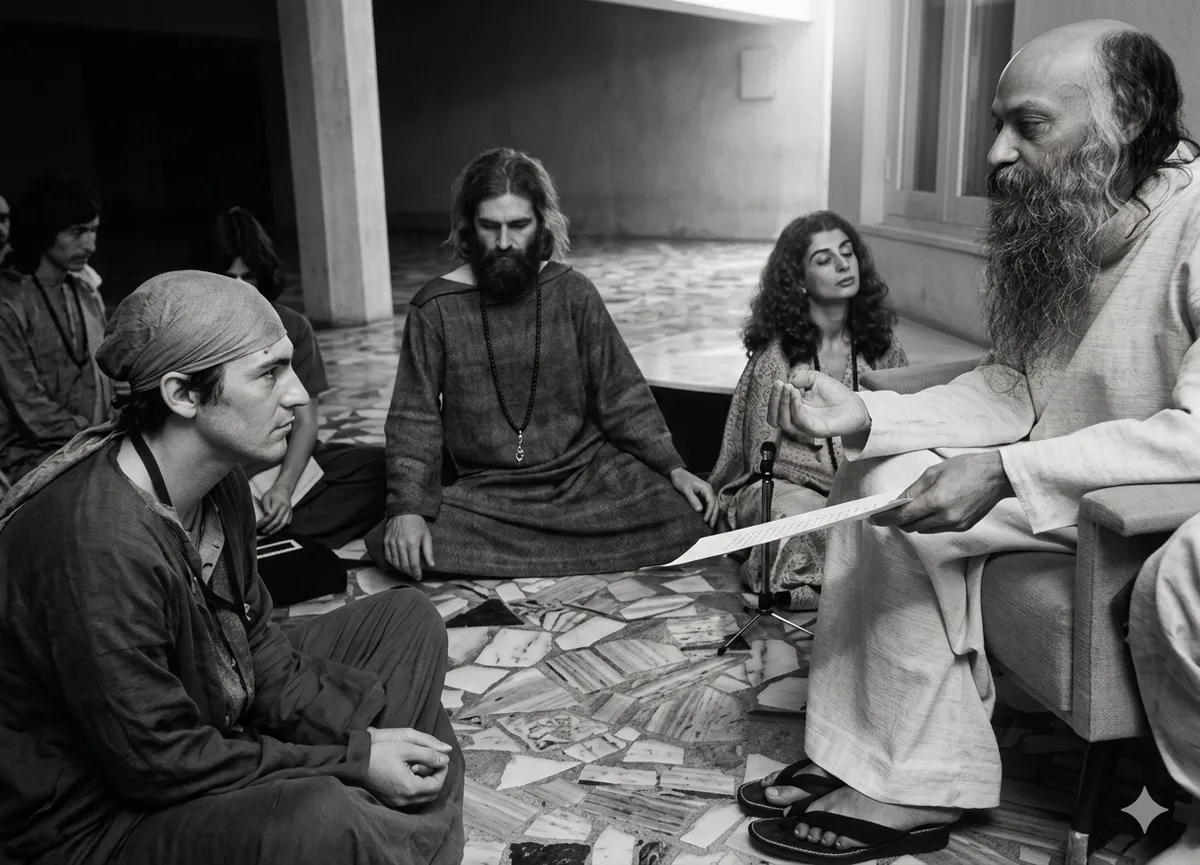
Either surrender completely, or let your mind race all the way until it gets tired and you naturally drop it—don’t stay half-and-half.
From the Discourses
Passages where Osho speaks to this question — each links to the complete discourse.
Osho, I have been listening to you for years. I have been with you a long time. From time to time I have heard many different statements from you, even mutually contradictory ones, yet no question has ever arisen in my mind about them. And in spite of them you have always remained one and indivisible in my vision and in my heart. Kindly shed some light on this.
You can be with me in two ways: through thought and intellect, or through the heart and feeling. If you are with me through the intellect and thought, there will be great difficulty. Day after day you will find contradictory statements. Every day you will have to sort them out, and still you will not succeed. The intellect never really resolves anything. Even where things are simple, the intellect tangles them up. And my words are very tangled. Even where everything is clear, the intellect creates problems. And I speak of paths filled with mist. Even if there were only one path, the intellect would find contradictions; here there are countless paths—contradictions upon contradictions. There is hardly a statement I have not refuted a thousand times. So if you are with me through the intellect, only two things are possible: either you will go mad and drop the intellect, or…
For some moments Kach was speechless. Like a person who does not know what to do, he asked: "But how is the renunciation of the mind possible? Perhaps you too ask me the same question? Whoever is in search of peace, faces this basic problem. Whoever is engaged in search of truth and salvation has this curiosity. The mind itself is the obstruction. The mind itself is restlessness. What is this mind? Is not the desire to be something the mind itself? For a moment, kindly come out of sleep and see this truth. Is not the desire to be something, the race for being something, the thirst for being something, the mind itself? If there is no thirst for being something, where then is the mind?
Pragya has asked: “You and all the saints say the same...”
I don’t know about all the saints, because among your so‑called saints most are not saints at all. Out of a hundred of your saints, perhaps one is a saint; the other ninety‑nine are as sick as you are—and often far more chronically sick. But you understand the language of those ninety‑nine, because they speak the language of your disease. The one who is a real saint—you don’t understand his language. I am choosing to speak about those few, those one‑in‑a‑hundred saints, so I can sift for you who the real saints are. There are too many non‑saints; they’re not worth counting. I keep speaking on saints. They are not many. Your “all saints” are not saints—and certainly Pragya’s “all saints” cannot be. For her, those she calls saints will be the sick and deranged—because her mind, her way of thinking, her chain of logic is repression: anti‑body, anti‑world. “You…
Osho, even while sitting within a vast storehouse of memories of billions upon billions of years, how can a seeker become unburdened by the mind? Such an immense past gives rise to despair in the heart.
Donkeys are great contemplatives! They look so pensive standing around—always thinking. That famous sculpture, The Thinker, by Rodin—very highly regarded in the West. But stand beside a donkey and see: even Rodin could not sculpt a thinker like the donkey appears, standing there and thinking. The donkey thought and thought. Hunger grew, but he could not decide: left or right? Because one had to be left. He was unwilling to leave even one; he wanted both. In trying to gain both, he lost both. There is a saying: “Accomplish one rightly and all is accomplished.” The donkey knew nothing of it. He could only go to one heap. This is the state of everyone’s mind. What appears in the world seems worth gaining. And what the saints say also seems worth gaining. The mind gets stuck between two greeds. Sometimes you think, “I will drop everything.” Immediately you see: the…
Question: Second question: Osho, what should I do? My mind is a great rascal! The German poet Heine wrote that once he got lost in a forest for three days. On the third day—tired, hungry, thirsty, losing hope—the full moon rose. He wrote: “I was amazed. I am a poet; I have written many poems on the moon, and always I saw my beloved’s face in it. Today I saw a loaf of bread floating in the sky. I couldn’t believe it. I rubbed my eyes and looked again—what has happened to the moon? A loaf of bread!” But a man hungry for three days will see only a loaf in the moon. What will you do with your beloved’s face? Bhookhe bhajan na hove Gopala—on an empty stomach no hymn arises. The beloved cannot appear; only bread appears.