
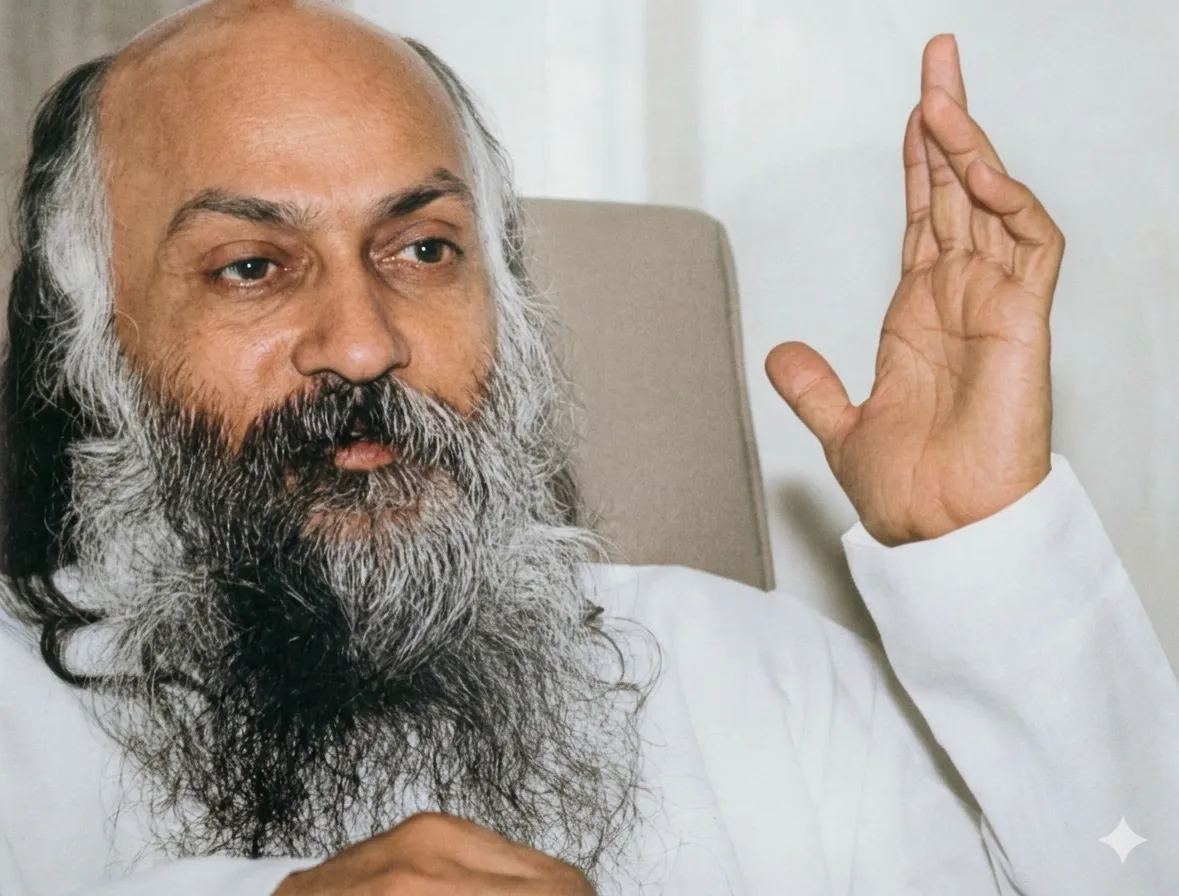
Start with Sadhana-Path (samadhi), Prem Ke Pankh (love), and Ahimsa-Darshan (non-violence), but any of Osho’s spoken talks can help—pick what fits your need now.
From the Discourses
Passages where Osho speaks to this question — each links to the complete discourse.
Do you suggest, Osho, any literature spoken by you or written by you that can shed light on the subjects of love, non-violence, and samadhi, as you suggested?
For samadhi, “Sadhana-Path” can be useful. For love, “Prem Ke Pankh” can be useful; for non-violence, “Ahimsa-Darshan” can be useful. And in any case, whatever I am saying will be useful, because I am not writing anything. So what I say and when I say it is not fixed—nothing is decided in advance. And none of the books are written; they are all spoken. So in that sense all the books will be useful, but particular attention can be given to these.
A friend has asked: Osho, Gandhi has urged the practice of vows such as ahimsa (nonviolence), satya (truth), asteya (non-stealing), brahmacharya (celibacy), and asangraha/aparigraha (non-possessiveness), and Patanjali too has emphasized them. So is it necessary to cultivate these before samadhi? Or can one reach samadhi without them?
Gandhi used to say continually, “I have no doctrine, no ideology. There is no such thing as Gandhism.” It sounded very humble. In Karachi there was a conference where Gandhi was speaking. Communists waved black flags and shouted, “Down with Gandhism!” Gandhi was at the microphone. Always, whenever anyone spoke of Gandhism, he would say, “There is no such thing.” But that day, when the slogan “Down with Gandhism!” was raised and the black flags waved, it suddenly burst out of his mouth, “Gandhi may die, but Gandhism is immortal!” What was hidden in the unconscious surfaced. It had been pushed down in some inner corner; hard to detect. We are not even aware of the corners of our own minds—what lurks where. It can slip out in an unguarded moment. It is necessary to understand Gandhi’s life very correctly. Gandhi’s life is a great failed experiment—a great experiment, and…
Osho, yesterday you said that jealousy is included in respect. I have immense respect for you, but the jealousy inherent in it keeps poisoning it, and I feel guilt and pain. Does reverence transcend this poison-laced respect?
It needs a little explaining—it's a delicate point. Whenever you respect someone, you do so because you see in that person something you do not have. You respect because you glimpse in the other something you would also like to possess. A beggar respects an emperor because he, too, longs to be an emperor. So on the one hand he respects, and inside he also envies. Because he is not yet an emperor but wants to be. You have attained what he wants to attain. He respects you as skillful, successful: “I stand far back in the line; you have gone ahead to where I should have been.” So you are powerful, clever, intelligent, strong—he respects you. But inside a fire of jealousy also burns—if he gets the chance, he would like to be in your place and push you aside. And if the beggar gets that chance, he will…
Osho, whenever you speak on Mahavira’s ahimsa you add love; when you speak on Buddha’s shunya you add love. Whatever you speak on, you invariably add love to it. Is it because you see an extreme lack of love in us sannyasins that you keep reminding us of love again and again? Please tell us.
I don’t add; I unveil. In the casket called ahimsa, the treasure hidden is love itself. I open the casket. I say to you, look inside! The casket is beautiful even from the outside—so finely carved! Master craftsmen have labored over it! But however beautiful a casket may be, it is still a casket; look within! Ahimsa is only a word; the essence is love! And if the essence dies, then no matter how much filigree you continue to carve on “ahimsa,” you will go on hauling the casket for centuries—but from it, life, nectar, bliss will not arise. Then ahimsa will fall into the hands of logicians; they will go on splitting hairs over the word. Mahavira used the word ahimsa for love. I say: set aside ahimsa and peep within. Open this casket! I don’t add; I lay bare. How can there be ahimsa without love? “Do not…
India talks about non-violence, yes -- in their scriptures. They have written beautiful doctrines of non-violence. They say: ahimsa parmo dharma: Non-violence is the greatest religion. But what happened to the Buddhists, how did they disappear? Millions of people were converted by Gautam the Buddha. Almost ninety percent of India had become Buddhist. Where they all disappeared, evaporated? What happened to those people? They were burned alive. They were killed. And these people were thinking that they are fighting for God, remember. They were not in any way fighting for themselves; they were fighting for Hinduism, for Islam, for Christianity, for Judaism. Beautiful labels, and ugly realities behind. The line is very very delicate, and only inside one's own subjectivity is one capable of knowing the difference. The difference cannot be known from the outside, but you can know.