
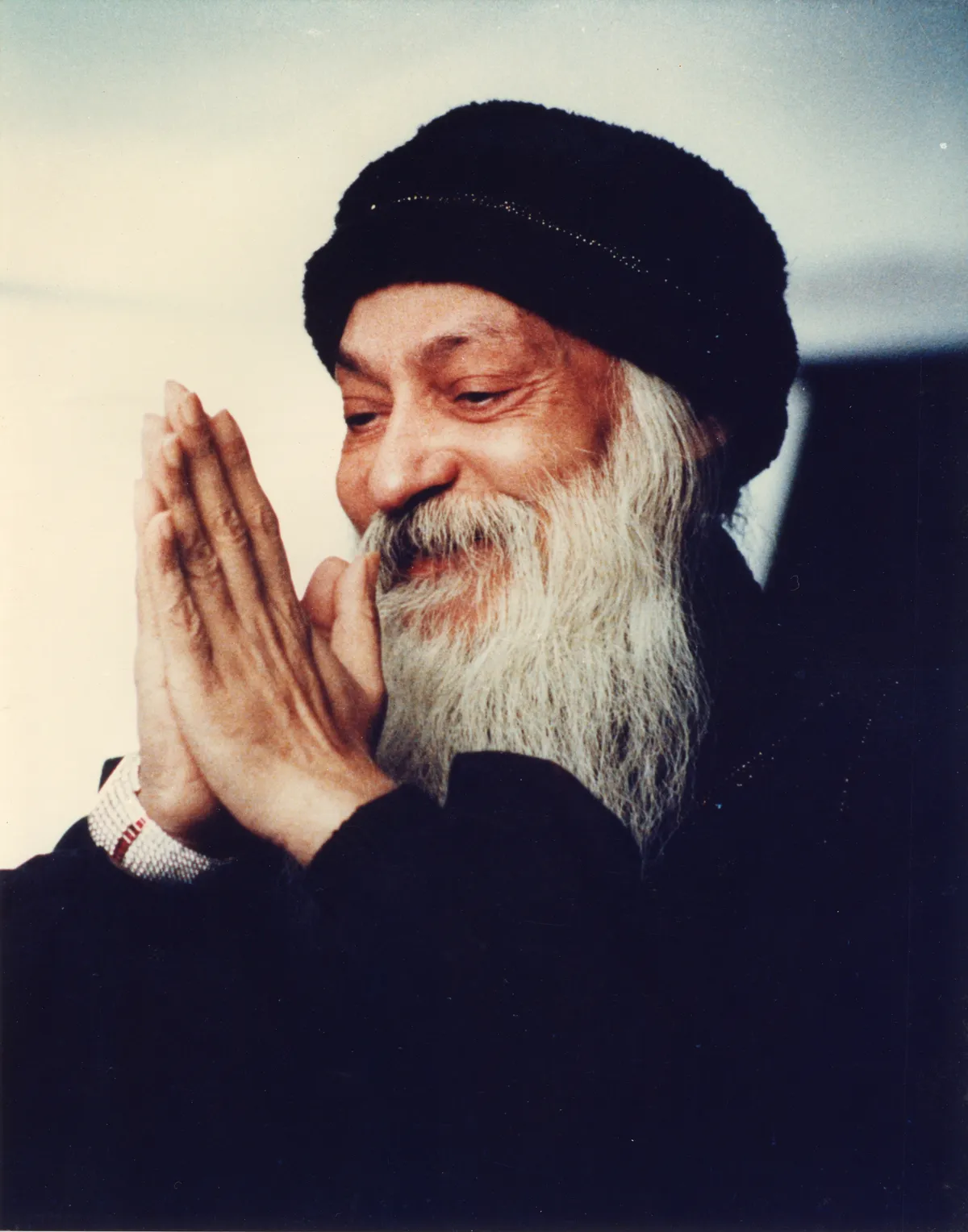
You don’t say truth—you live it; silence and your own experience show it, and words only point the way.
From the Discourses
Passages where Osho speaks to this question — each links to the complete discourse.
Why is truth inexpressible? Why can't it be told?
All words are small. All human efforts are limited. And then, it cannot be told straight. It can be communicated straight, but it cannot be told straight -- and that is the difference between a thinker and a meditator. The thinker goes roundabout because he has to go through thought. He searches for the sky through the clouds and gets lost in the clouds, may never reach the sky. The thinker gets lost in thoughts. The meditator starts by dropping thoughts. He starts by dropping thinking itself, and a moment comes when there is no thought: then there is immediacy. Then there is nothing between you and that which is. Then there is nothing at all -- you are bridged with reality. But that is an experience. Whenever you would like to tell that experience to somebody else you will have to use words, out of necessity, and words cannot…
Osho, awakened ones, considering place, time, circumstance, and the era-appropriate psychology of people, have expressed the same truth in very different forms. To the point that they appear mutually quite disputatious and even contradictory. Is an absolute expression of the ultimate truths of life and existence not possible? Will the limits of the age and the condition of the people always continue to be imposed upon truth?
Expression will always be limited. Expression will always be relative. The speaker and the listener—both create the boundaries of expression. I will say only what can be said. You will understand only what can be understood. Truth is vast. If I go to see the ocean and you say to me, “On your way back, bring a little of the ocean,” I will not be able to bring the whole ocean. I may bring a little water from it. But in that water much will be missing. There will be no storm of the ocean, no waves. And that was the real ocean: that tumultuous roar and fierce thunder! Waves crashing against cliffs! Those surges rising and spreading for miles! That swell! None of that will be there. I will bring a vessel filled with a little ocean water. Still, there will be something! If you taste it, it will…
Osho, what is the definition of God?
Words are very small. If you say God is light, then what of darkness? The scriptures have said that God is light. Suppose we accept this as a definition—then what about darkness? Where will darkness go? Darkness is too; in fact it is far more than light. Light sometimes is and sometimes is not; darkness is always, eternal. Where will you place darkness? If you say God is light, darkness is left out. If you say God is darkness, then light is left out. If you say God is both darkness and light, a contradiction arises: they cannot be together. Try to have both darkness and light in the same room. If you bring in light, darkness disappears; if you preserve darkness, you cannot have light. Then how can both be together? That becomes an impossibility. So you cannot say “both” either. Then the fourth device is to say: it…
A puzzled monk once said to fuketsu, "you say truth can be expressed without speaking, and without keeping silent. How can this be?" fuketsu answered, "in southern china, in the spring, when I was only a lad, ah!. How the birds sang among the blossoms."
Zen brings the whole truth to the world. Zen is a great blessing to the world; it brings the whole truth. The whole truth is: Truth cannot be said, and yet can be said. If not said, then showed, indicated. The ordinary duality is transcended. We are always moving from one pole of the duality to the other. Sometimes we say, "Yes, it can be said"; this is one pole. Then we become aware, "How can it be said?" -- the other pole. Then we keep silent, but then again we become aware that there is something left: "Yes, it can be said." This way it goes on moving, it swings. Zen says truth is a transcendence, transcendence of all duality. The duality between the word and the silence is also to be transcended. The Bible says in the beginning there was the word. The Vedas say in the beginning…
A friend has asked: You say that truth cannot be expressed in words?
It cannot be said. That which is known by rising beyond the mind has no way of being told, because to tell it one needs the mind. What is not known through the mind cannot be said through the mind either.