
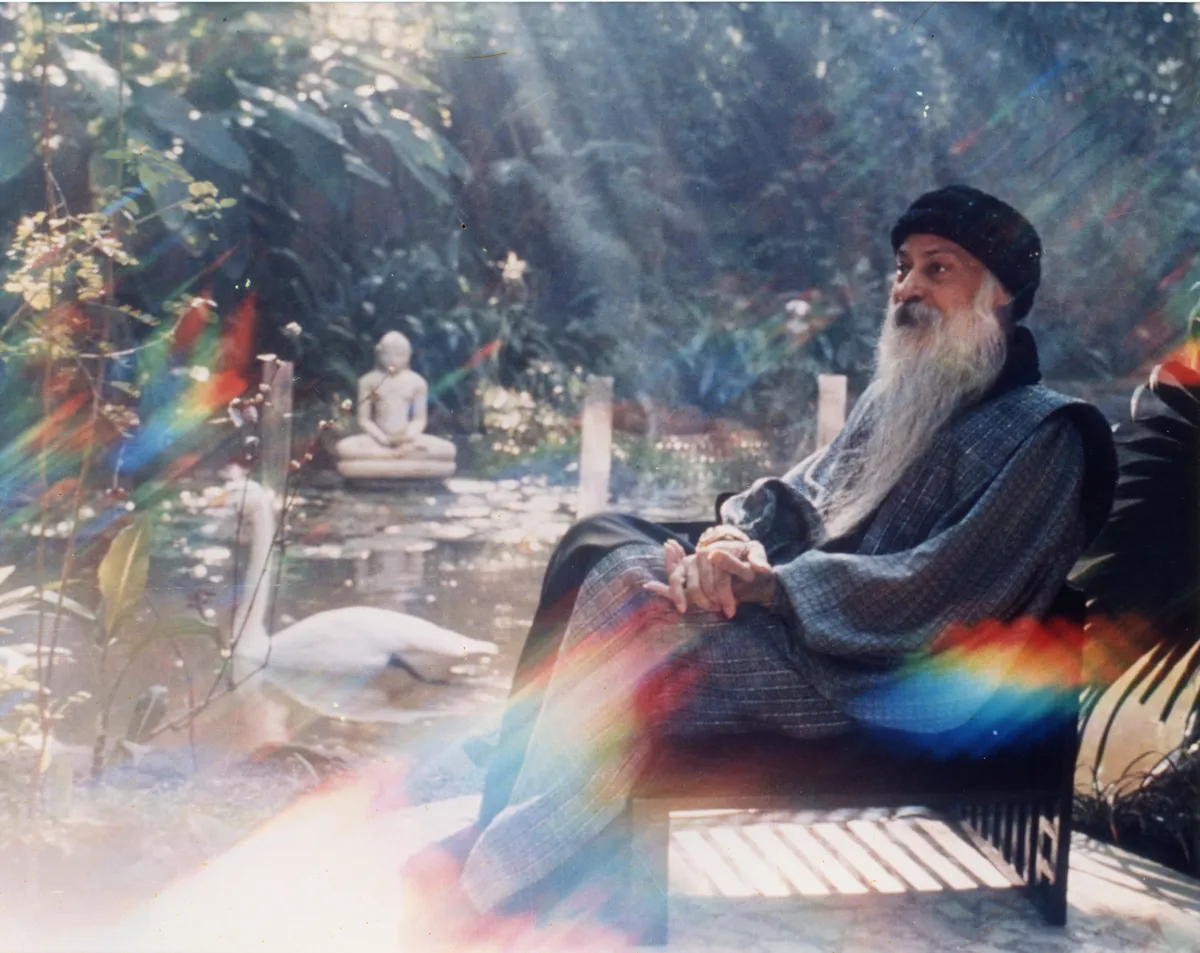
It means truth wins only inside you by being real, while outer victories can be lies wearing crowns.
From the Discourses
Passages where Osho speaks to this question — each links to the complete discourse.
Osho, this verse is from the Mundaka Upanishad: Satyam eva jayate nānṛtam, satyena panthā vitato devayānaḥ; yenākramanti ṛṣayo hyāptakāmā, yatra tatra satyasya paramaṁ nidhānam. That is: Only truth is victorious, not untruth. The path by which the desireless seers go, and where the supreme treasure of truth abides—that divine path opens to us only through truth. Is truth both the goal and the means? Kindly grace us with direction.
Devayāna means the realization and proclamation of one’s own divinity; freedom from tradition; freedom from the past; the art of living in the present. “Satyena panthā vitato devayānaḥ”—this path of truth is Devayāna; it is the road of rebellion; it is revolt. It is not Pitṛyāna. You cannot say, “My father believed, therefore I believe.” No—you must know. Knowing comes first. And one who has known has no need to believe. For the believer, the blessing of knowing never arises. The believer dies. The day he believes, he dies—because the search ends, inquiry ceases. Belief means: What’s left to do? I have believed. And this is what you have been taught: believe, have faith. Thus the whole earth is filled with hollow “religious” people—believers, not truly religious. Belief is always hollow. What is not your own experience, how can it be truth for you? I may say it is my…
India has taken as its national emblem: Satyameva Jayate—Truth alone triumphs. Nowhere is this evident. But people are interested in triumph, not in truth. If truth wins, they can become interested in truth; otherwise, they are not. If it were certain that untruth wins, people would speak untruth. People are interested in winning, not in truth. So I do not say to you that truth always wins. It is not necessary. Many times it will lose. In fact, it will lose more often than it wins—because those among whom you live are all false. I do not say truth always wins, but this I do say: truth is always blissful. Victory belongs to the others; bliss belongs within. Success belongs to the others. Jesus was crucified; he could have avoided it by lying. It would have been enough to say... Jesus said, “I am the son of God.
Osho, what is the proof of God’s existence?
And you still ask for proof? There have been people who offered proofs, and all their proofs are futile. No proof works. All the proofs for God so far are not worth a penny. Someone says: everything that is made must have a maker; such a vast world—surely it must have a maker. But that proof commits suicide; the moment it meets an atheist, it goes lame. The atheist says: If every made thing must have a maker, if God is needed to make the world, then who made God? With that he tightens the noose around your neck. Who made God? You protest: No, no one made God. Then the atheist says: If God can be without being made, why can’t the world be without being made? The argument collapses; it falls flat. You say: just as the potter makes the pot, so that Great Potter made this world.…
Osho, Sufis are regarded as seekers of truth—the truth which is the knowing of objective reality. An ignorant, greedy, and tyrannical king decided, “I will bring even this truth under my control.” He was the lord of Murcia in Spain, and his name was Roderic. He further resolved that Umar al-Alawi, the Sufi of Tarragona, would be forced to reveal this truth.
Consequently, Umar was arrested and brought before the royal court. Roderic said to him, “I have decided that the truth you know you will tell me in words I can understand. And if you do not, you will have to forfeit your life.” In reply Umar asked, “In this generous court, do you accept the universal principle that when a person, in answer to a question, speaks the truth, and if that truth does not incriminate him, he should be set free?” Roderic said, “So it is.” Umar then said, “Let all present here be witnesses to this. And now I will tell you not one but three truths.” Roderic said, “We must also be assured that what you call truths are actually true. Therefore, whatever you say must be accompanied by its proof.” Umar replied, “For a lord such as you, to whom we are about to give not…
Osho, “Satyam param, param satyam. Satyena na svargal-lokach chyavante kadachana. Satam hi satyam. Tasmad satye ramante.” That is, Truth is paramount, the highest, and that which is paramount is Truth. Those who take refuge in Truth do not fall from heaven, from the state of spiritual elevation. The very nature of the virtuous is Truth; therefore they always delight in Truth. Kindly unfold this sutra from the Shvetashvatara Upanishad for us in detail.
Chaitanya Kirti! Satyam param, param satyam. Param does not mean “most excellent.” That translation is mistaken. “Most excellent” still belongs to the same series—call it the last rung of the ladder, but it is the same ladder. The first rung is of the ladder, and the topmost rung is also of the ladder. In “most excellent” there is no qualitative difference, only quantitative. Param does not mean “most excellent.” Param means: that which transcends all series and gradations; for which there is no possibility of placing it in any category or class; which is, in its very nature, inexpressible. Whatever you say about it will be a mistake. Lao Tzu has a famous saying: Speak the truth—and in the very speaking it becomes untrue. The very act of speaking. Because Truth is like the vast sky and words are very small, smaller even than a courtyard. How can the sky…