
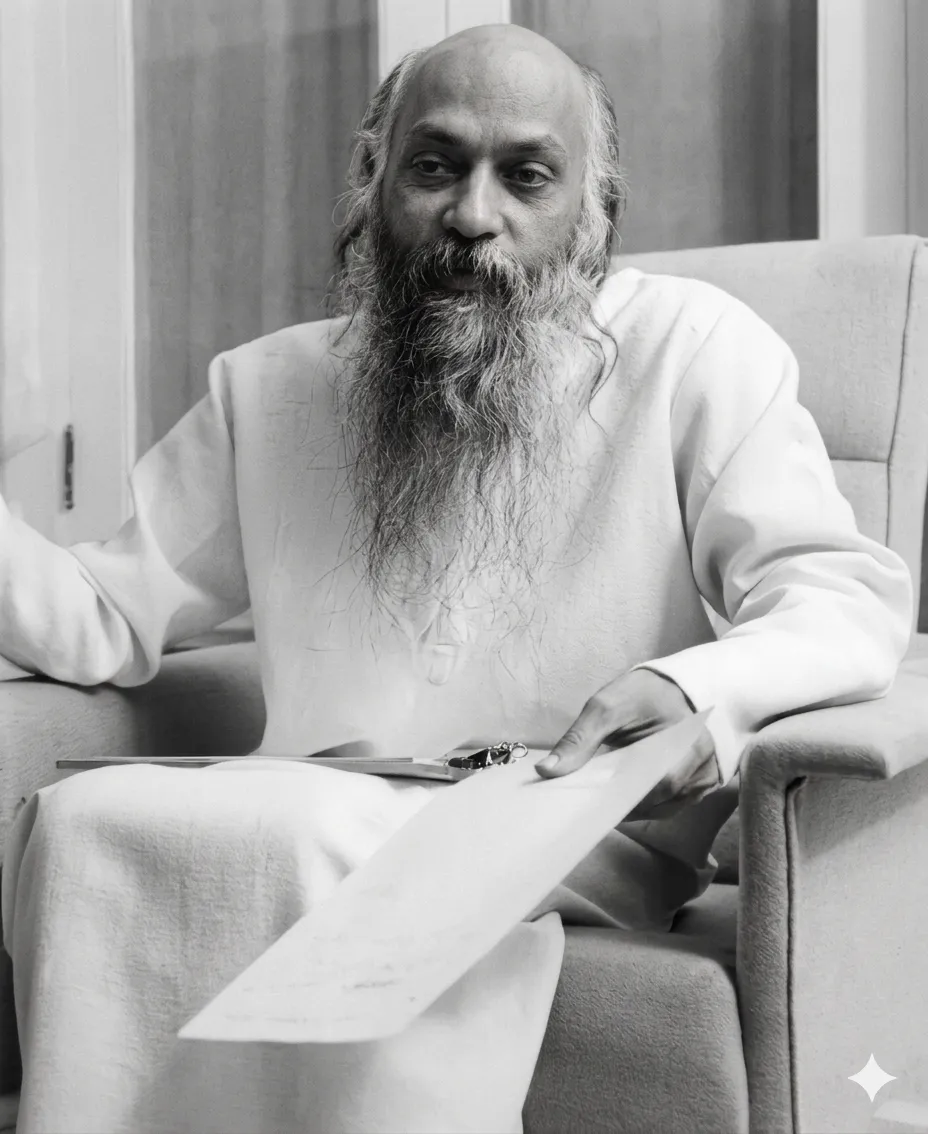
He smiles to show that the real teaching is silent; talking is hard but needed, so the smile appears before and after, and fades during the effort of speaking.
From the Discourses
Passages where Osho speaks to this question — each links to the complete discourse.
Beloved Osho, before you start talking, you smile. When you start talking, your smile disappears and you don't smile again until you've finished. Can you tell us about that?
It is relevant, because to speak is such a torture and such a useless activity. It has to be done because there is no other way to bring you towards the silence that exists in me. You won't listen to it; you can listen only to words. So I am smiling when I start talking, but while I am talking it is difficult to smile. It is such a torture and such a futile effort to say something which cannot be said, to talk about something which cannot be talked about, to go on continuously pointing with the fingers to the moon which cannot be fingered. But there is no other way, so I have to continue it. By and by, you will become able to listen to the nonverbal, to the wordless. By and by, you will become able to listen when I am not talking -- then there…
Osho, if Mahakashyap had not burst into laughter that morning, would Buddha still have given him the flower, the symbol of silence?
The head disciple laughed. “He’s not angry. When you go in with thought, your face has a different look. When you go in thoughtless, your face has a different look. Consider: when you are full of thought, your whole face is tense. There are lines in the eyes and furrows on the brow. When you are without thought, all furrows are gone, all tension drops. When you are thoughtless, such peace drizzles around you that even the ignorant would notice—will the master not? That he even lets you reach the doorway is his compassion. As for me, you don’t know—I used to be stopped outside the door. He would say, ‘Go back. Don’t bring idle babble here.’ He hadn’t even seen me yet! But my shadow arrived before me, my atmosphere reached the threshold before I did—as if a fragrance gave him the news.” The new disciple asked, “Then how…
पहला प्रश्न: ओशो,महाकाश्यप उस दिन सुबह खिलखिलाकर न हंसा होता, तो भी क्या बुद्ध उसे मौन के प्रतीक फूल को देते?
… प्रधान शिष्य ने कहा, नाराज नहीं। क्योंकि जब तुम विचार करते हुए जाते हो तो चेहरे का ढंग ही और होता है। जब तुम निर्विचार में जाते हो, तो चेहरे का ढंग ही और होता है। सोचो थोड़ा, जब तुम विचार से भरे होते हो तो सारे चेहरे पर तनाव होता है। आंख में, माथे पर बल होते हैं। जब तुम निर्विचार में होते हो, सब बल खो जाते हैं, सब तनाव खो जाता है। जब तुम निर्विचार में होते हो, तब तुम्हारे चारों तरफ ऐसी शांति झरती है कि अज्ञानी भी पहचान ले, तो गुरु न पहचानेगा! वह तुम्हें दरवाजे के भीतर घुसने देता है, यह भी उसकी करुणा है। उस प्रधान शिष्य ने कहा कि मेरी तुम्हें पता नहीं। दरवाजे के बाहर ही रहता था, वह कहता था, लौट जा। फिजूल की बकवास लेकर मत आ। …
Osho! In the discourse, about the fruit you said that I fell silent and said nothing. Osho, for so many years you have fed us so many fruits that now there is nothing left to say and nothing left to ask. Everything has been received. Now only your grace remains. My gratitude, your blessing and benevolence, hundreds of thousands, millions, billions of times over!
One of the West’s great philosophers, Wittgenstein, wrote in his astonishing book—this century’s most astonishing—Tractatus: “Whereof one cannot speak, thereof one must be silent.” About that which cannot be said, don’t, by mistake, say anything either. Because whatever you say will be wrong; whatever you say will spread misunderstandings; whatever you say will cause harm. Say only what can be said; remain silent about what cannot. Those who can understand will understand your silence; those who cannot will be driven into deeper confusions by your words. Therefore the real thing is never said. I, too, am not saying it. What I am saying to you is only to take you to that place where you can understand my silence. I am busy preparing for silence. If you are ready, I will become silent. It’s only a matter of your readiness. If you all become like Fali Bhai, I will fall…
पहला प्रश्न: ओशो! प्रवचन में फल के बारे में आपने कहा कि मैं चुप रह गया और कुछ नहीं बोला। ओशो, इतने सालों से आपने इतने फल खिलाए हैं कि अब न तो कुछ बोलने को रहा है, न कुछ पूछने को। सब कुछ मिल गया है। अब तो बस आपकी अनुकंपा मात्र रह गई है। आपका लाखों, करोड़ों, अरबों बार अनुग्रह, उपकार!
पश्चिम के एक बहुत बड़े दार्शनिक विटगिंस्टीन ने अपनी बड़ी अदभुत किताब, इस सदी की सबसे अदभुत किताब--ट्रेक्टेटस--में लिखा है: जिस संबंध में कुछ न कहा जा सके, उस संबंध में कुछ भूल कर कहना भी मत। क्योंकि तुम जो भी कहोगे वह गलत होगा; तुम जो भी कहोगे उससे भ्रांतियां फैलेंगी; तुम जो भी कहोगे उससे हानि होगी। जो कहा जा सके वही कहना; जो न कहा जा सके उस संबंध में चुप रह जाना। जो समझने वाले हैं, वे तुम्हारी चुप्पी समझ लेंगे; जो नहीं समझने वाले हैं, वे तुम्हारे शब्दों से और भी ज्यादा नासमझियों में पड़ जाएंगे। इसलिए जो असली बात है, वह तो कभी नहीं कही जाती। मैं भी थोड़े ही कह रहा हूं। तुमसे जो बातें कह रहा हूं, वे बातें तो तुम्हें उस तरफ ले चलने की हैं, जहां तुम मेरे मौन को समझ सको। मैं मौन की तैयारी में लगा हुआ हूं। तुम तैयार हो जाओ तो मैं मौन हो जाऊं। बस तुम्हारी तैयारी की देर है। तुम सब फली भाई जैसे हो जाओ तो मैं चुप हो जाऊं।
Osho, it is surprising that only when you speak do we get a slight glimpse of your peak through words. Why is that?
No one understands silence. If someone loves you and does not say so, you will not be able to grasp that he loves you. If in no way does he express it—through gesture, through the eyes, through words—these are all “words”—if he remains silent, you will never recognize that someone loves you. It has to be said; it has to be expressed. And then a very amusing thing happens. Even if there is no love, if someone is skilled in expressing, you will feel that there is love. Many times, the one who is skilled in expression becomes the lover. It is not necessary that there be love—because you do not understand love; you only understand words. Husbands and wives begin to feel depressed—how long can one keep saying the same words? Then they no longer carry any flavor. But as soon as words are lost, the relationship is lost.…
पहला प्रश्न: ओशो, आश्चर्य है कि जब आप बोलते हैं, तभी वाणी के माध्यम से हमें आपका शिखर थोड़ा दिखाई पड़ता है। ऐसा क्यों?
… अगर कोई आपको प्रेम करता हो और कहे न, तो आप पकड़ ही न पाएंगे कि प्रेम करता है। किसी तरह प्रकट न करे--भाव-भंगिमा से, आंख के इशारे से, शब्दों से, ये सभी शब्द हैं--चुप रहे, तो आप कभी भी न पहचान पाएंगे कि कोई आपको प्रेम करता है। कहना पड़ेगा, प्रकट करना पड़ेगा। और तब एक बड़े मजे की घटना घटती है। प्रेम न भी हो और अगर कोई कुशल हो प्रकट करने में, तो आपको लगेगा कि प्रेम है। बहुत बार, जो अभिव्यक्ति में कुशल है, वह प्रेमी बन जाता है। जरूरी नहीं है कि प्रेम हो। क्योंकि प्रेम को आप समझते नहीं, आप सिर्फ शब्दों को समझते हैं। पति-पत्नी उदास होने लगते हैं, क्योंकि उन्हीं-उन्हीं शब्दों को क्या बार-बार कहना! …
Osho, for forty years continuously Buddha gave discourses and sermons, and it is said that he did not speak a single word. Likewise, you too have been speaking and giving discourses for twenty years, and it could be said that you do not speak a single word. Is this true?
There is a sweet story about Mahavira. The Jains, in their rigidity, clung to the letter and missed the essence. The story is that Mahavira never spoke, and yet people heard. This is a difficult matter: Mahavira did not speak, yet people heard. Mahavira did not speak in any language that the ears can hear. The Jains say his speech is soundless—nishabd. There are no words in it. Yet people heard—those who could. If they too became wordless, sat near Mahavira in silence, they heard. Therefore there is another story in Mahavira’s life, important to note: wild animals heard him, gods of the sky came to listen, birds and beasts came, ghosts and spirits were present. The Jains have great difficulty explaining how birds and beasts can hear. Certainly, if Mahavira spoke in a language, then even among humans only those who knew that tongue could understand. If I am…
प्रश्न: ओशो, भगवान बुद्ध निरंतर चालीस वर्ष तक प्रवचन और उपदेश करते रहे, और कहा गया कि वे एक शब्द भी नहीं बोले। वैसे ही आप भी बीस वर्षों से निरंतर बोल रहे हैं, उपदेश कर रहे हैं, और कहा जा सकता है कि आप एक शब्द भी नहीं बोलते। क्या यह सच है?
महावीर के संबंध में बड़ी मीठी कथा है। जैन तो जड़ता से पकड़ लिए, इसलिए उसका सार नहीं निकाल पाए। कथा यह है कि महावीर बोले ही नहीं, फिर भी लोगों ने सुना। अब यह बड़ा मुश्किल मामला है। महावीर बोले नहीं, लोगों ने सुना। महावीर ऐसी किसी वाणी से नहीं बोले, जो कान सुन लें। तो महावीर की जो वाणी है, जैन कहते हैं, निःशब्द है। उसमें कोई शब्द नहीं है। फिर भी लोगों ने सुना--जो सुन सकते थे। अगर वे भी निःशब्द हो गए, महावीर के पास जाकर बैठ गए, तो उन्होंने सुना। इसलिए महावीर के जीवन में एक और कथा है, जो महत्वपूर्ण है, और वह यह कि महावीर को जंगली जानवरों ने भी सुना, आकाश के देवता भी सुनने आए, पशु-पक्षी भी सुनने आए, भूत-प्रेत भी मौजूद हुए। जैनों को बड़ी मुश्किल होती है समझाने में कि पशु-पक्षी कैसे सुनेंगे। निश्चित ही, अगर महावीर भाषा बोलते हों, तो पशु-पक्षी तो दूर, सारे मनुष्य भी नहीं समझ सकते। अब अगर मैं हिंदी बोल रहा हूं, तो जो हिंदी समझता है, वही समझ सकता है। जमीन पर हजारों भाषाएं हैं, वे लोग नहीं समझ सकते। …