
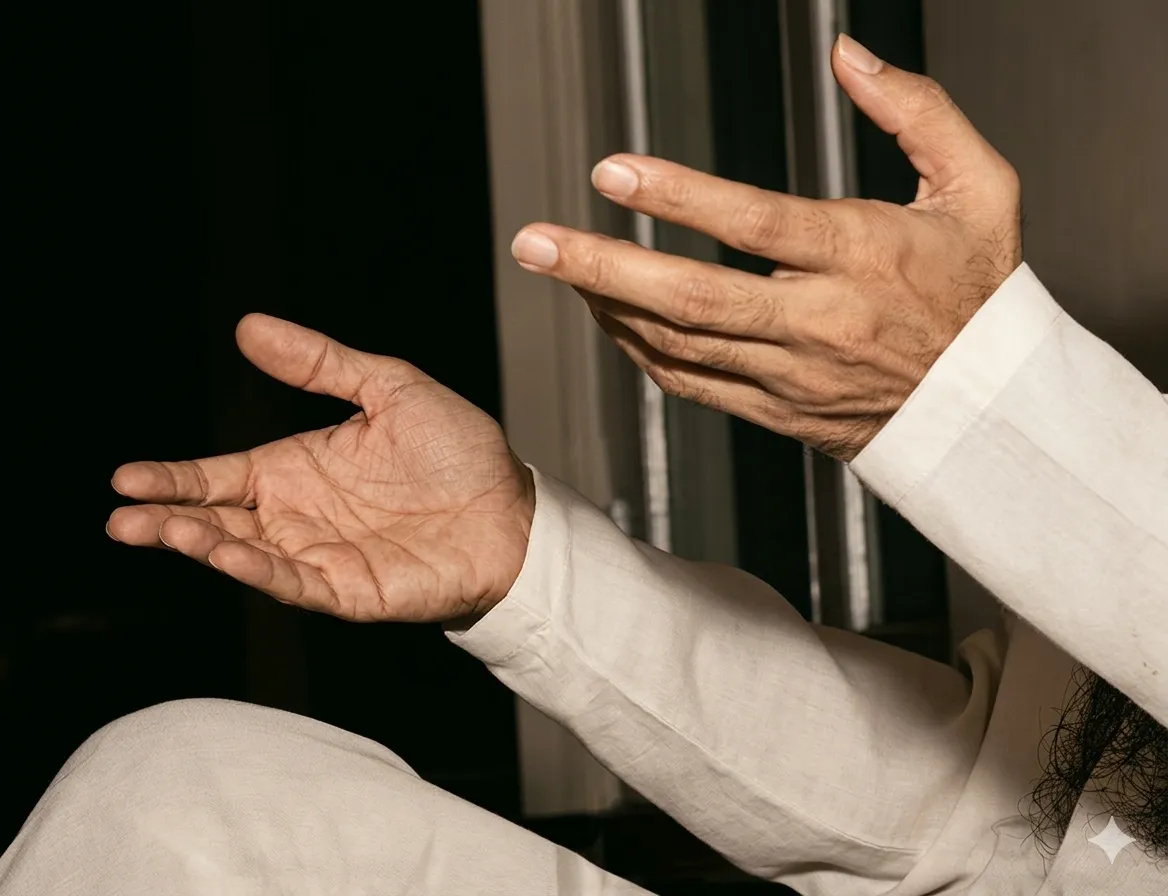
Masters are like mirrors—how they respond to you shows you, not them.
From the Discourses
Passages where Osho speaks to this question — each links to the complete discourse.
Osho, many stories are told about saints and siddhas that when they were pleased with someone, they would shower them with abuses. From Paramahansa Ramakrishna’s mouth many abuses would come—at every turn, abuses. The same is notably true in the life of the renowned music master Alauddin Khan. Would you kindly shed some light on this?
Anand Maitreya, whether a true Master sings a song or hurls an abuse, his aim is always one: by what means can your ego be erased. If it dissolves through song, he will sing; if through abuse, he will abuse. Neither the abuse has any value nor the song; both are means, devices. The whole endeavor of the true Master is this alone: how the rock of your ego may be shattered to pieces. For this reason Ramakrishna would sometimes pat your back, sometimes shower you with abuses. And this is not only with Ramakrishna; it is so with many realized ones. Sai Baba of Shirdi would abuse, throw stones, run after people with a stick. People thought he had gone deranged. He was not. As his death drew near, he abused more, threw more stones, ran more to beat. People thought the madness had reached its peak. Not so.…
Question: A MASTER GIVES UP MISCHIEF. HE IS SERENE. HE LEAVES EVERYTHING BEHIND HIM. HE DOES NOT TAKE OFFENSE AND HE DOES NOT GIVE IT. HE NEVER RETURNS EVIL FOR EVIL. ALAS FOR THE MAN WHO RAISES HIS HAND AGAINST ANOTHER, AND EVEN MORE FOR HIM WHO RETURNS THE BLOW. RESIST THE PLEASURES OF LIFE AND THE DESIRE TO HURT -- TILL SORROWS VANISH. NEVER OFFEND BY WHAT YOU THINK OR SAY OR DO. HONOR THE MAN WHO IS AWAKE AND SHOWS YOU THE WAY. HONOR THE FIRE OF HIS SACRIFICE. MATTED HAIR OR FAMILY OR CASTE DO NOT MAKE A MASTER BUT THE TRUTH AND GOODNESS WITH WHICH HE IS BLESSED. YOUR HAIR IS TANGLED AND YOU SIT ON A DEERSKIN. WHAT FOLLY! WHEN INSIDE YOU ARE RAGGED WITH LUST. THE MASTER'S CLOTHES ARE IN TATTERS.
You have asked: “You often say that this world is an echo-point, from where everything we give it returns to us. Love receives love; hatred receives hatred. If that is so, why were Buddha and Mahavira tortured? Why were Jesus and Mansoor killed? And why are you met here with false accusations, slander, and abuses?”
All cultures, all societies instruct people: respect your parents. Why? Because if this is not taught, children will kill their parents. There is fear. By nature, the process of life is such that the parents have to anger the child a thousand times. The child wants to play with a snake—the mother has to pull him back. The child wants to go toward the fire—the mother has to stop him. A thousand occasions arise when she must say no, no, no. The child begins to feel: into what enemies’ hands have I fallen! Whatever I want to do is wrong! Everything is wrong! None of my feelings are respected—only insult upon insult. The small child begins to think: wait, let me grow up; I will teach you a lesson. When the power is in my hands, I will show you. And it is no wonder that when the parents grow…
What constitutes the behaviour of an enlightened man?
An enlightened man is all emptiness. What constitutes an emptiness? It has no 'constitutes' in it; hence it is empty. A man who is enlightened has no character. Let me repeat it: an enlightened man has no character at all. He lives from moment to moment. He has no character to follow; he has no structure around him. A character is a structure, a character is an armour. An enlightened man has no character. Let me say he is characterless. But try to understand me -- because he has no structured consciousness. He HAS consciousness but the structure has been dropped. He's neither Hindu nor Mohammedan nor Christian. He is neither good nor bad, neither moral nor immoral, neither this nor that. He simply is. All duality has disappeared. You cannot evaluate him; you cannot categorize him; you cannot put him into any pigeon-holes of your logic. He exists like…
In roptchitz, the town where rabbi naftali lived, it was the custom for rich people whose houses stood isolated, or at the far end of town, to hire men to watch over their,property by night. Late one evening, when rabbi naftali was skirting the woods which circled the city, he met such a watchman walking up and down. 'for whom are you working?' he asked.
THE MAN TOLD HIM, AND THEN INQUIRED IN HIS TURN: 'AND FOR WHOM ARE YOU WORKING, RABBI?' THE WORDS STRUCK THE ZADDIK LIKE A SHAFT. 'I AM NOT WORKING FOR ANYBODY JUST YET,' HE BARELY MANAGED TO SAY. THEN HE WALKED UP AND DOWN BESIDE THE MAN FOR A LONG TIME. 'WILL YOU BE MY SERVANT?' HE FINALLY ASKED. 'I SHOULD LIKE TO,' THE MAN REPLIED, 'BUT WHAT WOULD BE MY DUTIES?' 'TO REMIND ME,' SAID RABBI NAFTALI. Ordinarily, you think you are perfectly awake. That's a misconception. Only a Buddha, a Baal Shem, a Moses, a Mahavir, are awake. You are completely asleep. I can hear your snoring right now; you are fast asleep. Just because you can open your eyes, don't claim that you are awake. Just that is not enough for being awake. For example, a man is in a coma. He breathes, but because he breathes,…