
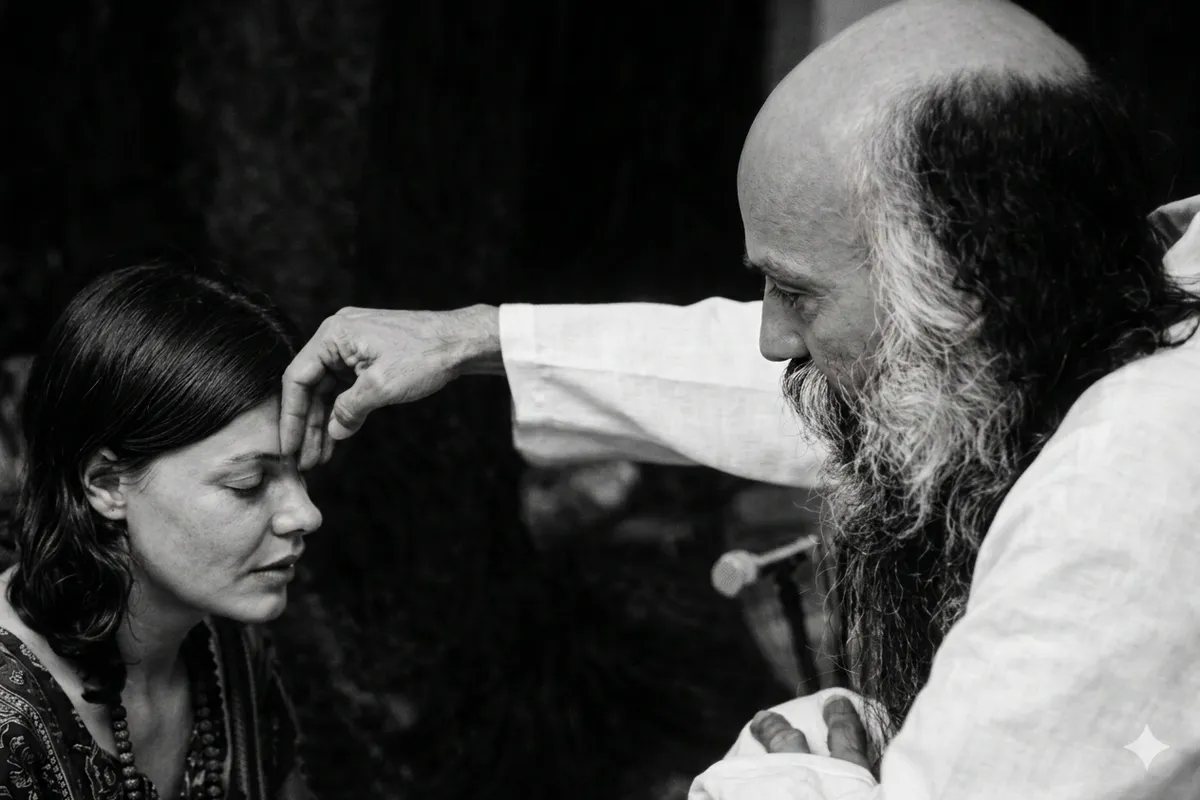
It’s not a staircase of better gods; it’s the same light showing up at different times, shining more or less depending on the person and the world.
From the Discourses
Passages where Osho speaks to this question — each links to the complete discourse.
Osho, in the Hindu sequence of avatars, beginning with Matsya and then the partial avatars like Rama, after the full avatar Krishna there still comes the Buddha avatar—and the prophecy of Kalki is also included. So, from the standpoint of chronology, why is Buddha not regarded as a full avatar? If there is any secret, from the perspective of evolution, as to why Krishna appears before Buddha, please tell us. And to what extent is it appropriate here to call the movement of time circular?
A partial avatar is just as much an avatar as a full one. In being an avatar there is no difference. Avatar simply means that the supreme consciousness has manifested. In how many dimensions it has manifested—that is another matter. So Krishna’s avatar is a full avatar in the sense that in all the dimensions of life, in all its facets, his touch is there. Buddha’s avatar, then, is not a full avatar. Kalki too will not be a full avatar. The descent will be complete—the process of descent, the coming down of consciousness, will indeed be complete—but it will not touch all the dimensions. There are reasons for this, many reasons. The current of time, the order of development—ordinarily one would expect the full avatar to come at the end; in the order of development, fullness should arrive last. But the evolutionary order is one thing; the avatar comes…
Questioner: the line of hindu incarnations begins with the fish and continues through rama, krishna, and buddha. Even the coming incarnation, to be known as kalki, is included in this series. But how is it that in this long line of incarnations krishna is said to be the complete incarnation of god, although buddha happened long after him? Why was buddha derived this honor? And what, from the viewpoint of evolution, is the secret of krishna preceding buddha? Is it so because the movement of time is circular?
Even a partial incarnation of God is as good as the complete one. It makes no difference as far as incarnation is concerned. An incarnation means that divine consciousness has become manifest. In how many dimensions it manifests itself is another matter. Krishna is a complete incarnation in the sense that divine energy has become manifest in all dimensions of his life. Buddha's incarnation is not that complete, nor is the coming incarnation of Kalki going to be. As far as the descent of divine energy is concerned, the process of descent is going to be complete in the case of every incarnation, but it may not touch every dimension of a man's life. And there are many reasons for it. In the ordinary process of evolution, completion should happen at the end. But incarnation is outside this process of evolution. Incarnation means descent from the beyond; it is not…
Osho, are there also grades in Buddhahood? Is that why the Hindus fixed the kalas (degrees) of the avatars?
Sahajanand! Buddhahood means going beyond ladders and gradations, crossing all categories—where all boundaries end, where all measures drop, where the immeasurable begins—that is Buddhahood. Therefore between two Buddhas no one is smaller and no one is greater. But all these gradings are not made by the enlightened; they are made by the buddhus—the fools. And buddhus will do it in their own way! They will search for categories in everything; they will put everything on a scale to be weighed. There was a Jain scholar, Rishabhdas Ranka. He was the one who brought me to Poona for the first time. If Poona has any complaint, it should be with Rishabhdas Ranka; it is not my fault. I might never have come to Poona on my own. He had been with Gandhiji for years, living in Wardha—very Sarvodaya. In the company of Gandhi and Vinoba he had memorized one thing and…
Osho, what are the reasons for calling Krishna a complete incarnation (purnavatara)? Please give some new reasons. And shed detailed light with reference to the sixty-four arts.
No, there is no other reason to call one “complete.” Whoever becomes zero becomes complete. Emptiness is the prelude to the complete. To be precise, the zero alone is the only complete. You cannot draw half a zero—not even in geometry. If you say, “I have drawn half a zero,” it is no longer a zero. There is no such thing as half a zero. The zero is always whole, entire. The incomplete has no meaning. How will you split zero into two parts? And if it can be split, how will you still call it zero? Zero is not cut, not divided; it is indivisible. From where division begins, number begins. That is why after zero we must start with one. One, two, three—this is the world of number. All numbers arise from zero and are lost back into zero. Zero alone is the complete. Who can be zero?…
Osho, what is an avatar?
All are avatars. Every person is an avatar. We begin to worship special avatars and forget the rest. Every person is an avatar. Either God is in everyone, or He is in no one. There cannot be any exclusive monopoly of Rama or Krishna or anyone—that they are avatars while A, B, C are not. Nor is that their claim; it is we who make that claim.