
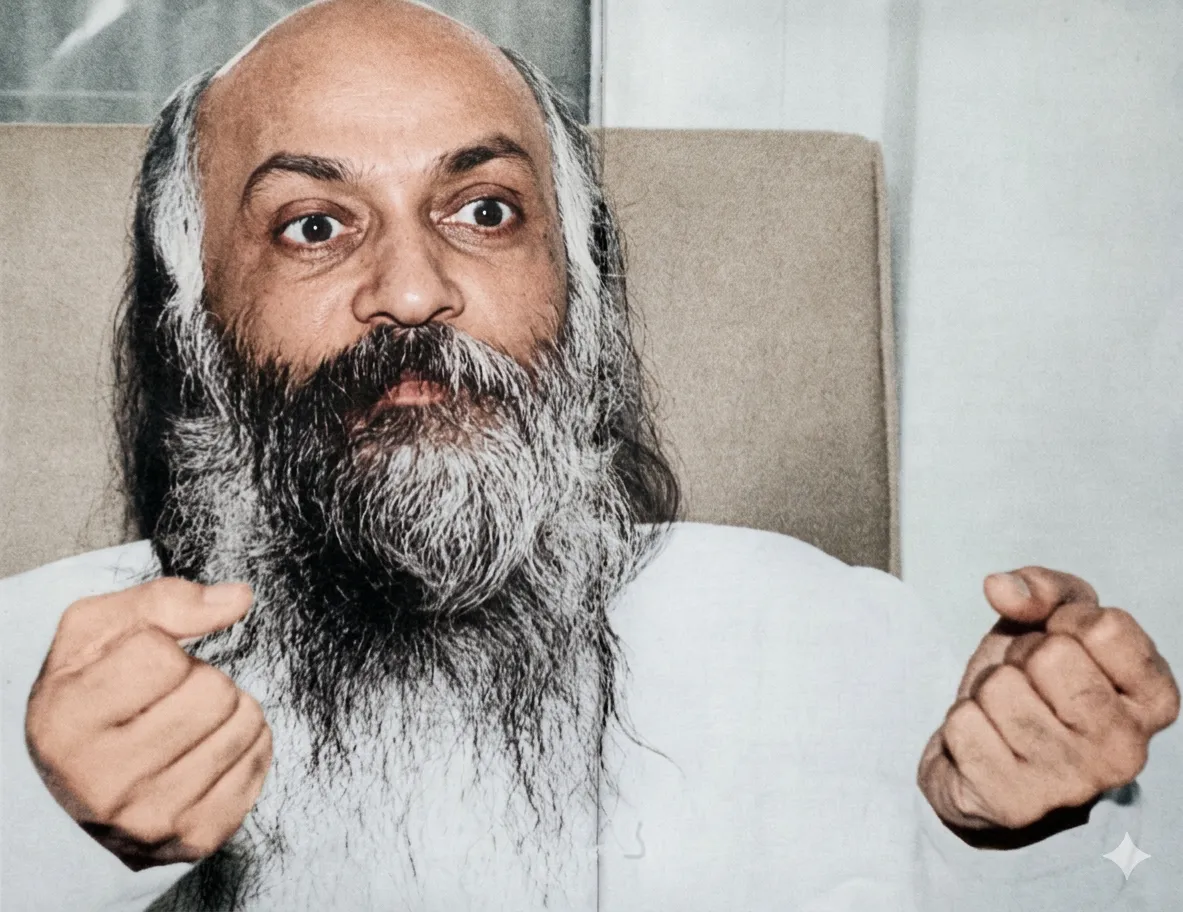
There’s nothing magic about 48 minutes—just pause for a short moment and be still.
From the Discourses
Passages where Osho speaks to this question — each links to the complete discourse.
Osho, just one small thing: what’s the significance of the forty-eight minutes in this?
It doesn’t mean anything. It doesn’t mean anything. Here it’s not a matter of minutes at all; just pausing for a while is enough.
Beloved master, can a person meditating an hour a day gain enlightenment in this life?
It has been found by all the great meditators of the world that just forty-eight minutes, exactly forty-eight minutes, are enough to make you enlightened. But to meditate for forty-eight minutes - I'm not even making it sixty, I'm giving you the exact time - is not an easy thing. Even to meditate for a single minute, a whole single minute, sixty seconds, is a difficult thing - but not impossible. You can try it to check. Just put a small watch in front of you with a second hand, and start looking at the second hand the moment it moves from twelve. Just keep watching the second hand and see how long you can manage watching it. At the most, somewhere between ten to twelve seconds you will have missed, you will have gone somewhere else. And by the time you come back, a few seconds are lost, the…
Another friend has asked: Osho, what is the relationship between the method of meditation and jati-smaran (recollection of past lives)?
But the one who becomes skilled in this—who can fully awaken any day’s memory up to the age of five—will find that the memories begin to awaken completely. And you should test it. As today passes, note down some events and lock them up. After two years, try to recall today. Most of it will have been forgotten. Then remember—and after remembering, break the lock and compare whether what you recalled matches what you had written. You will be amazed—astonished—that besides what you wrote, many more details have come back which you did not even note at the time. They will all be there in memory. Buddha called this alaya-vijnana. There is a corner of the human mind he called the storehouse of consciousness. Like a junk room in the house where we keep all the odds and ends, there is a storehouse that collects memories—where everything from birth after…
A friend has asked: Osho, monks, renunciates, yogis have attained meditation by sitting in caves for years. And you say that meditation is possible even in forty minutes. Is meditation really that simple?
After the three stages, the last ten minutes are only waiting. We can do nothing more. A man can only leave himself open for the divine. Can we drag “Him” in? How? Can we grasp “Him” in our fist? At most we can send an invitation and wait. The sun rises outside the door; we can leave our door open and say, “Come in”—we cannot bring the sun in. If the door is open, the sun comes. Note a strange fact. We cannot bring the sun in—but we can keep it out. Close the door. Not only that; we carry a small pair of doors in our pocket—our eyelids. The door may be open, but if we close our eyes, what can the sun do? Close these tiny shutters and the sun is helpless. Negativity we have in abundance. Negatively, we can block the divine; positively, we cannot compel it.…
Osho, the stream of the timeless is what Lord Buddha called a muhurta for a fleeting instant, and you call the same thing the present. This too makes sense to me, and yet it remains beyond my understanding. But even from this little understanding the joy that arises fills me with gratitude. Osho, I come to your refuge.
All those who have known, all who have awakened, have said one thing with certainty: truth is outside the stream of time—timeless, beyond time. The world is within time—or say, whatever is within time is the world; whatever is outside time is liberation. You can gather a few glimpses of this in your own life now and then. Consider: when you are unhappy, time seems long. When pain becomes intense and your very life writhes in suffering, time grows lengthy. The clock’s pace remains the same; the clock does not see your pleasure and pain, it knows nothing of them. It moves at its own rhythm, yet an hour passes as if centuries are passing. Whoever has known sorrow has known the long stretch of time; time becomes longer and longer. A loved one is dying, and you sit by their cot through the night; the night becomes so long…