
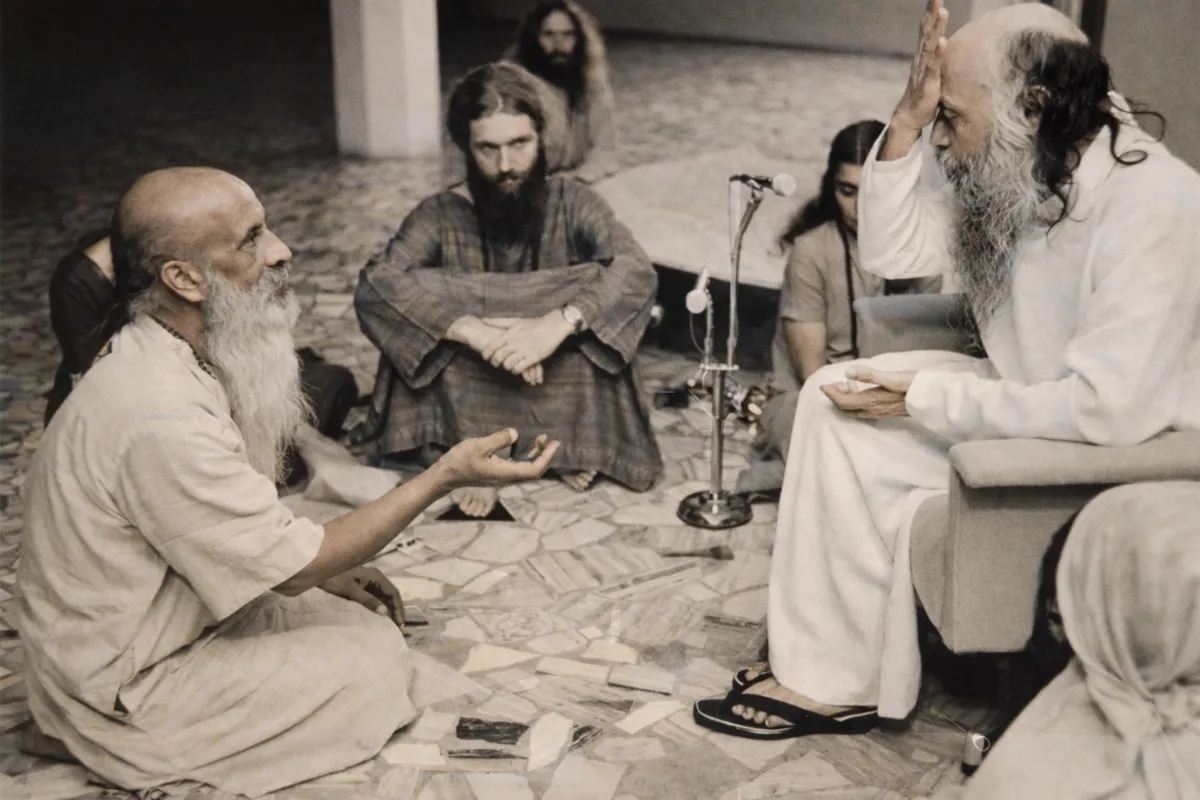
According to Osho, you don’t need a clock: rely on your inner biological watch. Set a clear intention for the session’s length and simply estimate; within five to ten days your sense of timing stabilizes. Minor variance (eight or twelve minutes for a ten-minute sit) is harmless. Practice rekindles trust in the natural inner rhythm that wakes, eats, and meditates on time.
Forget the clock—decide your time, sit, and your body-mind will learn to end the meditation roughly on time by itself.
From the Discourses
Passages where Osho speaks to this question — each links to the complete discourse.
A friend has asked: Here you keep time for us, so we know when ten minutes are up; at home, how will we know?
It doesn’t matter. Whether it turns out to be eight minutes or twelve instead of ten, there is no difference. Continue by estimation. In five or ten days your estimate will become steady. Our difficulty has arisen because we have made false substitutes; therefore the inner clock is not able to function. Otherwise, there is a biological watch within, and it does work. Why do you start feeling sleepy at eleven or twelve at night? If you get up at six in the morning, or at four, why does sleep break then? If you eat at twelve or one, why does hunger come exactly at one? What is the reason? There is a biological time; inside, a natural process is going on. Just as seasons change—there is no clock and no calendar anywhere—yet they change on time. Evening comes, morning comes; the sun rises and sets on time. In the…
A friend has asked: In the fourth stage, ten minutes feel far too short.
Whoever truly enters meditation will find them far too short. Whoever does not will find them far too long. Both kinds of people are here. One who does not enter will feel, “Who knows how these ten minutes became so long!” One who does enter will feel, “It just began, and it is already over.” Because time contracts with our joy. Time is not something real. Time depends on our experience; it is conditional. The more happiness there is, the shorter time becomes. The more suffering there is, the longer time becomes. The hands of the clock keep moving as they do, but there are the hands of the heart as well, and with joy and sorrow their speed changes. When you are happy, a moment flies like the wind. When you are unhappy, even a moment sits like a stone and won’t budge. So for those to whom meditation…
Within three, four minutes you will feel that the body has relaxed; the breathing has come into a rhythm. Then with each outgoing breath, simply say, 'Osho' inside; not very loudly -- just a whisper, but inside so that you can hear it. When the breath comes in, just wait. When the breath goes out, you call, and when the breath comes out, allow me to come in. Don't do anything -- simply wait; so your work is only when the breath goes out. When the breath goes out, go into the universe. The outgoing breath is almost like dropping a bucket into a well. And when the breath comes in, it is like the bucket being pulled out of the well. This is only for twenty minutes. So four, five minutes to get into it, and then twenty minutes to remain in it.
YOU HAVE BEEN DOING THE MEDITATIONS VERY COURAGEOUSLY HERE. Back home, you may feel alone. But don't feel it as a loneliness. If you are ready, I can help you there also. Just remember me, feel my presence, and then meditate. Space, distance, is meaningless if there is love. You may be sitting just by my side and there may be a distance of miles, thousands of miles. You may be thousands of miles away from me, but if there is love, the distance disappears; you are right by my side. Love is nearness, love is closeness. Distance in space, or nearness in space, is physical and meaningless. Wherever you are, it makes no difference. If you have a deep love for me, and if you can remember that love and surrender to me, I will be there working with you, within you.
My own statement is this: sin is that which takes a person away from himself; virtue is that which brings him nearer to himself. There is no other meaning to sin and virtue. Keep this in mind. And keep another thing in mind: the awareness of your chitta will gradually increase. Whatever you do, you will do more consciously. You did it yesterday too, the day before as well, but not so consciously. If you eat, you will eat consciously. If you speak, you will speak consciously. If you walk on the road, you will walk consciously. An awareness, a wakefulness, will go on increasing. And thus the first difference will appear: the more awareness grows, the harder it becomes to err. How can a man full of awareness get angry? How can a man full of awareness quarrel? How can a man full of awareness steal?