
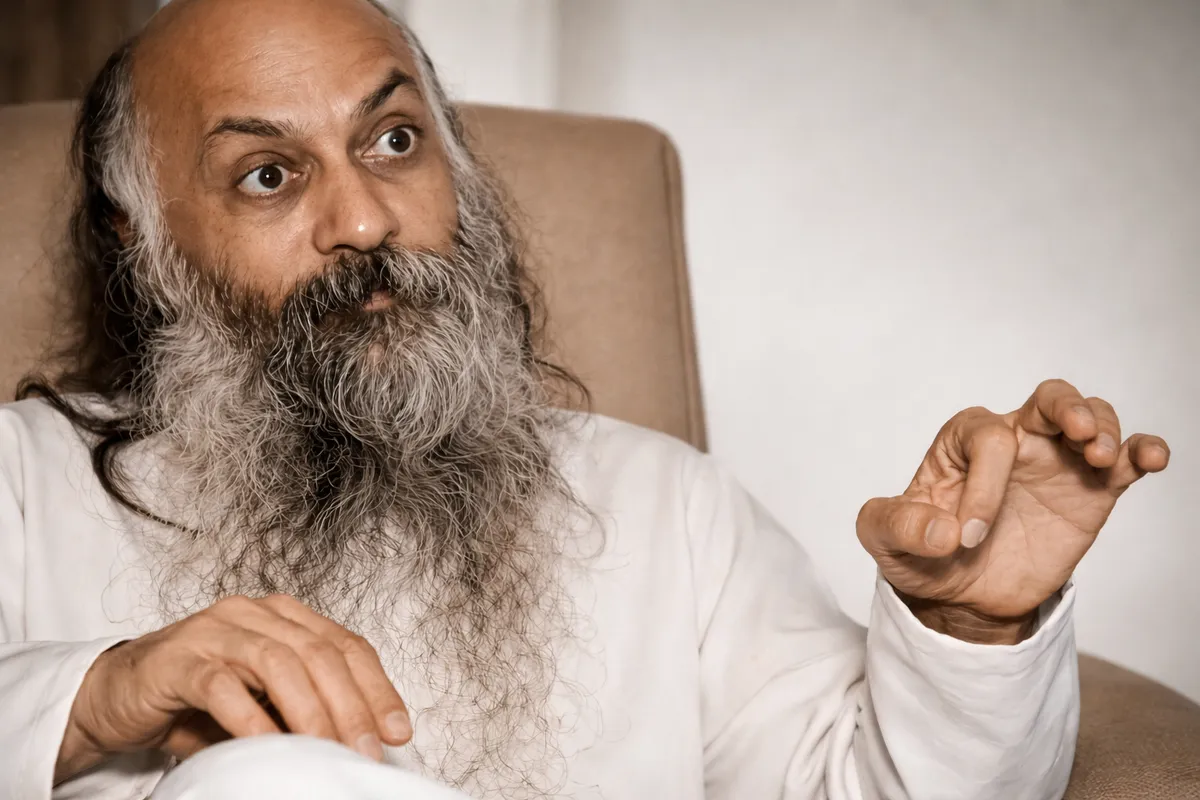
Krishna was born because his parents loved each other so deeply and consciously that their spirits met, not just their bodies.
From the Discourses
Passages where Osho speaks to this question — each links to the complete discourse.
Osho, in the incarnation of Rama, just as Ahalya’s stone‑like personhood waited for Rama and, from stone, Ahalya was restored, the Bhagavata also mentions that in Krishna’s incarnation Lord Krishna had union with Kubja. That may have been his biological need, but does it carry a spiritual meaning as well? What is it? Please clarify.
Not everything in life happens all the time; there are moments one must wait for; there is time whose coming must be watched for; there are occasions for which one has to pause. It is necessary to see this in many, many dimensions. A woman lying there like a stone... No, I would say she must have become stone; becoming stone is the poet’s imagination. But a woman who will blossom only through Rama—and only by Rama’s touch—will remain stone until Rama meets her. It is not that someone was literally lying there like a rock. That is the poet’s device, a way of speaking, his metaphor. But a woman who can bloom and become alive and conscious only through Rama’s touch—anyone else’s touch will leave her inert. The heart of the story is just this: each person has their own waiting. Each has their own awaiting. And until the…
ओशो, रामावतार में जैसे अहिल्या का शिला-व्यक्तित्व राम का इंतजार करता था और शिला में से अहिल्या हुई, इसी तरह भागवत में उल्लेख है कि कृष्णावतार में भगवान कृष्णचंद्र का समागम कुब्जा के साथ हुआ। तो वह उसकी बायोलॉजिकल नीड तो होगी, लेकिन क्या उसका कोई स्प्रिचुअल अर्थ घटाते हैं? वह क्या है, उसे जरा स्पष्ट करें।
जीवन में सभी कुछ सभी समय घटित नहीं होता है; क्षण हैं, जिनके लिए प्रतीक्षा करनी होती है; समय है, जिसकी राह देखनी होती है; अवसर हैं, जिनके लिए रुकना पड़ता है। बहुत-बहुत आयामों में इस बात को देखना जरूरी है। पत्थर की तरह पड़ी हुई कोई स्त्री...नहीं मैं कहता हूं कि पत्थर ही हो गई होगी, पत्थर हो जाना कवि की कल्पना है...लेकिन, कोई स्त्री जो राम से ही खिल पाएगी और राम के स्पर्श से ही खिल पाएगी, जब तक राम न मिलें तब तक पत्थर ही रहती है। ऐसा नहीं है कि कोई शिला की तरह पड़ी थी। वह तो कवि की व्यवस्था है, सोचने के ढंग हैं, और कवि के मेटाफर हैं। लेकिन जो स्त्री राम के स्पर्श से ही खिल सकती है और जीवंत हो सकती है और चेतना पा सकती है, कोई किसी और का स्पर्श उसे जड़ ही छोड़ जाएगा। कहानी का मर्म इतना ही है कि हरेक की अपनी प्रतीक्षा है। हरेक की अपनी अवेटिंग है। और क्षण आए बिना वह घटित नहीं होती है। जो पत्थर की तरह पड़ी थी, पत्थर ही हो गई थी...
Osho, Krishna’s relationship with Draupadi would have been platonic love. Now, the Bhagavata mentions—and when we spoke in Ahmedabad about Krishna you said—that even though the seed was expended, the union of Vasudeva and Devaki was a spiritual union, and that is why we received Krishna. But Krishna had sixteen thousand, or the eight principal queens—however one may put it—and the relationships he had with them; yet the sons of both Krishna and Rama were not so gifted. From this, can it be concluded that Rama or Krishna did not have spiritual intercourse with their wives at all?
Two things should be understood here. First, by “spiritual intercourse” I do not mean that I am condemning physical intercourse. By spiritual intercourse I simply mean that not only the bodies of two persons have met; their souls have met as well. What is born of the meeting of bodies cannot attain the heights that what is born of the meeting of souls can attain. I regard Krishna’s birth as the fruit of spiritual intercourse; I regard Christ’s birth the same way. That is why those who understood Christ could say that Christ was born and yet Mary remained a virgin, remained a maiden—because on the bodily plane there was no lust and no deep desire. The union happened on the plane of the soul; the body followed like a shadow. Hence the shadow bears no responsibility. But your question is certainly important: then what of the children of Krishna…
ओशो, द्रौपदी के साथ कृष्ण का संबंध प्लेटोनिक लव रहा होगा। अब भागवत में एक ऐसा उल्लेख है कि वसुदेव और देवकी--जो कृष्ण पर अहमदाबाद में हमने बात की थी, उसमें आपने बताया था कि शुक्र का विनियोग होते हुए भी वसुदेव और देवकी का जो संभोग हुआ था वह आध्यात्मिक संभोग था, जिसकी वजह से कृष्ण हमें मिले। मगर कृष्ण ने सोलह हजार या अष्ट पटरानी जो भी कहें, उनके साथ जो उनका संबंध था, तो कृष्ण के और राम के दोनों के पुत्र ऐसे प्रतिभावान नहीं हुए, इससे क्या यह नतीजा निकल सकता है कि राम या कृष्ण ने आध्यात्मिक संभोग अपनी पत्नियों के साथ किया ही नहीं?
एक तो आध्यात्मिक संभोग का यह अर्थ नहीं है कि मैं शारीरिक संभोग की कोई निंदा कर रहा हूं। आध्यात्मिक संभोग से मेरा सिर्फ इतना ही अर्थ है कि दो व्यक्तियों के शरीर ही नहीं मिले हैं, आत्मा भी मिली है। शरीर के मिलन से जो पैदा होता है, वह उन ऊंचाइयों को उपलब्ध नहीं हो सकता, जो आत्मा के मिलन से पैदा होता है और ऊंचाइयों को उपलब्ध होता है। कृष्ण का जन्म मैं आध्यात्मिक संभोग का फल मानता हूं। क्राइस्ट का जन्म भी आध्यात्मिक संभोग का फल मानता हूं। इसीलिए क्राइस्ट को जानने वाले लोग यह कह सके कि क्राइस्ट का जन्म भी हो गया लेकिन मेरी वर्जिन बनी रही, कुंआरी बनी रही। क्योंकि शरीर के तल पर कोई वासना और कोई गहरी कामना न थी। आत्मा के तल पर मिलन हुआ था, शरीर छाया की तरह उसके पीछे गया था। इसलिए छाया पर उसकी कोई जिम्मेवारी नहीं है।
Questioner; legend has it that ahilya, a woman turned into stone, had waited long enough for the coming of rama to resurrect her, and that another ordinary woman, kubja, persuaded krishna to make love to her. Do these stories have some spiritual significance?
Everything in existence happens in its own time, a time for which one has to wait with tremendous patience. Everything has its season; nothing happens out of season. Time and occasion have great importance in life. And it is necessary to go into it from different angles. I don't believe that Ahilya had actually turned into stone; this is just a poetic way of saying that she lived a stony life, a dull and dreary life until she met Rama whose love transformed her life. It is possible a woman will come to her flowering only through a particular man like Rama, and that she will patiently wait for such a man to come into her life. It is a poetic metaphor to say that Ahilya had turned into stone. It means to say that with the right opportunity, with real love, even stone comes alive. It also says that…
Questioner: you said in the course of a discussion of krishna at ahmedabad that the intercourse that vasudeo had with his wife devaki was not just sexual, but was a spiritual intercourse and that is why a person like krishna was born. In view of it one wonders why the sons of rama and krishna were not as talented and brilliant as their parents. Can it be said that rama and krishna did not have spiritual intercourse with their wives?
In this connection, two things have to be understood. When I talk of spiritual intercourse between two lovers it does not mean that I am condemning sexual intercourse. By spiritual intercourse I mean that when two persons, a man and a woman, make love, they meet not only on the physical plane but at the spiritual level too. A child born out of mere physical coitus cannot reach to that height of excellence one born out of spiritual intercourse can. I take Krishna to be a child of spiritual intercourse. That is why people who knew Jesus could say that his mother Mary remained virgin even after giving birth to Jesus. Though Mary and Joseph must have made love physically, it is true that the intercourse was much more spiritual than physical. Their desire for sex was not that strong. The physical part of it was like the shadow of…
Osho, what are the factors that make a womb worthy of the descent of a higher soul, or only of an inferior one? What preparations are needed so that a noble soul can enter the womb? How should they be done? And what particular characteristics did the wombs in which Buddha, Mahavira, Krishna, and Christ were born have, compared to ordinary wombs?
There are many yogic postures that create specific pressures, many breathing processes that do the same, and many sound intonations that apply particular pressures. All of these support the child’s talent, health, capacities, and possibilities to manifest fully. So far, man keeps discovering countless troublesome things, but what is truly needed—that man discover his own future—very little search is happening there. Yet all this is entirely possible. As soon as a child enters the mother, glimpses of that child’s possibilities begin to arise in the mother. It is a two-way process. If the mother becomes angry during these days, the child will be prone to anger; and if an angry soul has entered, a mother who never used to be angry will find anger arising. This too is very indicative, and seeing such indications experiments can be made to transform that child’s anger from the seed itself. Even today there…
ओशो, क्या-क्या बिंदु हैं जो गर्भ को श्रेष्ठ जीवात्मा के आने योग्य या निकृष्ट जीवात्मा के आने योग्य बनाते हैं? श्रेष्ठ आत्मा गर्भ में उतर सके, इसके लिए क्या-क्या तैयारियां करनी पड़ती हैं? कैसे करनी पड़ती हैं? और बुद्ध, महावीर, कृष्ण और क्राइस्ट जैसे लोग जिस गर्भ में आए, उसकी क्या-क्या विशेषताएं थीं सामान्य गर्भों की तुलना में?
… वे सब बच्चे की प्रतिभा को, स्वास्थ्य को, उसकी सामर्थ्य को, उसकी संभावनाओं को पूरा का पूरा प्रकट होने में सहयोगी बनते हैं। अभी तक आदमी और सब न मालूम कितने उपद्रव की चीजें खोज रहा है, लेकिन जो बहुत जरूरी है कि मनुष्य अपना भविष्य खोजे, वह बहुत कम खोज रहा है। लेकिन यह सब एकदम संभव है। और जैसे ही एक बच्चा मां के भीतर प्रवेश करता है, तो उस बच्चे की क्या-क्या संभावनाएं हो सकती हैं, उसका परिदर्शन मां में भी होना शुरू हो जाता है। यह दोहरी प्रक्रिया है। अगर मां क्रोध करती है इन दिनों में, तो बच्चा क्रोधी होगा। और अगर एक क्रोधी आत्मा भीतर आई है, तो मां जो कभी क्रोध नहीं करती थी, क्रोध करती मालूम पड़ने लगेगी। यह भी बहुत सूचक है। …