
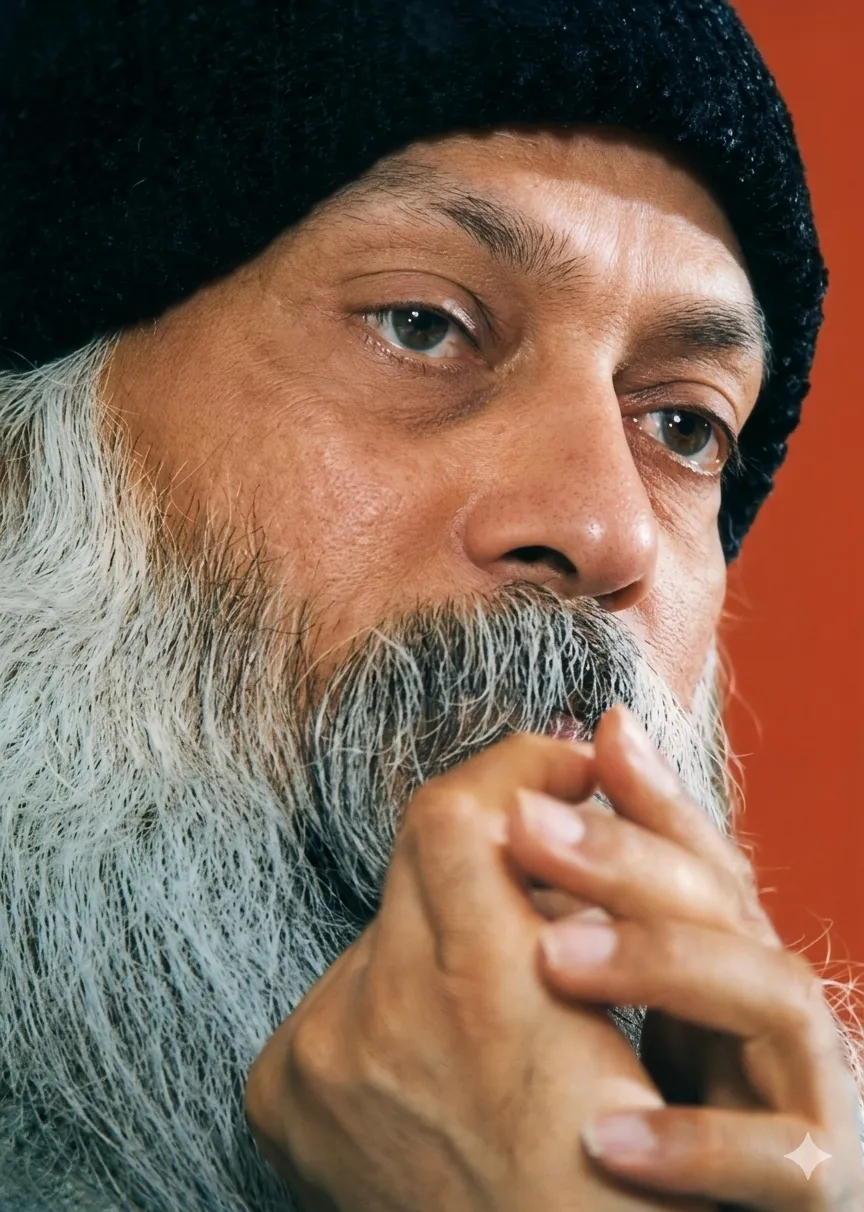
If you avoid blowing things up or taking sides, your mind calms down and can see what’s true.
From the Discourses
Passages where Osho speaks to this question — each links to the complete discourse.
Many scholars of the East and the West have offered countless explanations, trying to draw the thin line between understanding and exaggeration. Even Kahlil Gibran went so far as to say that exaggeration is the dead body of understanding. Cruelty is the outcome of the antithesis of love—the coward’s escape. If I may say so, sir, it is non-vision—or non-understanding—that brings all the brutalities and chaos in society. Would you please shed light on this aspect of life?
In this regard, two things must be understood. It is true that all the chaos of life, all misery, all cruelty is the fruit of unknowing—of ignorance. And ignorance runs deep. The greatest reason why ignorance deepens, or knowledge arises, is the absence of a centered mind—standing at a point between two extremes. Exaggeration is an extreme. And truth is never at the extremes. Like a clock’s pendulum swings from one end to the other and does not pause in the center, our mind too keeps swinging from one extreme to the other. It never stops where there is no excess—where there is the middle. Only a mind that has come to rest in the middle attains knowledge. A mind swaying on the extremes never does. First: the one who keeps oscillating from one extreme to the other can never be still, because it is impossible to stay at an…
Question: OSHO, WHAT IS UNDERSTANDING AND WHAT IS MISUNDERSTANDING? That's the difference here. I am not telling you Hinduism is right or Christianity is right or Judaism is right. I am simply telling you mind is wrong and no-mind is right. Now, no-mind cannot have any adjective: it cannot be Hindu, cannot be Mohammedan, cannot be Christian. Mind can have an adjective. Mind will have an adjective, is bound to have an adjective. It will have a certain definition, a certain limitation. No-mind is vast like the great space; it is void, it is clear. It is clarity, it is transparency. But we all live in our prejudices because we are all past-oriented. Whatsoever had been taught to us we go on repeating, whatsoever has been told to us we will go on telling to our children. That's how diseases are transferred from one generation to another generation.
Osho, you say the same thing in countless ways. But when I listen to you, it feels as if I am hearing it for the first time. And I feel so much joy that I don’t feel like going back home. What should I do—what can I do—so that I can just keep listening to you!
You will feel as if you have been made to rise out of season, before time—as if you were not yet to go and yet had to go. And if you go in that way, your home will become even more desolate than before. I do not want to make your home desolate; I want to make your home a temple. I want that when you go home, your home’s new form is revealed. I do not want to tear you away from home, from the world, from family life. That is the newness of my sannyas: I do not want to sever you from the world; I want to join you to the world in such a way that your connection with the world becomes a connection with the Divine. Let the world no longer be a barrier between you and the Divine; let it become a means. If…
Osho, Lao Tzu says, nothing needs to be done; understanding is enough. Explain when and how understanding becomes being?
Your inner attachments to anger are intact. You have not yet seen anger’s poison. For if poison is seen, you won’t say, “Granted, it is poison, but to reform the child a little dose may be given.” Who gives poison to reform anyone? Has anyone ever been improved by poison? Has any child ever been improved by anger? You know the truth: he can be spoiled, yes; he is never improved by anger. Has any order ever been truly established by anger? It may be disturbed—that is likely; how will it be created? And even if some order is produced by anger, it will be deception, false. If your wife becomes quiet out of fear of your anger, that quiet is not peace; inside her fire will go on burning. From such quietness no love can be born. She may become your slave, but not your beloved. And a slave…
Osho, it is your own saying: Understanding is necessary but not sufficient. The intellect certainly has a small island that is lit, but that island lies in a half-lit sea. And that half-lit sea lies in a completely unlit ocean. Would you kindly shed light on this statement?
This infinite expanse of sky is what Buddha called emptiness—shunyata. That very emptiness is what the Upanishads call Brahman. To become one with these infinite skies, Buddha called nirvana. That nirvana is what other awakened ones have called moksha, liberation. The intellect is a very small thing. If you try to understand the whole of life with intellect alone, you impose very narrow boundaries on existence. Because of your narrow boundaries, you will be deprived of existence itself. The intellect is useful; use it. Use it to go beyond it. Make it a ladder; climb it. Use it as a springboard to leap. What fault had the sanctuary in being surrounded by a wall? If spaciousness could not be born within limits, what is the fault? What fault is it of the temple? What fault of the mosque? They are enclosed by walls. What fault of the Kaaba? What fault…