
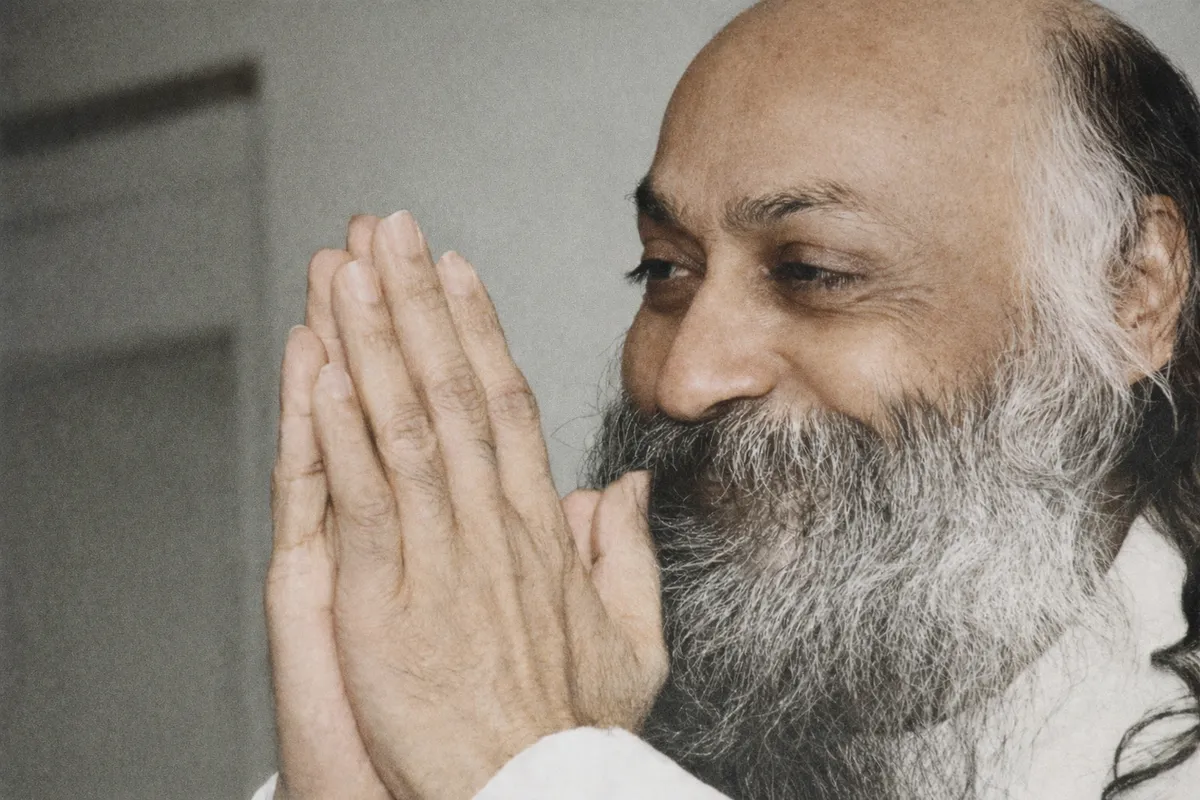
Try your very best until nothing works, then letting go happens by itself and awakening appears.
From the Discourses
Passages where Osho speaks to this question — each links to the complete discourse.
Beloved Osho, to break our habitual ways of acting, feeling and thinking, and to start witnessing instead, some effort seems to be required. But ultimately all effort, including the effort towards enlightenment, has to be dropped. Can you please speak on effort and non-effort, and how they relate to witnessing?
Don't be bothered about the future. You have not started making an effort, and you are worried that ultimately you will have to drop making an effort also. Just start -- make every effort. I can only say one thing to you: when you have made every effort -- and all the efforts will fail, as far as the ultimate experience of enlightenment is concerned -- when all the efforts fail, you are not required to make no-effort. When all the efforts fail, there is no-effort. You have done everything that was possible, humanly possible, and everything has failed. And everything fails as far as enlightenment is concerned. It is not your doing. But when everything fails, and you have not been miserly in making efforts, you were total -- what remains? A great silence. That is the no-effort. You don't have to do it. If you do it, it…
Beloved Osho, are there really discrete stages on the way to the ultimate happening, as this upanishad seems to suggest, or does this happening occur suddenly and unexpectedly? Is it a matter of long conscious effort, or of a sudden total surrender to existence?
So this Upanishad is dividing, not because divisions are there, but because you will not be able to understand the whole. The whole will be too much, too complex. The whole will be incomprehensible, and understanding will not be possible. That's why the division into seven stages, and that's why there are so many divisions. You can divide in fourteen, you can divide in seventeen -- you can divide into as many as you like. And theologicians go on fighting about these divisions. They are workable, utilitarian -- not existential. Just feel your body, close your eyes and feel. Where are the divisions? It is one. But if your eyes are not functioning well you will go to the eye specialist. And you know that eyes are not separate, they are one with the body, so then why go to the eye specialist? You can go to any doctor. The…
Beloved Osho, is it possible to become enlightened in a really easy and relaxed way, with not too much effort and lots of naps?
Gayano, you are asking me, a man who has never done anything. Just through relaxation ... without any effort and lots of naps! Mostly I am asleep. I just get up to talk to you in the morning, then I go back to sleep; then I get up again in the evening to talk to you and go back to sleep. My total hours of sleep must be eighteen. Six hours I am awake, two hours with you, one hour for my bath, for my food and the remainder I am in absolute samadhi. And I don't even dream -- so lazy! And you are asking me the question. This is my whole philosophy, that you should not make any effort, that you should relax and enlightenment comes. It comes when it finds you are really relaxed, no tension, no effort and immediately it showers on you like thousands of…
Osho, I have heard that enlightenment, or the natural state of man, is something acausal -- it just happens. And all our endeavours to bring about awareness, to be aware, are actually taking us away from this state since they are all mind games, and these activities for self-awareness are just a "holy business". I cannot imagine what my life would be if I gave up the search since it has permeated my life as long as I can remember. If there is no way to integrate, nothing one can do, why all this activity? Why bother? Yet what else is there to do? Please comment.
It happens only to those who are not holding anything back, when you have put all that you have at stake, when nothing is left behind, when you are utterly empty, you have emptied yourself totally, and it is not happening, then the understanding arises, "My efforts are futile. My efforts are ego efforts -- the ego is futile. My efforts are my own mind games. The mind itself is the barrier." But this has to become your own experience, Samadhi. It is not going to help if you have heard it. You can hear great truths, but unless they arise in your own being they are not true. A heard truth is a lie: only an experienced truth is a truth. And only the experienced truth liberates. How will you experience it? You would like to have it without any efforts. You would like it to happen as it…
in fact a relaxed person can move can make better effort and a man of efficient effort can be better relaxed there is no intrinsic contradiction the contradiction exists only in words, language and in the mind the experience of bliss is one of the most paradoxical paradoxical in the sense that you have to manage two logical contradictions together you have to be effortlessly effortful because both effort and relaxation are needed for the experience to happen but it can be managed because the contradictions are only superficial deep down they are complementaries one should try a few experiments for example, you can run: there is effort but still you can remain very relaxed you can bicycle: there is effort but at the same time your whole body can remain very quiet calm and relaxed you can move your hand: there is effort but you can move the hand…