
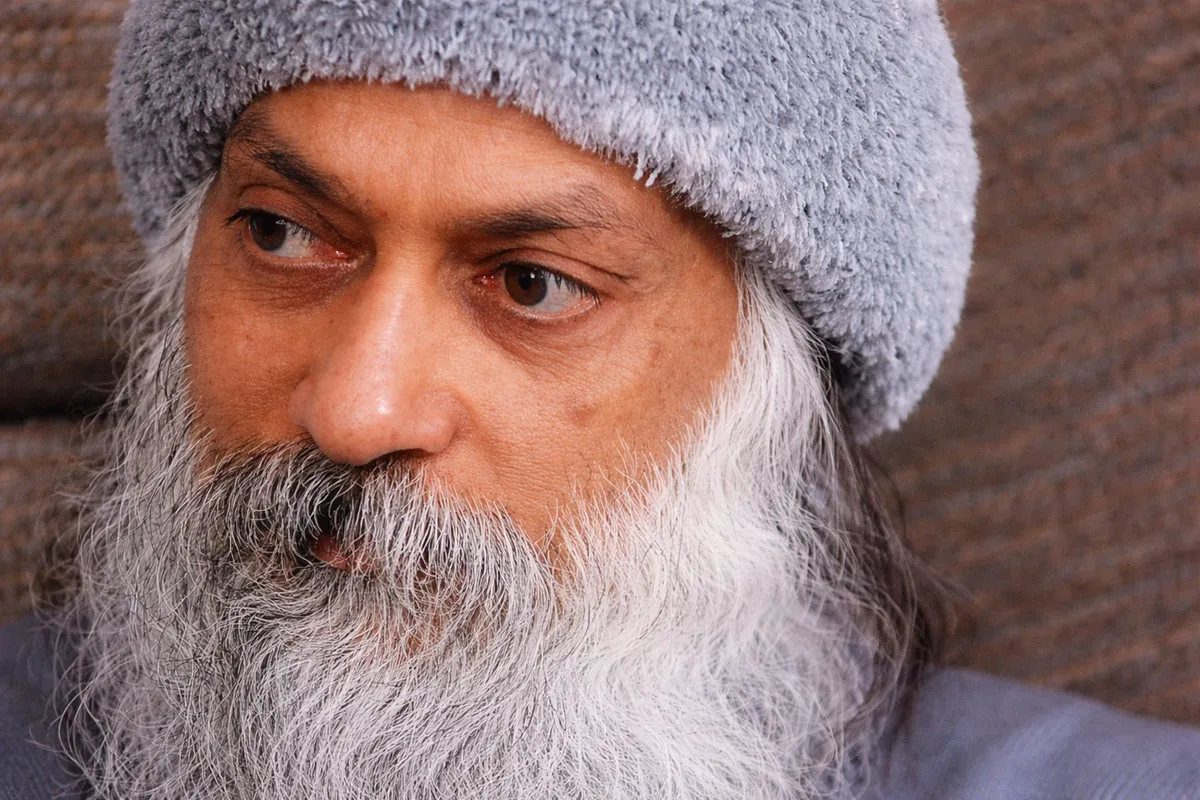
Don’t strain to focus; just relax and look openly, and your mind stays healthy and peaceful.
From the Discourses
Passages where Osho speaks to this question — each links to the complete discourse.
[NOTE: This is an unedited tape transcript of an unpublished darshan diary, which has been scanned and cleaned up. It is for reference purposes only.] [Osho spoke about the difference between meditation and concentration. In the past the two have been thought to be synonymous, and they are not.] Not only are they not synonymous, they are absolutely opposite dimensions. They never meet anywhere, they never cross each other's path -- different worlds altogether. Concentration is something within the mind and meditation is something beyond the mind. Concentration has its own utility. If you are working on a scientific project then concentration is needed; then you have to focus all your mind-energy on a single point.
First: meditation. Second: by meditation I do not mean concentration. As you may have heard—concentration is a taut mind. If you force the mind, it will stretch, tense. After tension there will be a certain sadness, fatigue. Naturally—whenever you do a strained work—there will be backlash. From strain, the mind becomes disturbed. Those who do concentration become tight, taut people. They do not remain simple; they become more complex, more knotted. You must have seen—someone begins turning a mala, or chanting Rama-Rama—he becomes more irritable. Someone sits in a temple and concentrates before an idol—he becomes more angry, more violent, more harsh; his ego becomes denser. Naturally—these are the consequences of concentration. If concentration is taken too far, a man can even go mad. If the mind is stretched so far that the brain’s nerves begin to snap—he goes mad. Thousands of madmen... This is not divine ecstasy.
Beloved Osho, how are one-pointedness, concentration and meditation related to each other?
Prem Dinesh, one-pointedness, concentration and meditation are not related to each other at all. This is one of the confusions prevalent all over the world. One-pointedness is another name for concentration, but meditation is just the opposite of concentration. But in most of the books, in most of the dictionaries, and by the so-called teachers, they are used as if they are synonymous. Concentration simply means one-pointedness. It is something of the mind. Mind can be a chaos, a crowd. Mind can be many voices, many directions. Mind can be a crossroads. Ordinarily, that's what mind is, a crowd. But if the mind is a chaos, you cannot think rationally, you cannot think scientifically. To think rationally and scientifically, you have to be concentrated on the object of your study. Whatever the object is, the one thing necessary is that you are pouring your whole mental energy onto that object.…
The official, riko, once asked nansen to explain to him the old problem of the goose in the bottle. "if a man puts a gosling into a bottle," said riko, "and feeds him until he is full grown, how can the man get the goose out without killing it or breaking the bottle?" nansen gave a great clap with his hands and shouted, "riko!" "yes, master," said the official with a start. "see," said nansen, "the goose is out!"
To carry fantasies about the future is a problem. A passport is not such a burden. To think about tomorrow and to go and book a ticket is not a problem. These are factual things, ordinary, practical things. But to think that tomorrow you will be happy, not today, that tomorrow you will love, not today, that tomorrow you will sing, not today, is dangerous -- because tomorrow never comes. Again when it comes, it will be today, and your old habit will say, "Tomorrow I will be happy." Tomorrow again and again, you will be happy, and you will never be happy. What I am saying is psychological future has to be dropped. The ordinary future is okay, it is not a problem at all. The fifth layer consists of conditionings. You have been conditioned -- Hindu, Mohammedan, Jaina, Buddhist, English, German, Indian -- these layers are there. Start…
One winter day, a masterless samurai came to eisai's temple and made an appeal: 'I'm poor and sick,' he said, 'and my family is dying of hunger. Please help us, master.'
DEPENDENT AS HE WAS ON WIDOWS' MITES, EISAI'S LIFE WAS VERY AUSTERE, AND HE HAD NOTHING TO GIVE. HE WAS ABOUT TO SEND THE SAMURAI OFF WHEN HE REMEMBERED THE IMAGE OF YAKUSHI-BUDDHA IN THE HALL. GOING UP TO IT HE TORE OFF ITS HALO AND GAVE IT TO THE SAMURAI. 'SELL THIS,' SAID EISAI, 'IT SHOULD TIDE YOU OVER.' THE BEWILDERED BUT DESPERATE SAMURAI TOOK THE HALO AND LEFT. 'MASTER!' CRIED ONE OF EISAI'S DISCIPLES, 'THAT'S SACRILEGE! HOW COULD YOU DO SUCH A THING?' 'SACRILEGE? BAH! I HAVE MERELY PUT THE BUDDHA'S MIND, WHICH IS FULL OF LOVE AND MERCY, TO USE, SO TO SPEAK. INDEED, IF HE HIMSELF HAD HEARD THAT POOR SAMURAI HE'D HAVE CUT OFF A LIMB FOR HIM.' Even if you feel, or you think you feel, or you pretend that you feel, compassion, just go deep and analyze it and you will always find…