
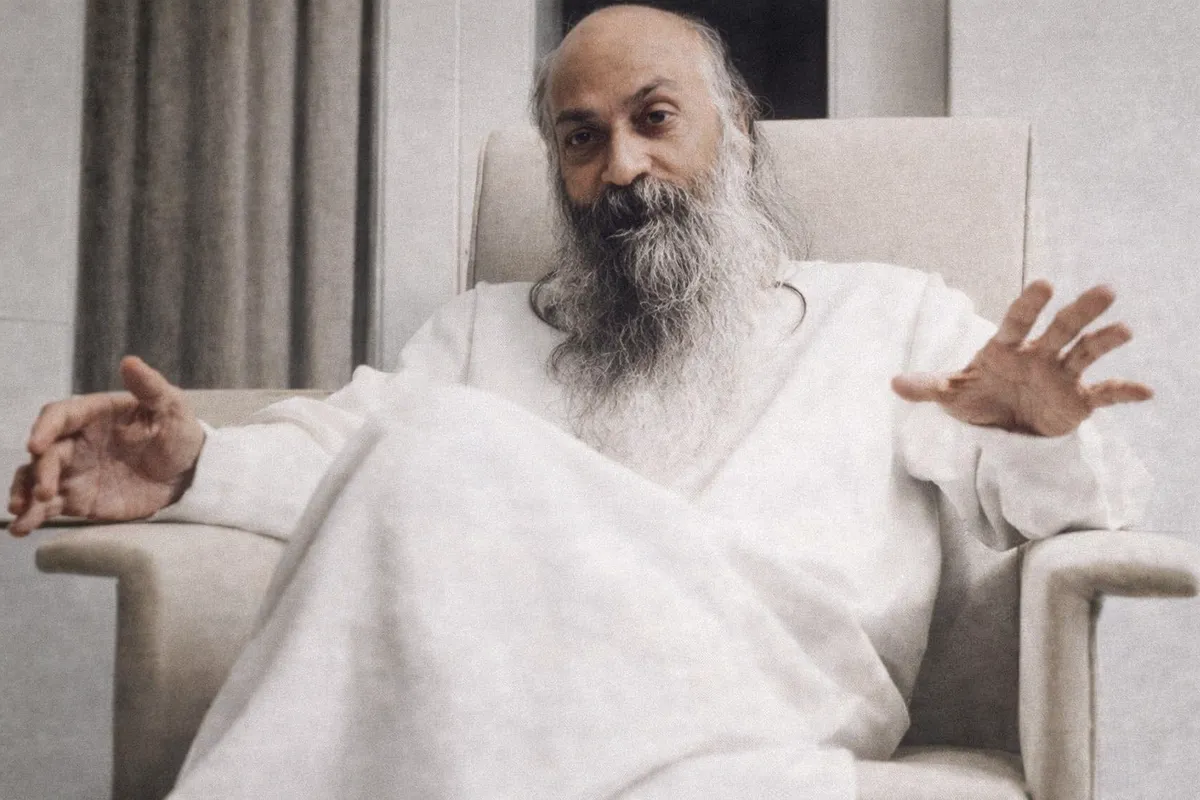
Truth is like a taste—you have to taste it yourself; you can’t truly describe it with words.
From the Discourses
Passages where Osho speaks to this question — each links to the complete discourse.
Why is truth inexpressible? Why can't it be told?
All words are small. All human efforts are limited. And then, it cannot be told straight. It can be communicated straight, but it cannot be told straight -- and that is the difference between a thinker and a meditator. The thinker goes roundabout because he has to go through thought. He searches for the sky through the clouds and gets lost in the clouds, may never reach the sky. The thinker gets lost in thoughts. The meditator starts by dropping thoughts. He starts by dropping thinking itself, and a moment comes when there is no thought: then there is immediacy. Then there is nothing between you and that which is. Then there is nothing at all -- you are bridged with reality. But that is an experience. Whenever you would like to tell that experience to somebody else you will have to use words, out of necessity, and words cannot…
Beloved Osho, what is truth? And whatever it is, why are most people not interested in it?
"Love God" -- I don't know how you are going to love God. You don't know what God looks like. You don't know from where to approach Him, which side is His face. The Indian god has three faces; from all the three sides you can approach him. The Hindu god has thousands of hands; you can hold any. But where are you going to meet these gods with thousands of hands, three heads ...? Just all junk. Nobody knows .... A small child was making a drawing. His father asked him, "What are you doing, so absorbed?" He said, "I am drawing a picture of God." The father said, "A picture of God? But nobody has seen Him, nobody knows how He looks. How can you make a picture of God?" The child said, "Just wait. Let me finish the picture and everybody will know how He looks." All…
Osho, awakened ones, considering place, time, circumstance, and the era-appropriate psychology of people, have expressed the same truth in very different forms. To the point that they appear mutually quite disputatious and even contradictory. Is an absolute expression of the ultimate truths of life and existence not possible? Will the limits of the age and the condition of the people always continue to be imposed upon truth?
Expression will always be limited. Expression will always be relative. The speaker and the listener—both create the boundaries of expression. I will say only what can be said. You will understand only what can be understood. Truth is vast. If I go to see the ocean and you say to me, “On your way back, bring a little of the ocean,” I will not be able to bring the whole ocean. I may bring a little water from it. But in that water much will be missing. There will be no storm of the ocean, no waves. And that was the real ocean: that tumultuous roar and fierce thunder! Waves crashing against cliffs! Those surges rising and spreading for miles! That swell! None of that will be there. I will bring a vessel filled with a little ocean water. Still, there will be something! If you taste it, it will…
Our consciousness is a small lake, a mirror. All that is needed is not a search for truth -- because truth is everywhere, confronting you from all sides; all that is needed is to drop this constant disturbance inside, this constant inner talk, these waves upon waves of thought, this continuous traffic in the mind. When the traffic disappears and the road is empty6, suddenly one knows what truth is. It has always been there, it was just that we were not able to reflect it. In the beginning only moments of no-mind happen, just small intervals. For a second all stops and you can have a glimpse of the truth. But even those glimpses are so enriching, even those glimpses are so transforming; even those glimpses give you a mutation. You start living differently, you start living on a different plane.
Butei, the emperor of ryo, sent for fu-daishi to explain the diamond sutra. On the appointed day fu-daishi came to the palace, mounted the platform, rapped on the table before him, then descended and, still not speaking, left. Butei sat motionless for some minutes, whereupon shiko, who had seen all that had happened, went up to him and said, "may I be so bold, sir, as to ask whether you understood?" the emperor shook his head sadly. "what a pity," said shiko. "fu-daishi has never been more eloquent."
I have heard that Wittgenstein, a great Western philosopher, who comes nearest to the Zen attitude, used to say that he did not solve philosophical problems -- he dissolved them. And he used to say: "We leave things as they are but perhaps for the first time we come to see them as they are." Nothing can be done about things as they are. All that can be done is to help you to see them as they are. "We leave things as they are but perhaps for the first time we come to see them as they are." And again: "Philosophy simply puts everything before us, and neither explains nor deduces anything -- since everything lies open to view, there is nothing to explain." Yes, life is a mystery, and there is nothing to explain -- because everything is just open, it is just in front of you. Encounter…