
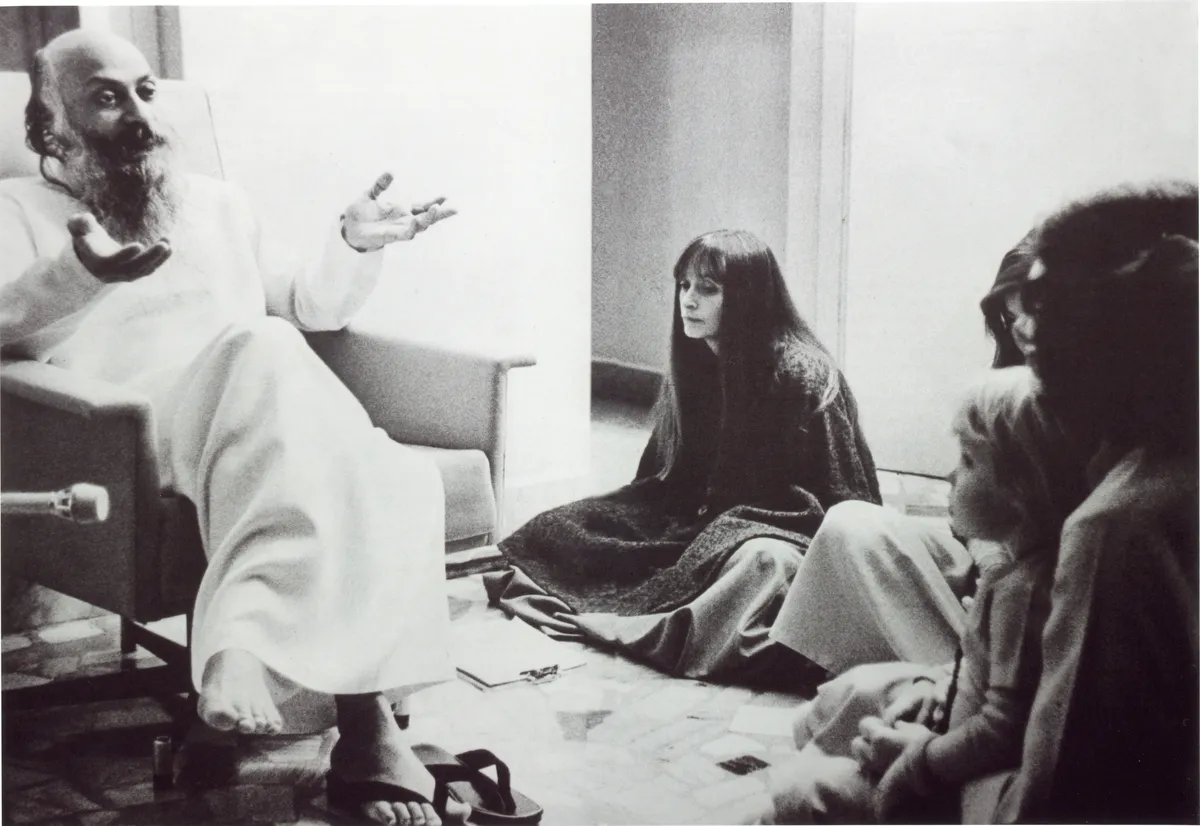
According to Osho, the “joy” most people feel in love is not bliss but brief self-forgetfulness—a narcotic escape from one’s own loneliness, born of mind and lust. True bliss in love is earned through prayer, meditation, and inward depth; only then does love flower as choiceless presence, needing no “other.” When you know yourself, the illusion of the other dissolves, and love becomes a steady, self-sustaining radiance rather than a fevered high.
Being happy with someone is often just forgetting your own loneliness for a bit; real love-bliss comes when you’re full inside through inner practice, so you don’t need another to feel whole.
From the Discourses
Passages where Osho speaks to this question — each links to the complete discourse.
Osho, could you say something about what is going on in Delhi?
I’ll tell a little story. When Lanka’s former ruler Ravana was on his deathbed, Rama sent Lakshman to learn statecraft from him—saying, “Son, we may have won, but we have no experience of running the administration here; go and ask him how to run things.” Lakshman went there and said to Ravana, “You are dying now—tell us how to govern here.” Ravana said, “Half the politics I handled, half Kumbhakarna did. Had you gotten in touch with Kumbhakarna as well?” Lakshman said, “Yes—he said: eat to your heart’s content and then sprawl on the sofa with your eyes closed. This is the best method.” “Tell me,” Ravana asked, “are you going to unleash dictatorship, or will you run things by democracy? Which method will be suitable?” “What will go down well with the people?” “Nothing,” said Ravana. “When you impose dictatorship, the people will yearn for democracy; and when you…
Love makes you less and less material and more and more spiritual. Ultimately love brings you to a point where you are no longer a body but only a soul, just pure energy, vibrating, pulsating, in rhythm with the whole. That's the experience that religions have been searching for down the ages. You can call it God, enlightenment, nirvana, or whatsoever you like, but the experience is of pulsating with the whole; not lagging behind, not pulsating with your own personal rhythm but becoming part of the total so totally that you cannot say "I"; the word "I" becomes irrelevant. You are just a dewdrop falling into the ocean. In that moment bliss arises because you are at peace with the whole, in tune with the whole. This harmony is bliss, this accord is bliss.
To enquire into love is the only purpose of life. Life is an opportunity to enquire into love. People go on accumulating money, power, prestige -- these are the fools. Death will knock at their door any moment and all their money and all their power and prestige will collapse. They came empty-handed and they will go empty-handed. Only a lover goes so full. He comes empty-handed but goes very full, overflowingly full. His death is a celebration; his life is a celebration -- his death is the crescendo of his life. At the moment of death when a man like Buddha or Jesus or Socrates dies, his death is the ultimate in sharing because this is his last moment on earth, his goodbye to existence. He gives totally and in that total giving he receives god as a guest. Buddha has used two words.
Someone has asked—the second question: Osho, yesterday you said that the other can never make anyone happy. But the joy, the bliss, and the sense of awe one experiences when one is immersed in love with a beloved—what is that?
I have heard: Mulla Nasruddin was sitting with a friend. He told his son, “Go to the cellar and bring the bottle of wine.” The boy went and returned. He had poor eyesight and a condition in which one thing appears as two. He said, “Shall I bring both bottles, or just one?” Nasruddin was troubled: there was only one bottle. If he said in front of the guest, “Bring just one,” the guest might think him stingy. If he said, “Bring both,” where would the boy find a second—there was only one. And if he told the guest, “My son sees double,” it would be needless disgrace; he still had to marry the boy off. So he said, “Do this—bring one and break the other. Smash the one on the left and bring the one on the right; the left one is useless anyway.” The boy went and smashed…
That which brings us together sets us apart
For them there is no short-cut. And all that is great belongs to that category. Only small things can be attained quickly. Coffee can be instant -- -- love cannot be. Instant love cannot be love. Instant simply means you are not even ready to pay the little patience for it. One should learn to be patient -- to be ready to wait with open doors, with a welcoming heart, but not in a hurry, not demanding, not forcing things. And the miracle, the paradox, is that the less you force things, the more quickly they happen. The more you force them, the longer it takes. Because meditation has to be learned -- and meditation only means stilling of the mind, the silencing of the mind -- you cannot be in a hurry. If you are in a hurry your mind will remain in a turmoil. You will be jumping…