
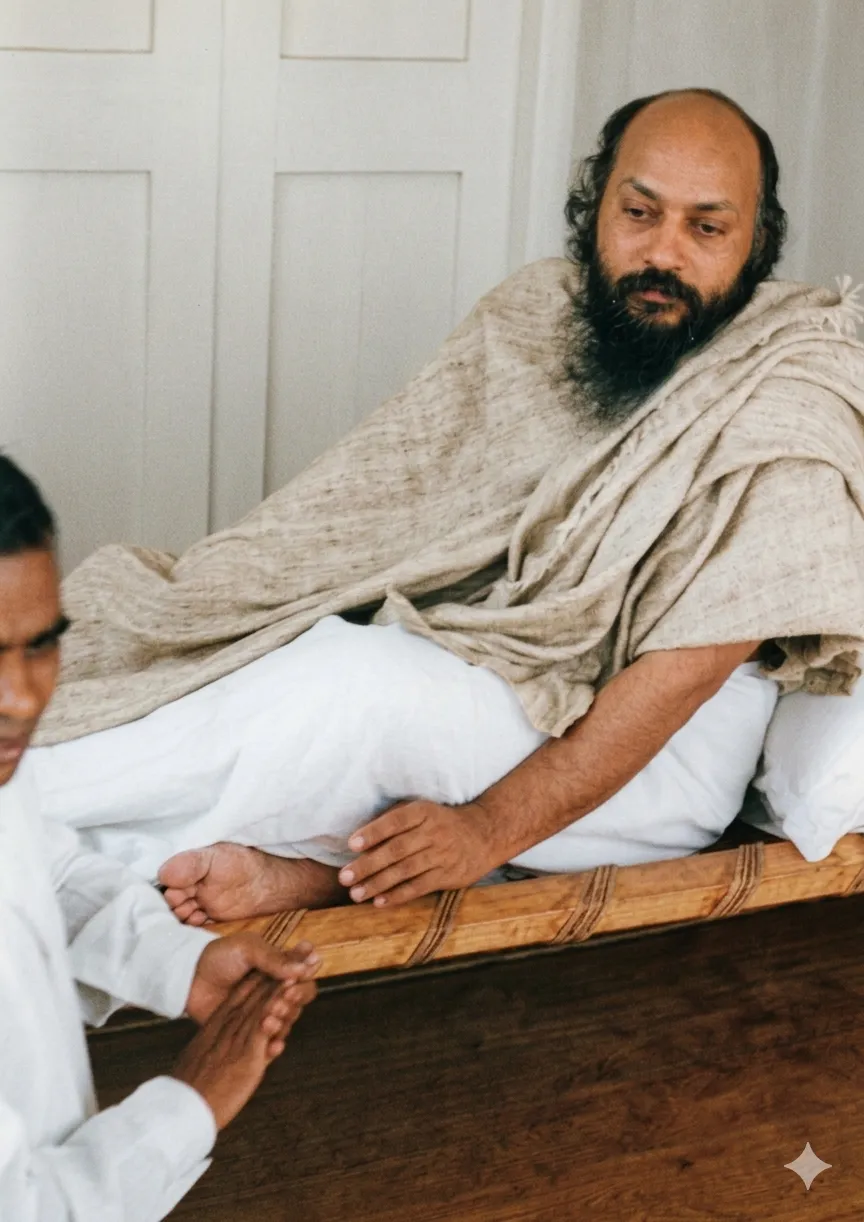
According to Osho, awareness is not an object you can search for but the very ocean of life you are already in—the essence of existence itself. It is non-dual: the seeker is the sought, the observer the observed. Recognizing this ever-present consciousness ends the restless search and brings natural peace, clarity, and a felt unity with all.
Awareness is like the water a fish swims in—already everywhere, including you—so stop looking elsewhere and notice it here and now.
From the Discourses
Passages where Osho speaks to this question — each links to the complete discourse.
I am not saying to do anything. Meditation is not a doing at all, it is pure awareness. But a miracle happens, the greatest miracle in life. If you go on watching, tremendous and incredible things start happening. Your body becomes graceful, your body is no more restless, tense; your body starts becoming light, unburdened; you can see great weights, mountainous weights, falling from your body. Your body starts becoming pure of all kinds of toxins and poisons. You will see your mind is no more as active as before; its activity starts becoming less and less and gaps arise, gaps in which there are no thoughts. Those gaps are the most beautiful experiences because through those gaps you start seeing things as they are without any interference of the mind. Slowly slowly your moods start disappearing. You are no more very joyous and no more very sad.
Osho: To think is the nature of the mind. And if you don't think then there is no mind. A state of no-mind comes, then you know. That is nature, this too is nature; that is not against this nature which creates ignorance, creates unknowing, creates conflict. We have not known the total mind, we have known only the mind which thinks. If you transcend it then you know the total mind -- which knows. Thinking is one thing, knowing is quite another. QUESTION: THE NATURE OF THE MIND IS TO THINK, AND THEN IT CEASES TO THINK. WHAT DO YOU DO IN ORDER TO CAUSE IT NOT TO THINK? DOES IT NATURALLY NOT THINK? Osho: If you become aware of your thinking process, then the process by and by is dissolved.
Osho, “If there is awareness, the other is always beneficial.” Is this what you mean by a buddha, an awakened one?
If there is awareness, the other is neither beneficial nor harmful; if there is awareness, you draw your well-being from everywhere. Without awareness, you draw your ill-being from everywhere. If there is awakening, wherever you are, heaven begins to be created—because of your awakening. If there is no awakening, wherever you are, the stench of hell begins to rise—because of you. Understand it this way: to live in stupor builds hell; to live awake builds heaven. No one has ever suffered while awake. No one has ever known happiness while asleep. In sleep, at most you can hope for happiness; happiness never arrives. In the hope of happiness you can bear a great deal of suffering, but happiness never arrives. What comes with wakefulness—that alone is happiness. There is no relation to the other at all. If you understand rightly, there is no other; it is you. Your idea about…
Osho, is choiceless awareness also a kind of choice? It seems to come down to a paradox.
No, choiceless awareness is not a choice. Choiceless means we do not make any choice, we do not select any option; we simply awaken. In that awakening we do not decide, “This is right, that is wrong; this should be accepted, that should be dropped.” We make no decision. We simply look, awake. In this awakened seeing there is no choice at all. And as long as there is choice, we cannot see with awareness. “Awareness with choice”—there is no such thing. Awareness, as such, is without choice. Awareness by its very nature is choiceless. So awareness can never be together with choice, because choice means bias has begun; sleep has begun. There are so many people sitting here: if I say, “Bacchu-bhai is a fine man,” then I cannot be aware in relation to Bacchu-bhai either, because my attachment has begun. Nor can I be aware in relation to…
Osho, are “just awareness,” mere alertness, and tathata the same?
In fact, when we say “just awareness,” mere alertness, there is a slight difference between that and tathata. And there is also a slight difference between that and the witness. Think of “just awareness” as the link between the witness and tathata—when you pass from witnessing to tathata, this will be the link in between: just awareness. In witnessing, the sense that “I am and you are” is firm. In just awareness there is only “am”; the sense of “you” has been forgotten—only the sense of being. In tathata, it is not only the sense of being; my being and your being are one being. Because as long as there is just awareness, as long as there is only the sense of being, there will be a boundary outside that sense of being—something I am not, from which I am separate. In tathata there is no boundary. There is only…