
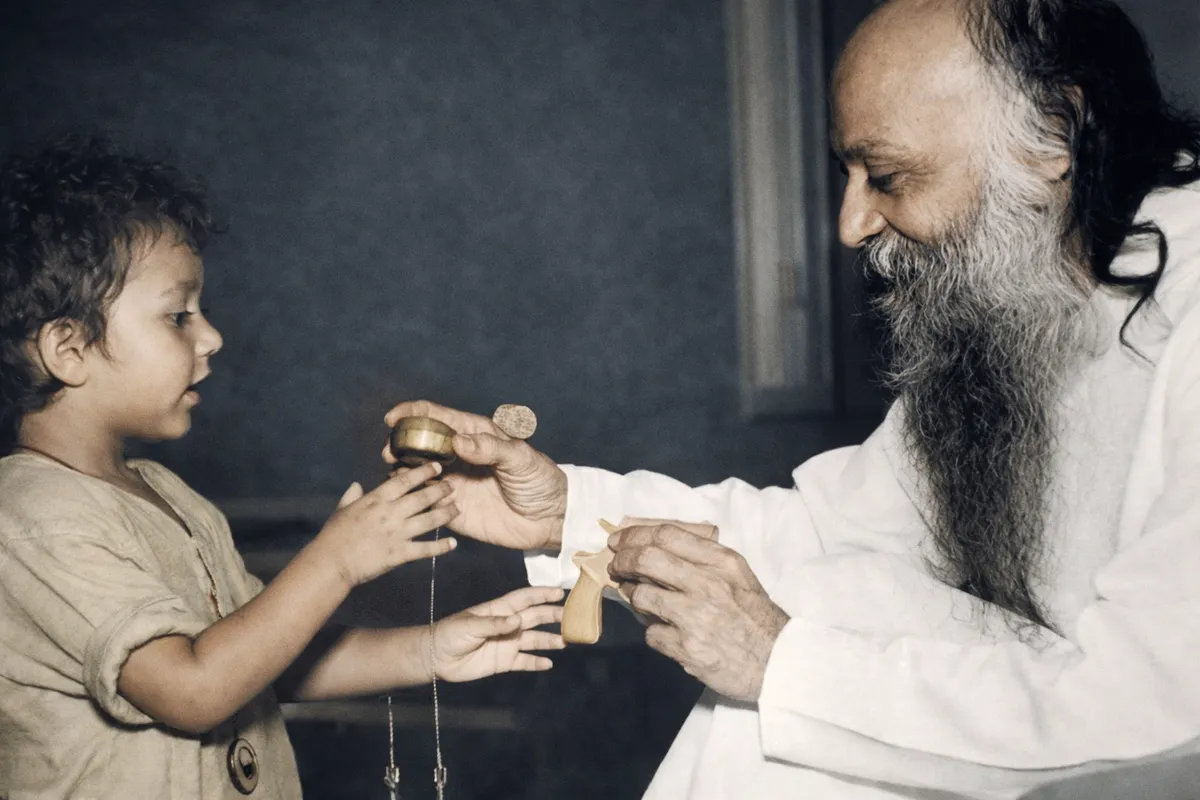
According to Osho, maturity is innocence regained after conscious rebellion against social conditioning: a rebirth into childlike clarity, love, and silence, where the heart leads to being and the mind serves. It means seeing with fresh eyes, becoming incorruptible, and moving beyond thoughts and emotions into pure isness. This ‘born again’ state is the ultimate flowering of meditation—freedom from patterns, structures, and bondage.
Maturity means becoming like a wise child again—dropping fake conditioning, letting your heart lead, using your head as a tool, and resting in quiet presence.
From the Discourses
Passages where Osho speaks to this question — each links to the complete discourse.
Question: BELOVED MASTER, WHAT IS THE MEANING OF MATURITY? Prem Lalit, maturity means the same as innocence, only with one difference: it is innocence reclaimed, it is innocence recaptured. Every child is born innocent, but every society corrupts him. Every society, up to now, has been a corruptive influence on every child. All cultures have depended on exploiting the innocence of the child, on exploiting the child, on making him a slave, on conditioning him for their own purposes, for their own ends -- political, social, ideological. Their whole effort has been how to recruit the child as a slave for some purpose. Those purposes are decided by the vested interests. The priests and the politicians have been in a deep conspiracy, they both have been together. The moment the child starts becoming part of your society he starts losing something immensely valuable; he starts losing contact with God.
What is maturity?
MATURITY is to know that nothing can be done. Maturity is acceptance of existence as it is: YATHA BHUTAM. Maturity is not to desire things otherwise. Maturity is relaxing with the whole. Immaturity is conflict, struggle. The part fighting with the whole is immaturity. The part come to be in tune with the whole, coming to a harmonious settlement with the whole -- not in defeat but in understanding is maturity. Nothing can be done. To realize that is maturity. And also: Nothing matters. You allow it deep into your heart that nothing matters. All is good as it is, is maturity. Otherwise people remain childish. When you are desiring you are childish. Every desire is a complaint against existence. Every desire is a discontent with the way you are, the being you are. And every desire brings frustration in its wake, because it cannot be fulfilled. Desire brings future…
Question: BELOVED OSHO, WHAT ARE THE QUALITIES OF A MATURE PERSON? The qualities of a mature person are very strange. First, he is not a person. He is no more a self. He has a presence, but he is not a person. Second, he is more like a child -- simple and innocent. That's why I said the qualities of a mature person are very strange, because maturity gives a sense as if he has experienced, as if he is aged, old. Physically he may be old, but spiritually he is an innocent child. His maturity is not just experience gained through life. Then he will not be a child, and then he will not be a presence; he will be an experienced person -- knowledgeable but not mature. Maturity has nothing to do with your life experiences.
What is maturity? How can I be mature?
You will have to understand first what immaturity is. That will give you the idea of what maturity is. Immaturity has a few ingredients in it. One, immaturity is a sort of dependence. A child depends on the parents; he is immature. If you are still depending, you are immature. You may depend on God or you may depend on me, but it is immaturity. You are still seeking your parents. Maybe your parents are gone and lost; now you are projecting your parents. There are many people who come to me and I can see immediately in their eyes they are searching for their father. It is not accidental that the pope is called the pope. "Pope" means "papa". People are looking for a divine daddy, continuously. This is immaturity. When are you going to stand on your own feet? How long are you going to remain a dependent…
You told me that my mind is immature. What does it mean to have a mind that is mature?
To think that you know is to be immature. To function from knowledge, from conclusion, is to be immature. To function from no-knowledge, from no conclusion, from no past, is maturity. Maturity is deep trust in your own consciousness; immaturity is a distrust in your own consciousness. When you distrust your consciousness you trust your knowledge, but that is a substitute and a very poor substitute at that. Try to understand this -- it is important. You have been living, you have experienced many things; you have read, you have listened, you have thought. Now all those conclusions are there. When a certain situation arises. you can function in two ways. You can function through all the accumulated past, according to it -- that's what I mean by functioning through a center. through conclusions, through experience, stale, dead -- then whatsoever you do your response is not going to be…