
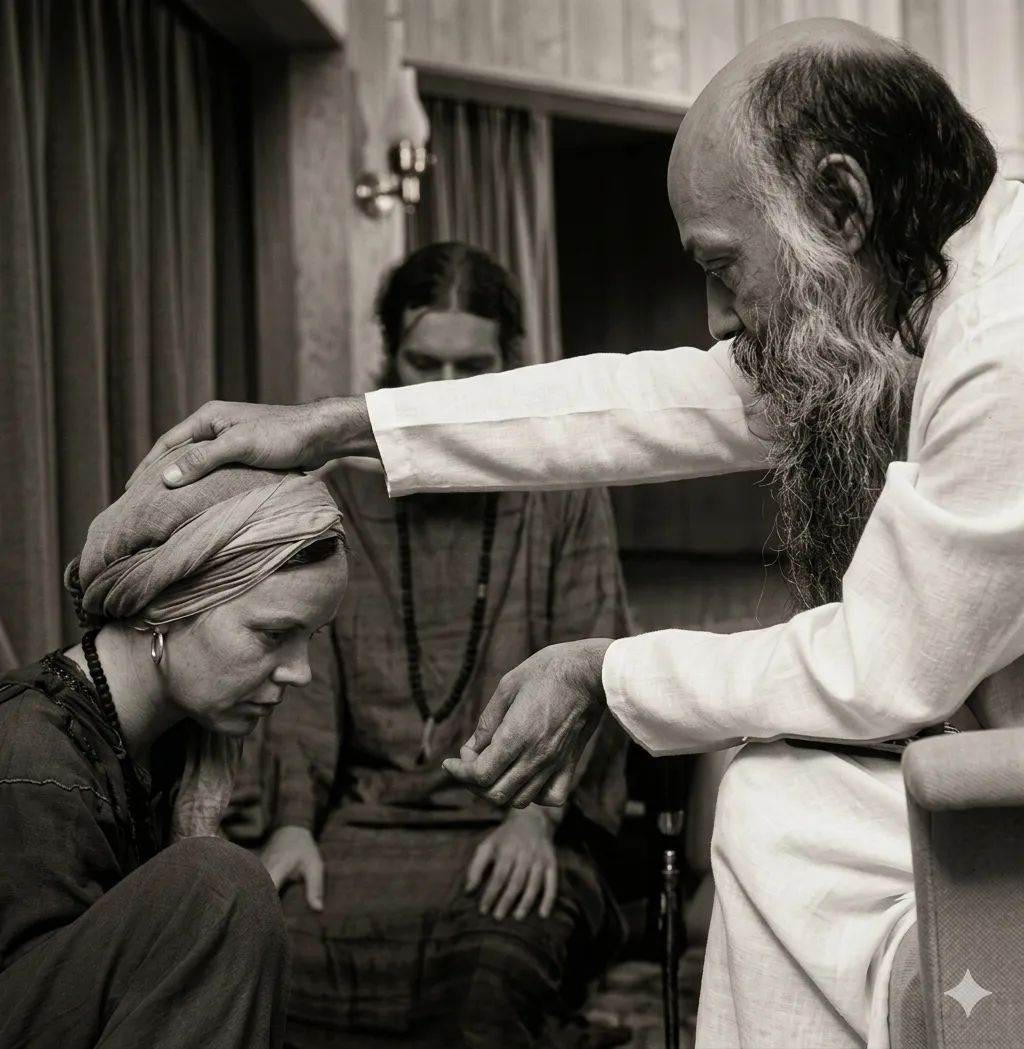
According to Osho, the old sannyas negated life—calling existence illusion, glorifying renunciation, and breeding ego and anger—thus essentially atheistic despite God-talk. His new sannyas affirms life as divine creativity: love, joy, and celebration, welcoming existence as God. It dissolves separation between Creator and creation, replacing prohibitions with reverence, courage to live, and direct, experiential theism.
Old sannyas says “life is bad, leave it”; Osho’s sannyas says “life is sacred—live it fully with love and celebration.”
From the Discourses
Passages where Osho speaks to this question — each links to the complete discourse.
Osho, what is the definition of God?
Words are very small. If you say God is light, then what of darkness? The scriptures have said that God is light. Suppose we accept this as a definition—then what about darkness? Where will darkness go? Darkness is too; in fact it is far more than light. Light sometimes is and sometimes is not; darkness is always, eternal. Where will you place darkness? If you say God is light, darkness is left out. If you say God is darkness, then light is left out. If you say God is both darkness and light, a contradiction arises: they cannot be together. Try to have both darkness and light in the same room. If you bring in light, darkness disappears; if you preserve darkness, you cannot have light. Then how can both be together? That becomes an impossibility. So you cannot say “both” either. Then the fourth device is to say: it…
Another friend has asked: What is the difference between meditation and samadhi?
Remember, there is none other than the Divine all around—inside and out, only that One is. He is in the sky, in the earth, in the winds, everywhere—inside and out, only the Divine is. When we were not, He was; when we will not be, He will be. The wave rises and subsides; the ocean is eternal. Remember, recognize: this ocean of bliss and light all around is the Divine. This inner existence of bliss, this inner light, is the Divine. Other than the Divine, there is nothing. Everything other than the Divine is untrue. Only the Divine is truth. Remember, remember. Recognize, recognize—this is the doorway to Him; this is the path to Him. Only bliss, only light, only the Divine. All around, only He is—within as well, without as well. Be submerged, become one. That which you have been seeking for lives upon lives—this is that place. That…
What is neo-sannyas all about?
Neo-sannyas is an effort to introduce the concept of 'sannyas without any renunciation of the world'. To me, India has given only one thing to the world, to human consciousness, and that is the concept of sannyas the concept of renunciation. But this renouncing can be one of two things. It can be of the world. Then it becomes negative: it becomes life-denying; it goes against life. To me that negative, life-denying aspect of sannyas is a disease. And because of that life-denying aspect, sannyas, religion, has suffered much. It couldn't become a major part of life, it couldn't become a part of human consciousness. The main current of it is life-denying. Neo-sannyas is a total yes to everything in life -- including everything that gives you higher consciousness, including everything that gives you a nearness to the divine, including everything that has been denied only because it was life-affirming.…
September 28, 1970 was a memorable day. At Manali in the Himalayas, Osho initiated His first group of sannyasins. This event was followed by this special evening discourse, on the significance of Neo Sannyas. To me, sannyas does not mean renunciation; it means a journey to joy bliss. To me, sannyas is not any kind of negation; it is a positive attainment. But up to now, the world over, sannyas has been seen in a very negative sense, in the sense of giving up, of renouncing. I, for one, see sannyas as something positive and affirmative, something to be achieved, to be treasured. It is true that when someone carrying base stones as his treasure comes upon a set of precious stones, he immediately drops the baser ones from his hands. He drops the baser stones only to make room for the newfound precious stones. It is not renunciation.
A few things about sannyas.... The oldest concept of sannyas was very life-negative, it was utterly against life, but my idea of concept is absolutely life-affirmative. Nothing has to be dropped, everything has to be transformed. All that is available is immensely valuable: anything denied will never allow you to be whole, and if you are not whole you can never be holy. So the old sannyas was an unholy sannyas: it accepted only part of life, it denied the remaining part. It accepted the mind, it denied the body; it accepted love but it denied sex; it accepted god but it denied the world... and they are all together. There is no demarcation between where the world ends and god begins. God is in the world, the world is in god. In fact these are two terms for the same phenomenon.