
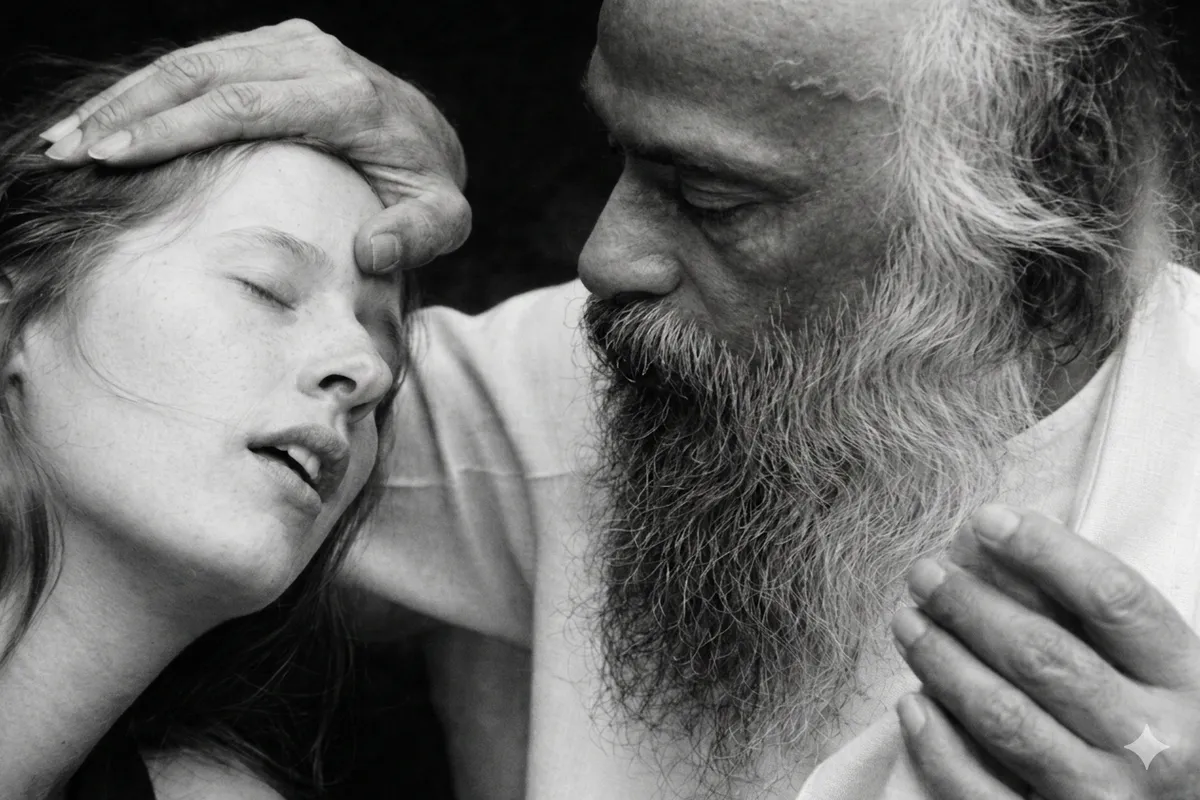
According to Osho, love is choiceless, non-dual, and all-inclusive; it embraces everyone without competition or exclusion. 'Like' belongs to the dual mind of preference—where liking one implies disliking another—so it is narrow and divisive. Love is vast enough to hold the whole of existence; liking is a selective choice that inevitably creates its opposite.
Liking is picking favorites, but love is a big open heart that doesn’t have to choose or leave anyone out.
From the Discourses
Passages where Osho speaks to this question — each links to the complete discourse.
Osho, as I feel, love has been very confusing. Personally, sir, I feel society has confused the term “love” with attachments. To me, attachment is the outcome or by-product of human need. May I ask you what love actually is?
Love liberates, makes the other free, allows the other to be a person. Attachment turns the other into an object and possesses so totally that it refuses to recognize that the other has a soul: If I say yes, then yes; if I say no, then no; if I say day, day; if I say night, night! Attachment says, “Only I am; you be erased.” Husbands have made wives into objects, wives have made husbands into objects. Lovers make each other into objects, and the moment an object shows a little movement, a little independence, attachment turns into enmity and pain. Love is a state of consciousness, not a relationship. Attachment is a relationship. And wherever there is relationship, there is need; we relate in order to fulfill a need. Love will, of course, relate—but it is not a relationship. As I said, the lamp’s light falls; if you pass…
Osho, what is the fundamental anguish of human life?
There is only one anguish: that a human being cannot become what he was born to be. There is only one anguish: that the seed remains a seed and does not bloom like a flower; that it cannot scatter its fragrance to the infinite winds; cannot converse with the moon and stars; cannot offer its colors to the sky; cannot be expressed. If the poem within the poet cannot be revealed—anguish. If the painter cannot paint—anguish. If the dancer cannot dance—if chains lie on his feet—anguish. Anguish means only this: that what we are meant to be—our innate nature and destiny—does not come to fruition, and we are forced to be something else. Then anguish is born. Then melancholy gathers over life. And all those countless people you see burdened with sorrow, living in a kind of hell—the reason is only this: each has come carrying the seed of becoming…
love and life are synonymous in language they may have different meanings but in existence they are precisely the same phenomenon no difference, no gap exists between the two the really alive person is pure love and if love is missing then life is nothing but a vegetation one can go on vegetating without love life has not happened at all one was born, one existed, one died but life never happened life happens only the moment love starts flowing and the greater the love, the deeper life becomes a sannyasin has to remember not to put any limitations on his love love should not become object-focussed the moment you become object-focussed you are getting trapped for example, if you love one person that means that the remaining whole existence has been rejected you have excluded it out of your love affair your love has become very narrow and a…
What is love?
It depends. There are as many loves as there are people. Love is a hierarchy, from the lowest rung to the highest, from sex to superconsciousness. There are many many layers, many planes of love. It all depends on you. If you are existing on the lowest rung, you will have a totally different idea of love than the person who is existing on the highest rung. Adolf Hitler will have one idea of love, Gautam Buddha another; and they will be diametrically opposite, because they are at two extremes. At the lowest, love is a kind of politics, power politics. Wherever love is contaminated by the idea of domination, it is politics. Whether you call it politics or not is not the question, it is political. And millions of people never know anything about love except this politics -- the politics that exists between husbands and wives, boyfriends and…
A friend has asked, Osho, in bhakti-yoga you have given love a fundamental place. I don’t know whether we ordinary people are familiar with love or only with lust! What is the difference between the two? And can lust become love?
It is worth asking, and worth understanding. Because we take lust to be love. And lust is not love; it can become love. In lust there is the possibility of love. But lust itself is not love; it is only a seed. If rightly used, it can sprout—but a seed is not a tree. So the one who becomes satisfied with lust, or concludes, “This is the end,” will never even come to know what love is. Lust can become love. Lust means attraction between two bodies—between bodies. Love means attraction between two minds. And devotion means attraction between two souls. They are all attractions, but on three planes. When one body is drawn to another body, that is kama, sex. When one mind is drawn to another mind, that is prem, love. And when one soul is drawn to another soul, that is bhakti, devotion. We live on the…