
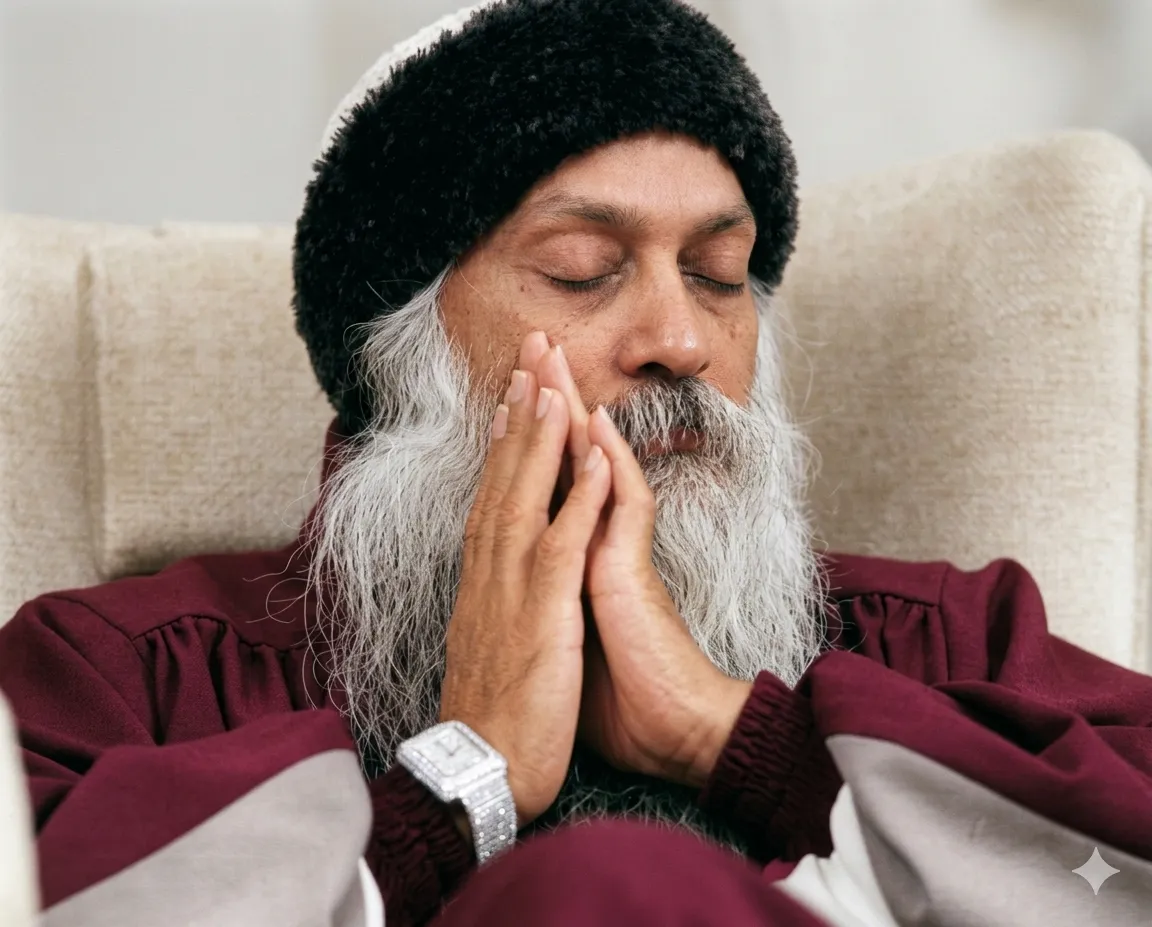
Don’t imagine someone controlling you; just be empty and quiet inside so life can move naturally through you, like wind through a flute.
From the Discourses
Passages where Osho speaks to this question — each links to the complete discourse.
Osho, what is the difference between surrender and blind imitation?
So be careful: the freedom you allow yourself, allow the other too. You have no right to judge another as blindly credulous or as a surrendered being. Drop that concern. You cannot judge anyway—how will you enter another’s heart? How will you know? Think only about yourself. See within whether, up to now, you have lived by blind belief or by surrender. Decide only there; leave worrying about others. Otherwise, all your judgments will be wrong. Jesus said: Judge not; do not set yourself up as a judge in relation to another. To the friend who has asked: if you are asking for yourself, good. Drop worrying about others. Look within and see: whatever I have been clinging to till now—have I ever staked my life to hold it? Have I meditated for it? Have I loved for it? Or am I just clutching what culture, society, civilization handed me?…
चौथा प्रश्न: ओशो, समर्पण और अंधानुकरण में क्या अंतर है?
इसलिए खयाल रखना, जो तुम अपने लिए मौका देते हो, वह दूसरे को भी देना। तुम्हें कोई हक नहीं है किसी दूसरे के बाबत निर्णय करने का कि वह अंधविश्वासी है, या समर्पित हुआ व्यक्तित्व है। तुम इसकी चिंता छोड़ो। तुम कर भी नहीं सकते निर्णय। तुम दूसरे के हृदय में उतरोगे कैसे? जानोगे कैसे? तुम तो अपनी ही सोच लो। इतना ही देखो अपने भीतर कि अब तक तुम अंधविश्वास से जी रहे हो, या समर्पण से जी रहे हो। बस, वहीं निर्णय कर लो, दूसरों की फिकिर छोड़ दो। अन्यथा तुम्हारे सभी निर्णय गलत होंगे। जीसस ने कहा है, निर्णय करो ही मत; दूसरे के संबंध में न्यायाधीश बनो ही मत। तो जिन मित्र ने पूछा है, अगर अपने लिए पूछते हों, तो ठीक। दूसरों की चिंता छोड़ दें। अपने भीतर ही देख लेना है कि अब तक जो मैं पकड़े हुए हूं, उसको पकड़ने के लिए मैंने कोई जीवन दांव पर लगाया है? कोई ध्यान किया है? कोई प्रेम किया है? या सिर्फ संस्कृति ने, समाज ने, सभ्यता ने जो दिया है, उसे पकड़े हुए हूं! दूसरों ने दिया है। …
I am often able to achieve the state -- or what seems like the state -- which you call 'being a hollow bamboo' -- silent, watching, empty. The only problem is that there is no bliss in that emptiness: it is just nothing. Can I expect something to fill it one of these days?
Mariel Strauss, it is because of this idea that you are missing the whole beauty of nothingness: this desire to fill it. You are not-really a hollow bamboo, because in this hollow bamboo this desire is there, and this desire is enough to fill the hollow bamboo, to block its emptiness. This desire to fill it one day, this expectation that "Some day, God will come and fill my emptiness"' this very idea is preventing you from really becoming a hollow bamboo. Drop this desire. Forget all about filling your hollow bamboo -- then you are a hollow bamboo. And when you are a hollow bamboo, it is immediately full of God. But not that you have to desire it; if you desire it you will go on missing it. This is one of the basic paradoxes to be understood about religious inquiry. Understand it as deeply as possible, let…
The song continues:
DO NOUGHT WITH THE BODY BUT RELAX; SHUT FIRM THE MOUTH AND SILENT REMAIN; EMPTY YOUR MIND AND THINK OF NOUGHT. LIKE A HOLLOW BAMBOO REST AT EASE WITH YOUR BODY. GIVING NOT NOR TAKING, PUT YOUR MIND AT REST. MAHAMUDRA IS LIKE A MIND THAT CLINGS TO NOUGHT. THUS PRACTICING, IN TIME YOU WILL REACH BUDDHAHOOD. ... A lunatic is a person whose whole world is confined in himself. He is the talker and he is the listener; he is the actor and he is the spectator -- he is all, his whole world is confined in himself. He has divided himself in many parts and everything has become fragmentary. That's why people are afraid of silence -- they know they may crack up. And if you are afraid of silence that means you have an obsessive, feverish, diseased mind inside, which is continuously asking to be active. ... Activity is
Beloved Osho, for a few moments the other morning, while watching you, I saw that nobody was there. I saw the emptiness, the hollow bamboo. Why did I find this spooky and awesome when you have been speaking of the beauty of emptiness for years?
It is just because from your very childhood you have been told that the goal is not emptiness, but fullness. Emptiness symbolizes the beggar's bowl. In the West particularly, the word `emptiness' never achieved any positive meaning. In the East the case is different. We have two words for emptiness. One -- which will translate the English word `emptiness' -- is riktata. It simply means absence of something. And the other is shunyata for which, in the Western languages, there is no equivalent because that kind of experience has not happened in the West. Shunyata is emptiness from one side, and fullness from another side. For example, this room is full of people now, furniture, things. We can empty it -- all the people can leave the room, all the furniture can be removed -- and then somebody can come and see and can say, "The room is empty." He…