
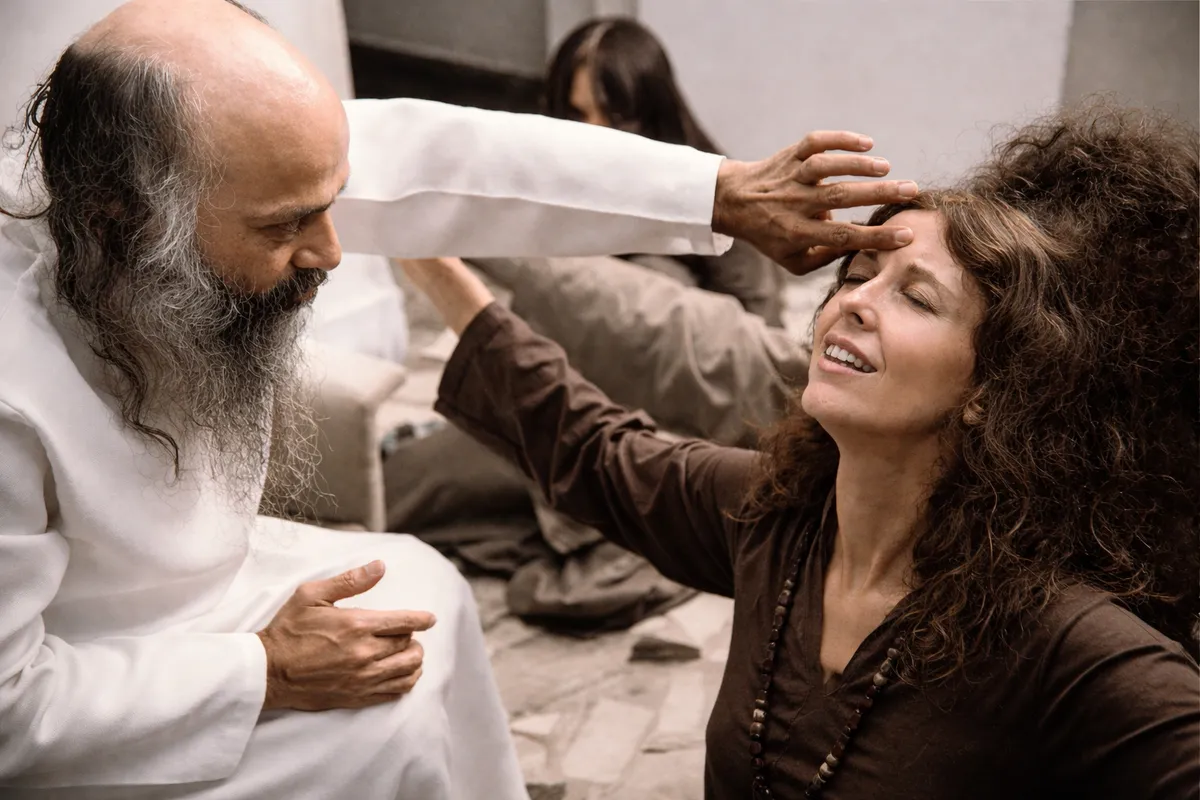
According to Osho, analyzing and understanding are diametrically opposite: analysis belongs to the mind—thinking, reasoning, categorizing—while understanding is a non-mind, choiceless awareness, a pure look without judgment or labels. Analysis breeds endless chains and keeps you entangled; understanding simply watches, and in silent witnessing the content dissolves, revealing consciousness itself—meditation.
Analyzing is busy thinking about something; understanding is quietly watching it without words until it loosens and fades.
From the Discourses
Passages where Osho speaks to this question — each links to the complete discourse.
What is the difference between waiting for godot and waiting for god?
It is as if the sun has risen in the morning and you are sitting in your room with closed doors and windows, in darkness. Open the doors, you become available to the sun. The sun was already available -- just the meeting happens. You cannot wait for God. All waiting is for Godot. Godot means the one who never comes, who CANNOT come, whose arrival is impossible. And the only impossible thing is that which has already happened -- how can it happen again? You are alive, and you are waiting for life, Now, this is ridiculous. The real man of religion does not think in terms of God. He thinks in terms of life or, even better, of living -- because life can again become an abstract idea. Living, moment-to-moment living. In that very living, one knows what God is, because one knows who one is. Your idea…
Question: OSHO, WHAT IS UNDERSTANDING AND WHAT IS MISUNDERSTANDING? That's the difference here. I am not telling you Hinduism is right or Christianity is right or Judaism is right. I am simply telling you mind is wrong and no-mind is right. Now, no-mind cannot have any adjective: it cannot be Hindu, cannot be Mohammedan, cannot be Christian. Mind can have an adjective. Mind will have an adjective, is bound to have an adjective. It will have a certain definition, a certain limitation. No-mind is vast like the great space; it is void, it is clear. It is clarity, it is transparency. But we all live in our prejudices because we are all past-oriented. Whatsoever had been taught to us we go on repeating, whatsoever has been told to us we will go on telling to our children. That's how diseases are transferred from one generation to another generation.
Osho, I practice self-analysis, “introspection,” to awaken the witnessing. Is this right as a first step? Kindly explain.
That is why you see: the wife is happily sitting, listening to the radio, knitting her sweater; the moment the horn honks downstairs—husband has arrived—she lies down: “I have a headache.” Don’t think she’s faking; it really happens. I’m not saying she is deceiving—this has become her habit. The husband’s horn is enough to trigger a headache. Association has formed. Don’t think I say she’s cheating. Perhaps in the beginning she faked it; now that is long past—now it’s a habit. As the husband comes, the headache rises—because only when she has a headache does the husband put his hand on her head. Otherwise, who puts his hand on his wife’s head! Someone might put a hand on another’s wife; who puts a hand on his own! Only when the wife is troubled does the husband show a little sympathy. Love is gone; now only sympathy keeps things moving. The…
What is the difference between waiting for godot and waiting for god?
It is as if the sun has risen in the morning and you are sitting in your room with closed doors and windows, in darkness. Open the doors, you become available to the sun. The sun was already available -- just the meeting happens. You cannot wait for God. All waiting is for Godot. Godot means the one who never comes, who CANNOT come, whose arrival is impossible. And the only impossible thing is that which has already happened -- how can it happen again? You are alive, and you are waiting for life, Now, this is ridiculous. The real man of religion does not think in terms of God. He thinks in terms of life or, even better, of living -- because life can again become an abstract idea. Living, moment-to-moment living. In that very living, one knows what God is, because one knows who one is. Your idea…
Osho, “understanding” — what kind of phenomenon is it?
On the second day he saw—he is doing it all day; three or four times a day, for an hour each time—he saw that this anger is toward no one; this anger is within me. And today was his third day. He came and said, “I am astonished: the moment it became clear that it is toward no one, that it is within me, it was as if something inside took its leave—everything has become quiet. I am utterly unable now: if someone abuses me at this moment, I will not be able to get angry. At least not at this moment. Because it is as if a great weight inside has been thrown out. Everything is empty.” Understanding means: whatever happens within you happens knowingly, in your awareness, in your wakefulness, in your consciousness. Whatever! And then much will stop happening by itself. And what stops—that is sin. And…