
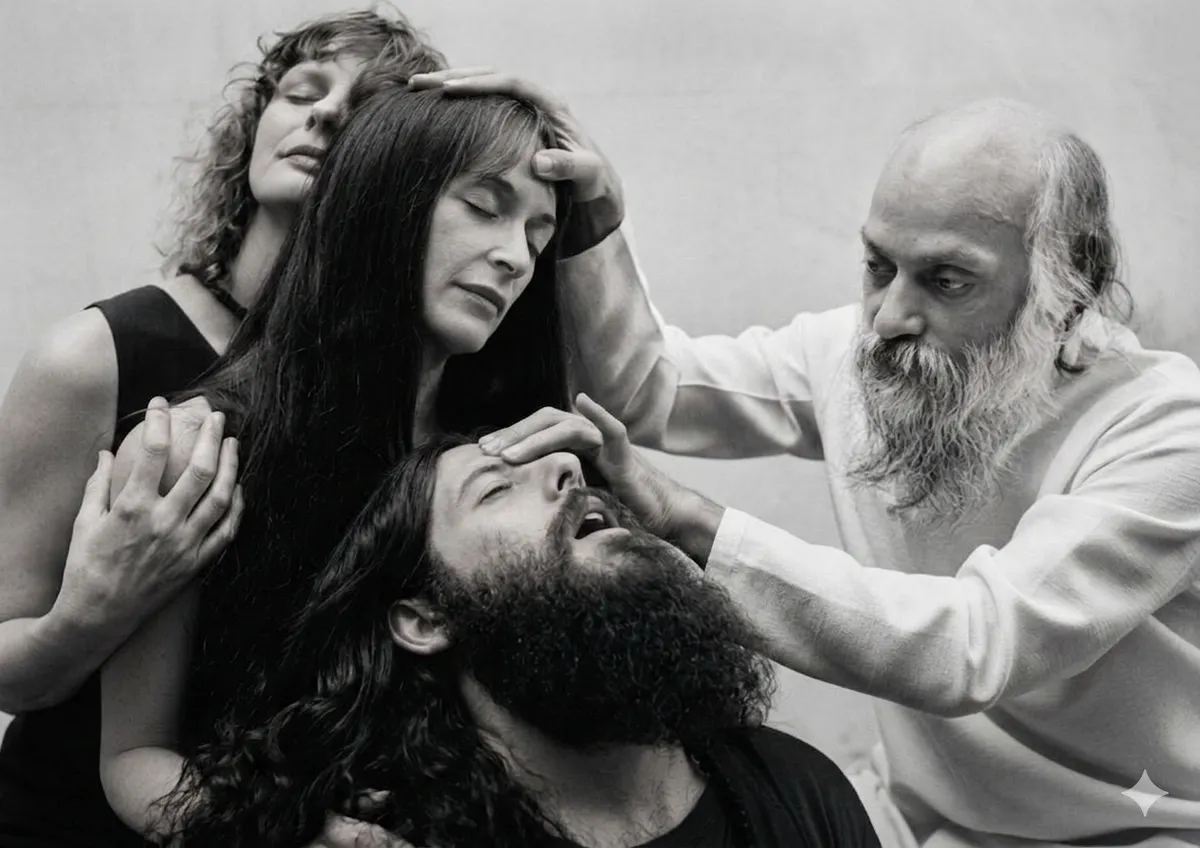
Osho updates yoga for today’s skeptical, tense people by first letting you clean out old emotions, then guiding you into real meditation.
From the Discourses
Passages where Osho speaks to this question — each links to the complete discourse.
What is the basic difference between the more familiar systems of yoga and the system that you have developed?
The jump is possible. And I think that for us today, it has become urgent that we move within. But the preparation is bound to be different than it has been in the past, so my method works first as a catharsis. Then, it tries to create a harmony with your body. We are separated from our bodies. All the old traditions have emphasized that body and mind are two things. That is absolutely wrong. Body and mind are just two poles of one existence. The old traditions have emphasized that you are not the body, but my emphasis is quite the contrary. You are the body. You are more than the body, you go beyond the body, but you are also the body. There is no division as such, no conflict. We have created the conflict, and that conflict has created a gap. The gap has to be bridged.…
What is kundalini yoga and how can it help the west? Why is your method for awakening kundalini chaotic rather than like the traditional, controlled methods?
Awareness of the thought process will change the quality of the mind; asanas and pranayama will change the quality of the body. Then the moment comes when your body and mind are one, without any conflict at all. When they are synchronized, you are neither body nor mind. For the first time, you know yourself as the Self. You transcend. You can transcend only when there is no conflict. In this harmonious moment when body and mind are one, with no conflict, you transcend both. You are neither. Now you are nothing in a sense: no-thing. You are simple consciousness. Not conscious of something, but just awareness itself. This awareness without being aware of anything, this consciousness without being conscious of anything, is the moment of explosion. Your potential becomes actual. You explode into a new realm: the ultimate. This ultimate is the concern of all religions. There are so…
Osho, the meditation you teach—is it Patanjali’s Raja Yoga or something else? If it is something else, what is its source? And how is your meditation different from the kind that Patanjali is known for and systematized?
Just as I am different from Patanjali—so is it. And when Patanjali needs no other source, I too need no source. And if Patanjali can be authentic, there is no obstacle to my being authentic. The delightful thing is: rather than giving proof from a man who lived five thousand years ago, it is better that I, who am present, be the proof. You can talk to me; you can ask questions. You cannot talk to Patanjali, nor can you question him. The meditation I am speaking of—one could say—it is “mine.” But this “mine” has nothing to do with the “I.” It is “mine” only in the sense that if I were to make someone else the authority for what I say, it would not be trustworthy. “Mine” in the sense that whatever I say is from experience, not from thought. It is not collected from any scripture; it…
प्रश्न: ओशो, आप जो ध्यान सिखाते हैं, वह क्या पतंजलि के राजयोग का है या दूसरा? यदि दूसरा है, तो उसका स्रोत क्या है? तथा पतंजलि चर्चित, उनके द्वारा आयोजित जो ध्यान है, उनके प्रकार से आपका किस प्रकार भिन्न है?
जैसे मैं पतंजलि से भिन्न हूं, ऐसे ही। और जब पतंजलि को किसी और स्रोत की जरूरत नहीं है, तो मुझे भी किसी स्रोत की जरूरत नहीं है। और जब पतंजलि प्रामाणिक हो सकते हैं, तो मेरे प्रामाणिक होने में कोई बाधा नहीं है। और बड़े मजे की बात यह है कि पांच हजार साल पहले हुआ कोई आदमी, उसका प्रमाण दें, इससे तो बेहतर है कि मैं जो मौजूद हूं मैं ही प्रमाण बनूं। मुझसे बात भी हो सकेगी, सवाल भी हो सकेंगे। पतंजलि से बात भी नहीं हो सकेगी, सवाल भी नहीं हो सकेंगे। जिस ध्यान की मैं बात कर रहा हूं, कहना चाहिए, वह मेरा ही है। लेकिन मेरे का ‘मैं’ से कोई लेना-देना नहीं है। मेरा सिर्फ इस अर्थ में कि मैं किसी दूसरे को प्रमाण बना कर कुछ भी कहूं, तो वह भरोसे की बात नहीं। मेरा इसी अर्थ में कि जो भी मैं कह रहा हूं वह अनुभव है, विचार नहीं है। जो भी मैं कह रहा हूं वह किसी शास्त्र से संगृहीत नहीं है, स्वयं से जाना हुआ है। लेकिन मेरे का अर्थ ‘मैं’ नहीं है। वह भूल निरंतर हो जाती है। …
Osho, what is the definition of God?
Words are very small. If you say God is light, then what of darkness? The scriptures have said that God is light. Suppose we accept this as a definition—then what about darkness? Where will darkness go? Darkness is too; in fact it is far more than light. Light sometimes is and sometimes is not; darkness is always, eternal. Where will you place darkness? If you say God is light, darkness is left out. If you say God is darkness, then light is left out. If you say God is both darkness and light, a contradiction arises: they cannot be together. Try to have both darkness and light in the same room. If you bring in light, darkness disappears; if you preserve darkness, you cannot have light. Then how can both be together? That becomes an impossibility. So you cannot say “both” either. Then the fourth device is to say: it…
पहला प्रश्न: ओशो, परमात्मा की परिभाषा क्या है?
शब्द तो बड़े छोटे-छोटे हैं। अगर कहो परमात्मा प्रकाश है, तो फिर अंधेरे का क्या होगा? ऐसा कहा है शास्त्रों में कि परमात्मा प्रकाश है। चलो मान लें इसे परिभाषा, फिर अंधेरे का क्या होगा? फिर अंधेरा कहां जायेगा? अंधेरा भी है, प्रकाश से कहीं ज्यादा है। प्रकाश तो कभी होता है कभी नहीं भी होता; अंधेरा सदा है, शाश्वत है। अंधेरे को कहां रखोगे? अगर कहा परमात्मा प्रकाश है, तो अंधेरा बाहर पड़ गया। अगर कहा परमात्मा अंधेरा है, तो प्रकाश बाहर पड़ गया। अगर कहो परमात्मा अंधेरा प्रकाश दोनों है, तो विरोधाभास होता है। दोनों एक साथ हो नहीं सकता। एक ही कमरे में अंधेरा और प्रकाश करके दिखाओ। प्रकाश करोगे, अंधेरा खो जायेगा; अंधेरा बचाओगे, प्रकाश न कर सकोगे। तो दोनों साथ कैसे होंगे? तब एक असंभव बात हो गई। तो यह भी नहीं कह सकते कि दोनों है।
What is the difference between waiting for godot and waiting for god?
It is as if the sun has risen in the morning and you are sitting in your room with closed doors and windows, in darkness. Open the doors, you become available to the sun. The sun was already available -- just the meeting happens. You cannot wait for God. All waiting is for Godot. Godot means the one who never comes, who CANNOT come, whose arrival is impossible. And the only impossible thing is that which has already happened -- how can it happen again? You are alive, and you are waiting for life, Now, this is ridiculous. The real man of religion does not think in terms of God. He thinks in terms of life or, even better, of living -- because life can again become an abstract idea. Living, moment-to-moment living. In that very living, one knows what God is, because one knows who one is. Your idea…