
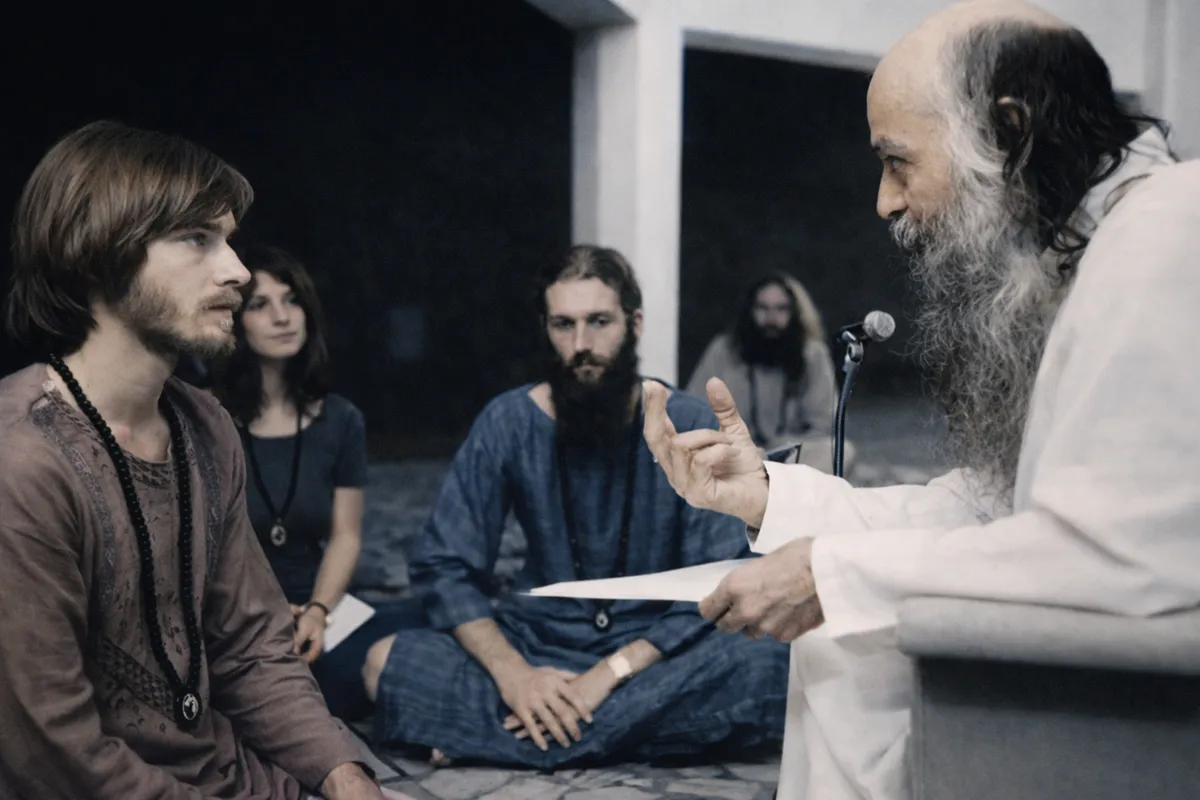
Mind is just your inner engine running; when it rests, you meet your quiet, real self.
From the Discourses
Passages where Osho speaks to this question — each links to the complete discourse.
Osho, what is mind?
As I see it, mind is not an object—it is only a function. This fan is running. There is the fan’s moving state and there is its still state. When the fan stops, we do not ask where the “movement” went, because movement was not an object. Movement was simply an activity of the fan. The fan that was moving has become still. The being within us—its moving state is the mind, and its still state is the soul.
Osho: To think is the nature of the mind. And if you don't think then there is no mind. A state of no-mind comes, then you know. That is nature, this too is nature; that is not against this nature which creates ignorance, creates unknowing, creates conflict. We have not known the total mind, we have known only the mind which thinks. If you transcend it then you know the total mind -- which knows. Thinking is one thing, knowing is quite another. QUESTION: THE NATURE OF THE MIND IS TO THINK, AND THEN IT CEASES TO THINK. WHAT DO YOU DO IN ORDER TO CAUSE IT NOT TO THINK? DOES IT NATURALLY NOT THINK? Osho: If you become aware of your thinking process, then the process by and by is dissolved.
Are mind and consciousness two separate things or is the silent mind (or the concentrated mind) what is called 'consciousness'?
IT DEPENDS. IT DEPENDS ON YOUR DEFINITION. But to me, mind is that part which has been given to you. It is not yours. Mind means the borrowed, mind means the cultivated, mind means that which the society has penetrated into you. It is not you. Consciousness is your nature; mind is just the circumference created by the society around you, the culture, your education. Mind means the conditioning. You can have a Hindu mind, but you cannot have a Hindu consciousness. You can have a Christian mind, but you can't have a Christian consciousness. Consciousness is one; it is not divisible. Minds are many because societies are many; cultures, religions are many. Each culture, each society, creates a different mind. Mind is a social by-product. And unless this mind dissolves, you cannot go within; you cannot know what is really your nature, what is authentically your existence, your consciousness.…
Osho, it seems Buddha put all his emphasis on knowing and understanding the mind. Is a human being made by the mind? Are all talks about the soul and God useless?
Pandits go on chattering; they have no idea what they are saying. The enlightened fall silent, because they know. How can the most sacred be said? Bring it to the lips and it becomes false. Words are too small. Can they contain the vast? They cannot. It is like trying to bind the sky in your fist—the fist will close, the sky will remain outside. In the same way words get bound, and God remains outside. The word “God” is not God. Your rote of “God, God” has nothing to do with God; it is a disease of your mind. We do know the truth of Paradise, but to console the heart, Ghalib, this fancy is pleasing. You know it well. Your heaven, your liberation, your God—you know very well the truth of them: this “God” of yours is nothing. It is overheard talk. A rumor. You heard it from…
Osho, are mind, intellect (buddhi), chitta, and ego (ahamkar) distinct things—separate entities—or one and the same? And is the soul different from these, or is their aggregate itself called the soul? Among these, which is inert and which is conscious? And where exactly are they located in the body?
It’s like asking: is the father different, the son different, the husband different? No—the person is one. But before some he is a father, before others a son, before others a husband; before some he is a friend, before others an enemy; to some he appears beautiful, to others not; to some he is master, to others servant. If we had never visited that house and someone told us, “Today I met the master,” another said, “Today I met the servant,” a third said, “I met the father,” and a fourth, “The husband was at home,” we might think many people live there—some master, some father, some husband. The person is one. Our mind behaves in many ways. When it stiffens and declares, “I am everything; no one else is anything,” it appears as ego—ahamkar. That is one mode of the mind’s functioning. When the mind thinks—reasons—it is buddhi, intellect.…