
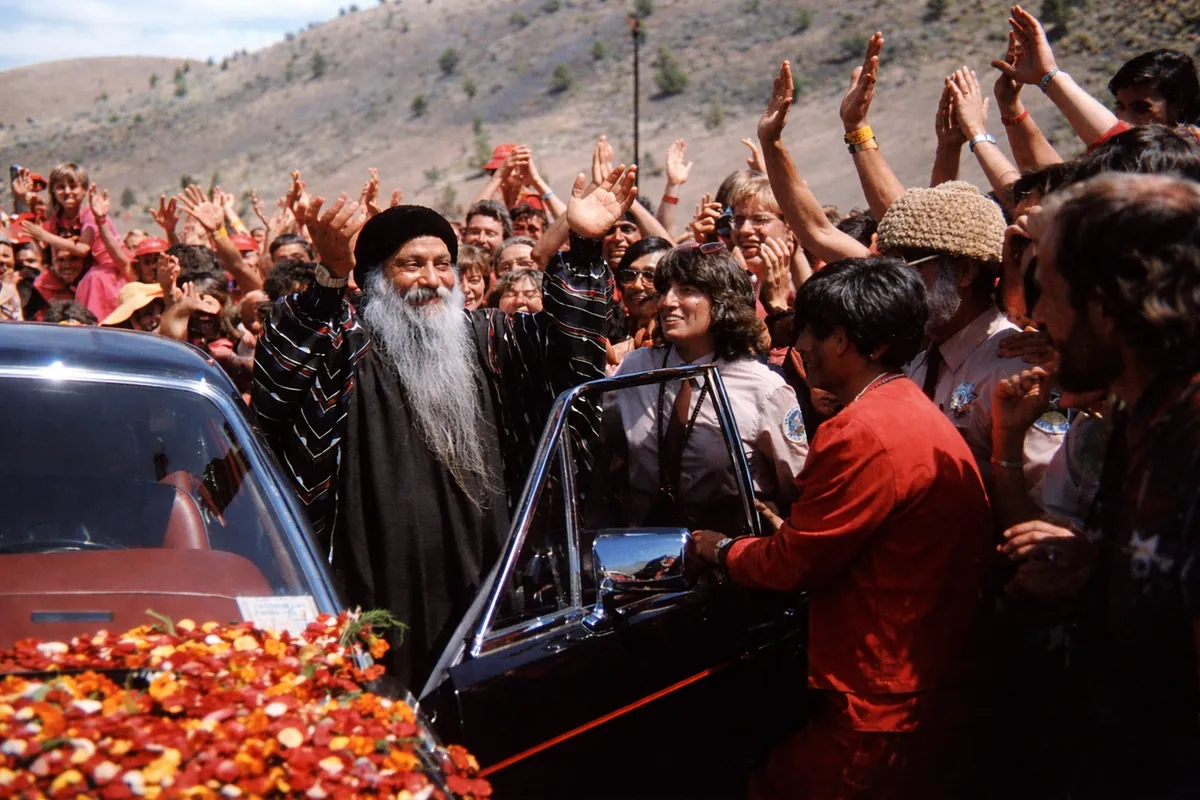
It’s a calm, steady stillness where your mind stops swinging to extremes, and there’s no “me” rushing to label it.
From the Discourses
Passages where Osho speaks to this question — each links to the complete discourse.
Osho, I have had lots of exhilarating moments of what seemed to me to be real consciousness, but then as soon as I have felt conscious I begin to feel unconscious, and it seems more and more to me that being conscious is a state one has to just experience and not recognize. Have you anything to say on this?
THE STATE of real awareness is not exhilarating. It has no excitement in it, it is absolutely peaceful. It is neither hot nor cold. You live in a world of coldness, dullness, hence your mind is constantly seeking for something exciting, exhilarating, elevating. You live always in dark valleys so you hanker for peaks, sunlit peaks. That is your desire, but that is not the nature of consciousness itself. Consciousness is exactly in the middle. It is neither low nor high, it is neither a valley nor a peak, it is neither cold nor hot. Buddha has called it MAJJHIM NIKAYA -- the middle way. It is exactly in the middle, and it is in the middle that transcendence happens. It is neither positive nor negative, neither good nor bad, NETI NETI, neither this nor that. You have come to such a delicate point where everything is balanced. You are…
Osho, in the thought-free state you describe, consciousness would have to be passive in its very being. So if the conscious mind becomes completely thoughtless and inactive, what difference remains between that and inert existence? When there is nothing to do and mere being is the goal, is there any difference between such a state and dead stillness? What purpose could the existence of consciousness have for us? Please explain the difference between the existence of a wooden chair and a thought-free, inactive human existence.
Then Huxley wrote that that day it occurred to him: LSD itself does nothing; it is a consciousness-expanding drug. For a few moments your awareness expands a little. And with just that small expansion, the chair became alive! So Huxley wrote, “Now I can believe those who looked at a stone and bowed as if before God; their consciousness must have had some other expansion.” He also wrote, “Now I can believe someone like Van Gogh, who painted a chair.” Why paint a chair? Can you imagine sitting down to paint and choosing a chair? And a unique painter like Van Gogh labors for months to paint a chair—must he be mad? Is a chair worth painting? But Huxley said that until then he had never understood why Van Gogh painted a chair; then he understood Van Gogh must have seen this chair in another moment of consciousness, which he…
Is enlightened consciousness less spicy than ordinary consciousness?
Saints are pinned butterflies. Sinners are alive -- a snake resting on the rock in the afternoon sun. Sinners sometimes can become saints, but then their sainthood has a totally different quality to it. They cannot belong to any church, they cannot belong to any sect. They cannot belong -- how can a saint belong? The saint is like a fragrance, free, moving in the winds -- he cannot belong. Jesus never belonged to anybody. That's why Jews were angry with him -- they wanted him to belong. Real saints will not be recognized as saints, no church will sanctify them as saints. And the saints that are sanctified by the church are really bogus, mumbo-jumbo, false, artificial, synthetic, plastic saints. Yes, they don't laugh, that's true. But Jesus is not that kind of saint. He laughs, he drinks, he eats well, he loves..He was a true man of the…
Osho, before discussing the process of entering a conscious death, I would like to ask: what is the difference between stupor and awakening? What do we call the state of unconsciousness? In other words, in wakefulness and in unconsciousness, what is the state of the jivatma’s consciousness?
Religion is a search for attention; so, in their own way, are gambling, battle, hunting. The man who enters the forest to hunt a lion is also seeking attention; so is the yogi in a cave striving at the ajna chakra. The search may be noble or ignoble, desirable or undesirable, successful or futile—but the underlying hunger is one. Attention means: the knowing power within me becomes fully manifest—no part left potential or dormant. Whatever capacity to know I carry turns from potential into actual. In the moment a person is fully awake, in that very moment he fully is. Awakening and being happen together. Think of a seed: the tree is hidden in the seed, but only potentially. The seed can die without becoming a tree; the tree is not a necessity, only a possibility. When the tree manifests, it is the seed in its expressed form. Sleep is…
Consciousness changes everything from prose to poetry, from mathematics to music, from logic to love. It is a radical transformation -- and only after this transformation does one start enjoying the adventure of life. Then each moment is ecstatic, exquisite. Its beauty is immense, unfathomable, immeasurable, inestimable. One can experience it but one cannot express it. No expression is possible, no definition is possible. It is so vast and our words are so small; our words are like dewdrops and the experience of consciousness is oceanic. You cannot force the ocean into a dewdrop. The experience of consciousness is absolutely wordless. It happens only in utter silence. The silence is so profound that even you are not there. It is just space. Everything is gone -- your mind is gone, your ego is gone, there is space full of light.