
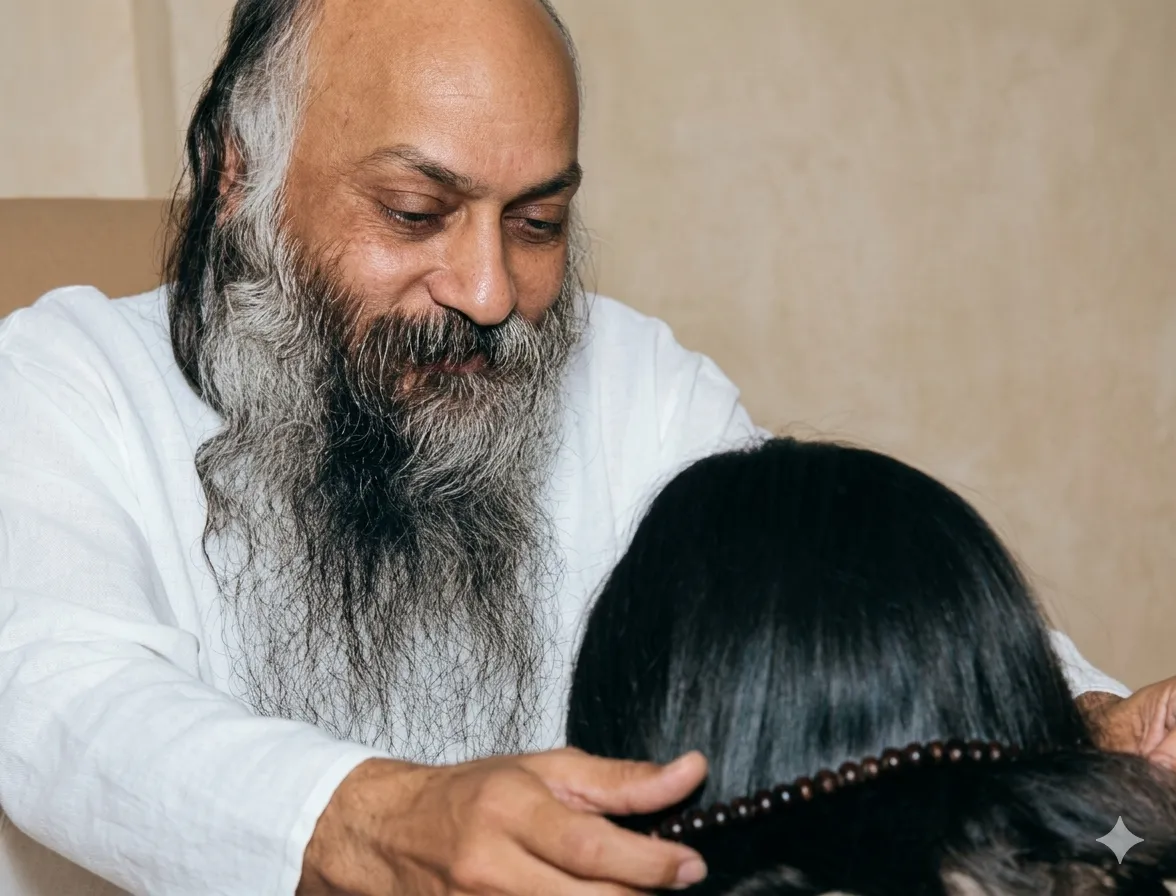
When your head gets noisy, stop forcing it; relax and let calm arrive by itself, like a breeze you don’t chase.
From the Discourses
Passages where Osho speaks to this question — each links to the complete discourse.
Beloved Osho, many years ago, it seems, I used to be able to meditate -- I think. A beautiful, silent, transparent state would arrive from somewhere; I presumed this was meditation. Now, nothing comes except a racing mind. What happened?
The answer that Junnaid gave to his disciples is worthy of being remembered. He said, "For these three days, do you think I cannot see that food has not been given to us, that we have been thrown out, that we have been stoned, that we are thirsty, that for three days we had to remain in the open desert...? Don't you see that I am also aware of it? But this does not mean that he is not taking care of us. Perhaps this is the way he is taking care of us; perhaps this is what we need at this time. "It is very easy, when life is going comfortably, to thank God. That thankfulness means nothing. These three days I have been watching. slowly, slowly, all of you have stopped thanking Him after the prayer; you failed the test. It was a beautiful test. Even if death…
It has been asked: It has been asked, Osho, you tell us to think—yet what will come from thinking alone? As I keep thinking, I get drowned in thoughts themselves, and my conduct does not change. My conduct remains exactly the same. So please tell me, how is conduct to be changed?
Commonly it is said, “What value is there in thought? The real value is in conduct.” This is utterly false and futile. It is false and futile because conduct, deep down, is nothing but the expression of thought. Where there is no seed of thought, there can be no plant of conduct. Yes, it is possible to throw a false conduct over oneself from the outside. But false conduct has no value whatsoever, except that it deceives others and destroys one’s own life. The question asked is: “What will happen by thought alone?” This is why I ask, and why the question arises—if I were to pray to you, I would say: as yet no thought has been born in you. You are taking others’ thoughts to be your own. Hence the problem of trying to bring thought and conduct into harmony. If the thought were truly yours, it would…
Osho, should one just keep watching it? Keep feeling it? What thought should be there at that time? What feeling should be there at that time?
So you can prevent meditation from happening—and you are preventing it—but you cannot make it happen. Our whole problem is very reversed. The reality is that when someone asks me, Meditation is not happening, he is asking the question upside down. In fact, he is striving with all his life’s breath to make sure that meditation does not happen. He has spoiled lifetimes to see that meditation does not happen. And for meditation he has erected a thousand kinds of barriers so that it cannot happen. You are fully arranged so that you do not become a witness. And then when you hear from someone that there is great bliss in witnessing, you think, All right, let me also become a witness. So you try to become a witness too. And all your arrangements to prevent witnessing continue as before; nothing in them changes. Within that very setup you also…
In 1969 followers of the Maharishi Mahesh Yogi invited Osho to talk to them. This was the first occasion on which Osho addressed a western audience, and the first time he talked publicly at length in English. The discourse has been published in OTI January 1 & 16, 1991; and February 1, 1991. Osho: Really, there can be no method as far as meditation is concerned. Meditation is not a method. Through technique, through method, you cannot go beyond mind. When you leave all methods, all techniques, you transcend mind. So meditation itself is not a method. Truth cannot be achieved through method. Method is our own invention. We, who are ignorant, have achieved knowledge through methods constructed, created, projected, in our ignorance. Through method you can achieve a sort of self-hypnosis, a sort of auto-hypnosis. Any method, whatsoever it's name, can only give you an illusory kind of peace.
Osho, then I think many things will clear up on their own.
Yes, they will clear up on their own; there’s not much to it. Take this common notion that one must be silent in meditation—there is no need for such a notion. We are silence already, and whatever is happening is happening outside us. Thoughts are happening too; they are happening outside us. We do not have to become silent; we are silence already. Whatever is moving is moving outside us. By mistake we made it one with ourselves; there the error occurred. When you sit in meditation, thought is moving. We made the mistake of taking up an identity, an identification: “This thought is me, it is mine.” That was the error. This is a thought, and I am I. And this thought is circling around me—like a fan whirring, like a fly buzzing… this thought is circling. This is this, and I am I; what have I to do…