
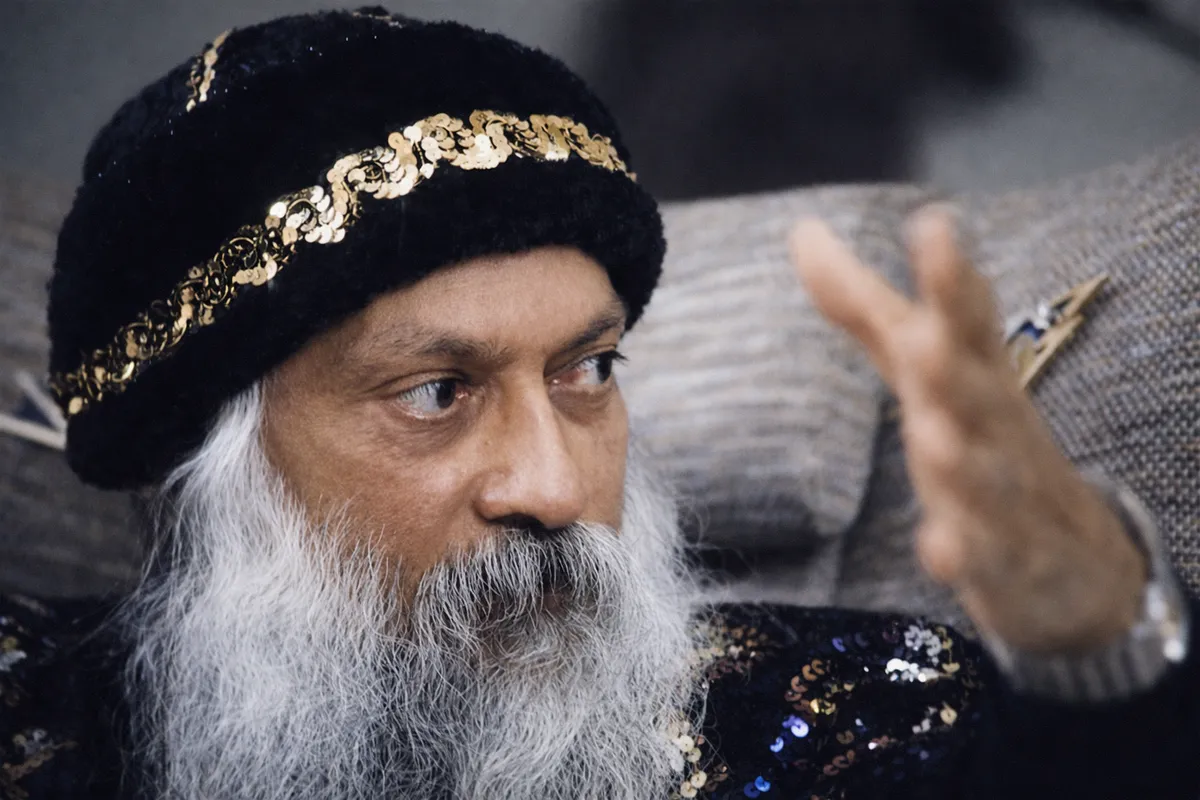
You get so quietly absorbed that your senses go silent, and a deeper inner “sound” and presence can show up.
From the Discourses
Passages where Osho speaks to this question — each links to the complete discourse.
Chinmaya Yogi has asked: While listening to you, suddenly a trance-like state comes over me. Then neither do I see you, nor do I hear your words. What is happening? Am I perhaps making some mistake in meditation?
See the mind’s tricks! This is the beginning of meditation—and the mind will say, “You’re making a mistake in meditation; that’s why drowsiness is descending.” This is not drowsiness. For it the Yoga scriptures have a different word—yoga-nidra. It is not sleep. It is a state of rasa, of rapture—so saturated with sweetness that neither I am seen nor am I heard. You have not gone to sleep. You have become so inwardly merged with me, so one with me…! To hear, distance is needed. To see, distance is needed. A little space is required to see. You can only see the other; you can only hear the other. How will you see yourself? Such moments will come when you are so absorbed with me that neither words will be heard nor will I be seen. And these are precisely the moments when the wordless will be heard. And when…
Some friends come to me and say, Osho, we keep hearing all sorts of sounds. When will this stop?
It is never going to stop. You are not to become unconscious so that you don’t hear sounds. No—meditation will not come by the stopping of sounds. Sounds are there, and within you no reaction, no response arises—meditation is concerned only with this much. A man is shouting next door; nothing happens to you: you hear, and nothing happens. A sister came to me today and said that in the last fifteen minutes of the afternoon silence her heartbeat increased a lot. So many sounds became audible that she got frightened; she felt like getting up and running away. Not hearing sounds would be a swoon. Hearing sounds and reacting by running away—that is the ordinary state. Hearing sounds and simply listening, remaining only the witness, the watcher—that is meditation. You are not to become stupefied. Whatever is happening, you will know it all—but it will become dreamlike. As long…
Question: BELOVED OSHO, WHAT IS THE TRANSCENDENTAL? Meditation is just the opposite. It is awakening. It is becoming fully aware of your body, of your mind. And you have simply to be watchful. You don't have to repeat anything, because repetition means you have fallen into identifying with the thought process. Chanting is also a thought process. Repeating a mantra or a name of God -- Hindu, Mohammedan, Christian, it doesn't matter. You can simply count from one to a hundred and back again, from a hundred to ninety-nine, ninety-eight, ninety-seven, then go back. Go up, go down. Just climb the whole ladder up to a hundred and again come down. Four or five times you will be able to do it and then you will fall asleep. But the whole night you will have to do that, climbing up, coming down, climbing up, coming down.
If you all sleep here tonight—so long as you are awake, there may be some differences; once asleep, all difference disappears. One and the same sleep descends upon all. If someone were to inspect each face—he would find only one taste: of sleep. However he investigates—women will be sleeping, men sleeping; children sleeping, old people sleeping; the healthy sleeping, the ill sleeping; the ugly and the beautiful sleeping; the poor and the rich sleeping; the worldly and the sannyasin sleeping—but the sleep is alike. The taste of sleep is one: unconsciousness. So too happens in the supreme awakening. Whoever awakens—their taste is one. Certainly their words differ—Krishna spoke in Sanskrit, the Buddha in Pali, Mahavira in Prakrit, Jesus in Aramaic, Mohammed in Arabic; languages differ, cups of different colors and shapes from different lands and times—but the taste is one. And the one who recognizes this taste—he alone is religious.
Osho! You were just here, you were just here. The fragrance of your breath is in these breezes. The whisper of your lovely footsteps is in the air. The earth and sky that beheld you… you were just here, you were just here. When I saw you, my breath simply stopped, my Master! These eyes would not lower. The moment I came to my senses, where did you hide? You were just here, you were just here.
Meera! If you want to know the divine, to attain it, you must sustain a very paradoxical kind of awareness. Paradoxical because from one side it is awareness, and from the other it is a kind of unawareness too—an ecstasy, a divine drunkenness that is not stupor but awakening; in which within, a lamp of meditation is lit, a flame of alertness burns. Love knows this art of paradox. Love is the key that opens the lock on that door. Love knows how to sway and yet remain centered within. Love knows how to close the eyes and still come to vision. Love knows how to move not even an inch, and yet complete a journey of a thousand miles. Reason will not grasp it. For thought it is inaccessible. But for love it is natural and easy. What is needed is an awareness colored by ecstasy; and an ecstasy…