
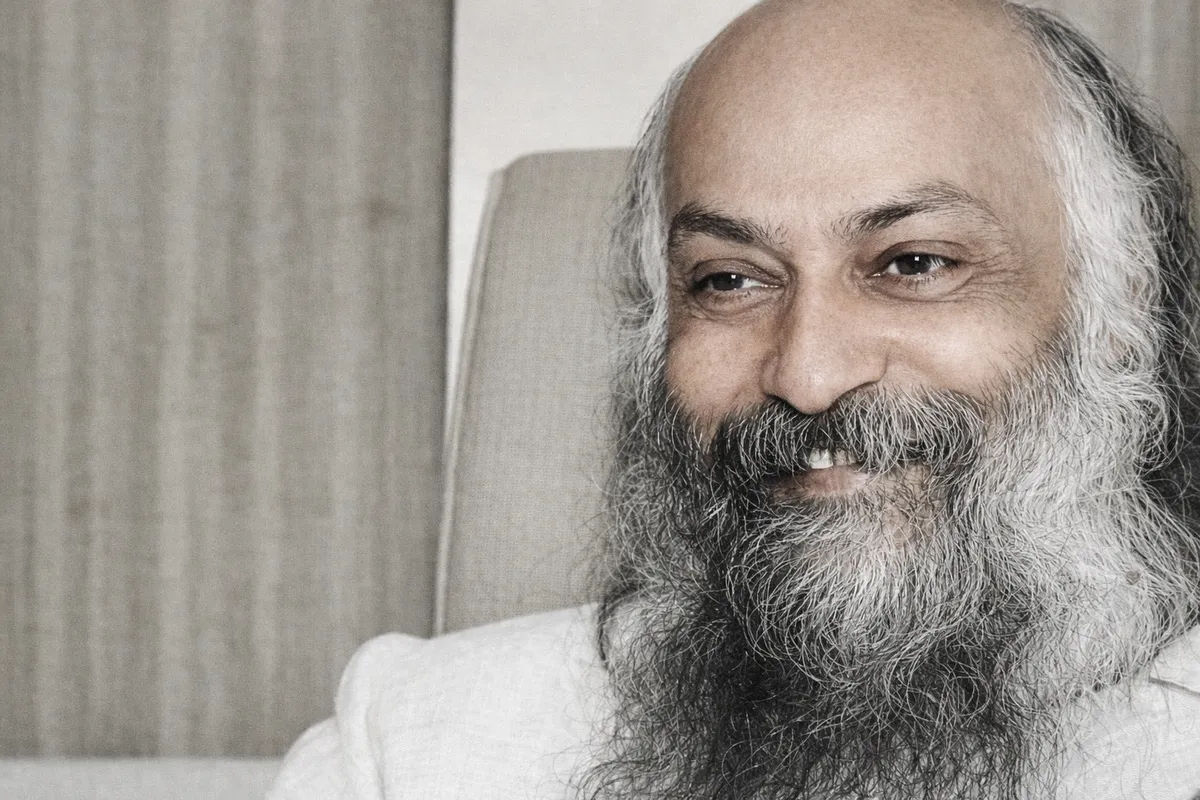
When bad thoughts show up, don't fight or pick sides; just watch them like clouds passing by.
From the Discourses
Passages where Osho speaks to this question — each links to the complete discourse.
Beloved Osho, sometimes, when dark sides of my mind come up, it really scares me. It is very difficult for me to accept that it is just the polar opposite of the bright ones. I feel dirty and guilty and not worthy of sitting with you in your immaculate presence. I want to face all facets of my mind and accept them because I hear you often say that acceptance is the condition to transcend the mind. Can you please talk about acceptance?
The basic thing to be understood is that you are not the mind -- neither the bright one nor the dark one. If you get identified with the beautiful part, then it is impossible to disidentify yourself from the ugly part; they are two sides of the same coin. You can have it whole, or you can throw it away whole, but you cannot divide it. And the whole anxiety of man is that he wants to choose that which looks beautiful, bright; he wants to choose all the silver linings, leaving the dark cloud behind. But he does not know that silver linings cannot exist without the dark cloud. The dark cloud is the background, absolutely necessary for silver linings to show. Choosing is anxiety. Choosing is creating trouble for yourself. Being choiceless means: the mind is there and it has a dark side and it has a bright…
Beloved Osho, the darkness seems so deep, my eyes covered in a haze, my mind never-ending noise -- except for those moments I am with you -- swirling around and around. The light is there but seems so far away in all this darkness. Sometimes I wonder if I am going to make it. Beloved master, I cannot find the door.
Don't be worried. You don't need to find the door, because you are outside the door! You are never inside, you only believe you are inside. Existentially, you are always outside. The moment you understand that you are out -- it was just an idea that you were in -- the faraway light is no longer far away; it is you. And the darkness that surrounds you is not found anymore. But the basic thing is to realize that you are already outside the door. There is no way for you to be inside the door. That's what I was saying: watchfulness is not part of the mind and cannot be part of the mind. Mind cannot be a witness. Mind is the darkness. Mind is the whole problem, and the solution is just outside the door waiting for you to recognize that you are not in, you are out.…
A second friend has asked: Osho, in the practice of awakening, of awareness, fear arises, and there is a constant worry that the routine of life may fall into disorder. It also seems that when anger, sex, etc., arise, if one acts on them, they are finished in five to seven minutes—one feels free of them. If you don’t act, their after-echo, their waves, keep resounding within for days. Then it feels as if it would have been better to have done it and been done with it. So what should one do? Is such awakening not repression?
Two things. First, if through “awakening” your anger—which would otherwise be over in five minutes—goes on for two days, understand it is not awakening; it is repression. Repression makes things spread. It creates even more disturbance than indulgence. If sexual desire arises and is over in a moment, but with your so-called awakening it drags on for days, grows dense, and becomes a burden on the mind, know that it is not awakening, it is repression. Many of us don’t rightly understand the difference between awakening and repression. Understand it. Repression means: what has arisen inside, you press it down inside; you don’t allow it to come out. Indulgence means: you let it out on someone. Get the difference clear. Repression means: you force it down upon yourself; indulgence means: you unload it onto the other. Awakening is a third thing—letting it out into the void: neither pressing it down…
Next time it happens, just watch it. Become very objective, a detached watcher, just to see what exactly it is, how it arises just like a small seed, and then how it grows and becomes a big tree and how you are completely lost in it. Just see the whole process of its growth and just see how you help it to grow. Don't be in a hurry to drop it and don't be in a hurry to get out of it; that's where people are wrong. People are in such a hurry to get out that they can't see how they get in, and that is the secret: just watch how you get in. Once you have seen the whole process and the misery that comes out of it, in that very understanding something evaporates. It is not a question of dropping -- just an old habit evaporates.
When thought objects vanish, the thinking subject vanishes, as when the mind vanishes, objects vanish. Things are objects because of the subject; the mind is such because of things. Understand the relativity of these two and the basic reality: the unity of emptiness. In this emptiness the two are indistinguishable and each contains in itself the whole world. If you do not discriminate between coarse and fine you will not be tempted to prejudice and opinion.
Give love, and the begging bowl is there, your love has disappeared. Give your whole life, and the begging bowl is there, looking at you with complaining eyes. "You have not given anything. I am still empty." And the only proof that you have given is if the begging bowl is full -- and it is never full. Of course, the logic is clear: you have not given. You have achieved many many things -- they have all disappeared in the begging bowl. The mind is a self-destructive process. Before the mind disappears you will remain a beggar. Whatsoever you can gain will be in vain; you will remain empty. And if you dissolve this mind, through emptiness you become filled for the first time. You are no more, but you have become the whole. If you are, you will remain a beggar. If you are not, you become the…