
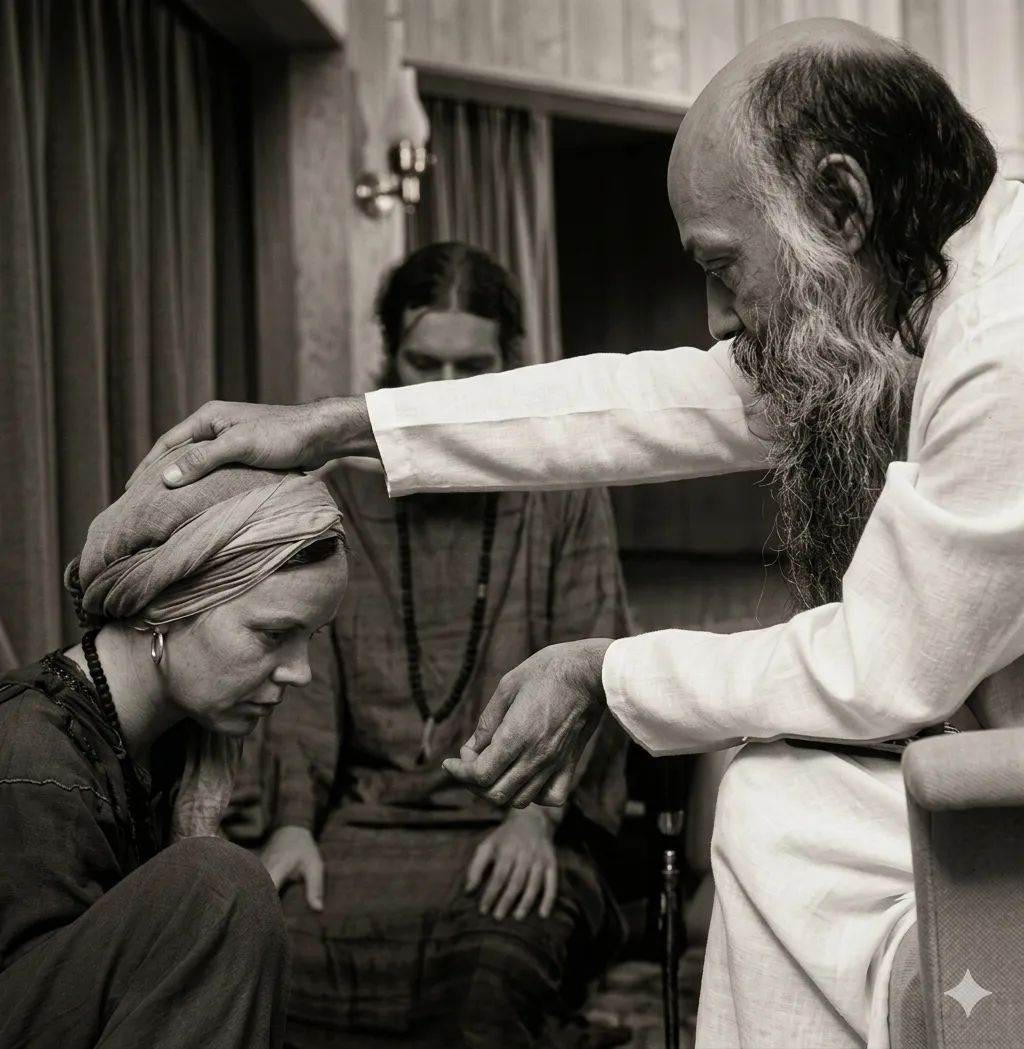
It’s like a wise reflex: from inner nothingness, the whole being responds at once without thinking, so there’s no doubt or regret.
From the Discourses
Passages where Osho speaks to this question — each links to the complete discourse.
If there is absolute emptiness inside an enlightened one, then how is it that he seems to be making decisions, discriminating, liking this or disliking that, saying yes or no?
The same is the situation with unenlightened minds and enlightened minds. An enlightened mind simply looks. Everything is clear. He has a clarity. His whole being is light. He looks around and he simply moves, acts -- he never thinks. You have to think because you don't have eyes. Only blind men think; they have to think because they don't have eyes. They need substitute eyes, and thinking provides that. I never say that Buddha or Mahavira or Jesus are great thinkers. That would be just nonsense. They are not thinkers at all. They are knowers, not thinkers. They have eyes, they can see, and through their seeing they act. Whatsoever comes out of a Buddha comes out of emptiness, not out of a mind filled with thoughts. It has come out of an empty sky. It is the response of emptiness. But for us it is difficult because nothing…
What constitutes the behaviour of an enlightened man?
An enlightened man is all emptiness. What constitutes an emptiness? It has no 'constitutes' in it; hence it is empty. A man who is enlightened has no character. Let me repeat it: an enlightened man has no character at all. He lives from moment to moment. He has no character to follow; he has no structure around him. A character is a structure, a character is an armour. An enlightened man has no character. Let me say he is characterless. But try to understand me -- because he has no structured consciousness. He HAS consciousness but the structure has been dropped. He's neither Hindu nor Mohammedan nor Christian. He is neither good nor bad, neither moral nor immoral, neither this nor that. He simply is. All duality has disappeared. You cannot evaluate him; you cannot categorize him; you cannot put him into any pigeon-holes of your logic. He exists like…
Can one live and function in the world in a state of enlightenment or no-mind? Is an enlightened person self-sufficient in the world?
In a single moment he was no more Jesus, he was Christ. In a single moment he was no more human, he was superhuman. The gap is very small. That's why Buddha says, 'Miss it by a single inch, or by a single moment and you are thrown millions of miles away.' Just a single inch was the difference between these two sentences -- there was not much gap, maybe a single breath. But he was just ordinary when he shouted against god -- human, weak. Just a moment later on he was reconciled; there was no problem then. If this is the way god wants it to happen, then this is the way it has to happen. He accepted. A smile must have come to his face, and not only to his face but to his heart also. In that moment he must have expanded. Now there was nothing…
A friend has asked: Osho, whether I move in deepest attunement with nature, in the outermost attunement, or even against it—in all three situations nature is equally pleased; I am completely free to choose any one of them. Then why should my happiness differ among the three choices?
There will be a difference, because each leads to a different experience. Consider: the earth has gravity. You walk along the road; if you walk upright, you don’t fall. You are free—you can also walk crookedly and fall. Gravity will not say, “Don’t walk crookedly.” Walk askew, fall, your leg breaks—there is pain and trouble. When you fall sideways on the ground, the same gravity is at work; it was at work when you were walking, too. No difference. The same law functions—impartially. If you err in walking, or choose wrongly, you will be hurt. Choose rightly, and you will not be hurt. What does happiness mean? Happiness means: in accord with the law. Unhappiness means: against the law. The law is neutral. You drink poison—nature will kill you. You are ill; you take a dose of poison—the illness dies and you become healthy. Even water, if you drink too…
Osho, if the ego decides on non-choice—“choicelessness”—what will be its state?
The ego cannot make such a decision. Non-choice, “choicelessness,” is the name of the state of consciousness when the ego is not. The ego cannot decide, “All right, from now on we are choiceless.” That itself is a choice. You have chosen again. You remain the chooser. People come to me and say, “The mind doesn’t become quiet. We try hard to meditate, but the mind won’t settle.” I tell them, “Drop worrying about peace. Just meditate; it will quiet down.” They ask, “Then it will become quiet?” I’m telling you to drop the concern. They say, “We agree to drop even the concern—but will it become quiet or not?” They don’t drop it. Even when they say they agree, they don’t really agree. A fortnight later they come back: “You said drop the concern; we did—but it still hasn’t become quiet.” They don’t even notice what they are saying:…