
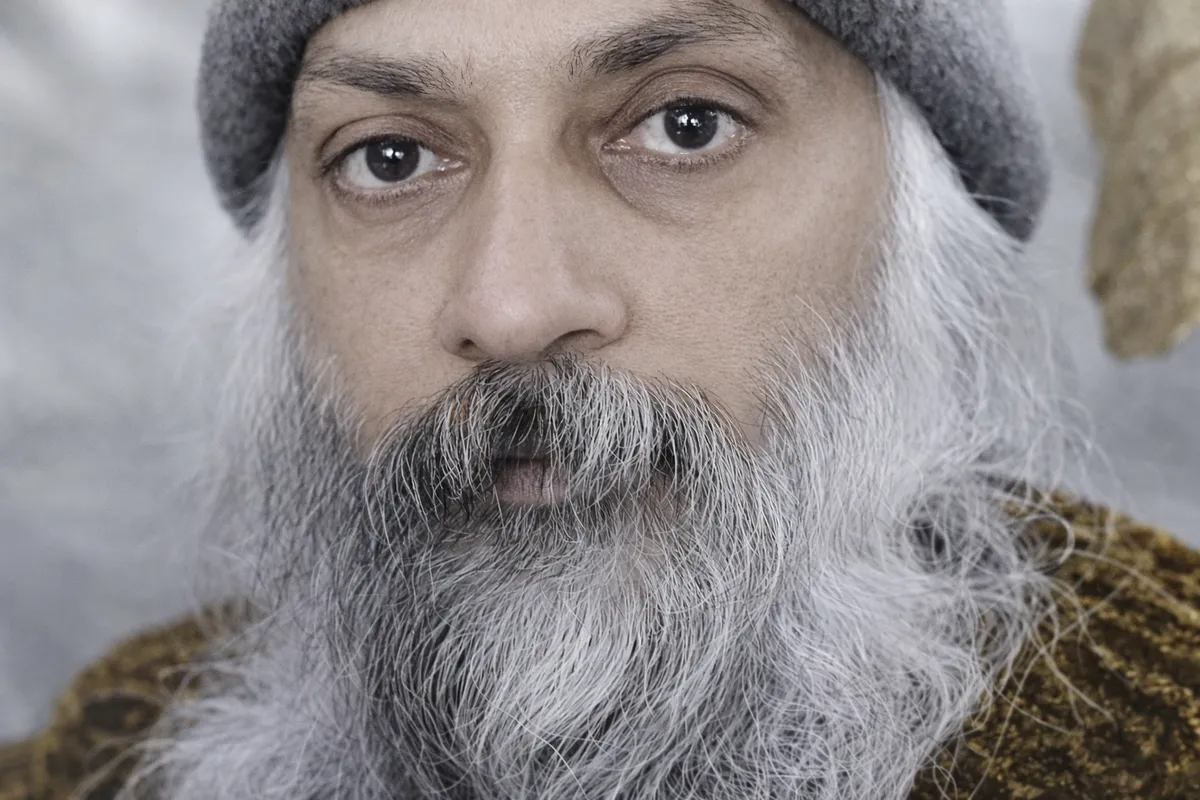
Don’t fight darkness; switch on the light—keep calmly watching your feelings as they appear until they show you where they come from.
From the Discourses
Passages where Osho speaks to this question — each links to the complete discourse.
Osho, we feel that to penetrate and transform the deeper layers of the unconscious only through awareness is difficult and not enough. What else should one do other than the practice of awareness? Please explain more about the practical dimensions on this matter.
Silence is energy. Brahmacharya is energy. Not to be angry is energy. But this is not suppression. If you suppress anger, you have used energy again. Don't suppress -- observe and follow. don't fight -- just move backwards with the anger. This is the purest method of awareness. But certain other things can be used. For beginners certain devices are possible. So I will talk about three devices. One type of device is based on body awareness. Forget anger, forget sex -- they are difficult problems. And when you are in them, you become so mad that you cannot meditate. When you are angry you cannot meditate; you cannot even think about meditation. You are just mad. So forget it; it is difficult. Then use your own body as a device for awareness. Buddha has said that when you walk, walk consciously. When you breathe, breathe consciously. The Buddhist method…
Question: OSHO, HOW DOES ONE EXPLORE THE HIGHER STATES OF CONSCIOUSNESS? If you start looking... just whenever you have time, just sit silently and look at what is passing in your mind. There is no need to judge, because if you judge, the mind immediately changes its scenes according to you. The mind is very sensitive, touchy. If it feels that you are judging, then it starts showing things that are good. Then it won't show you the naked washerwoman of Bombay, that picture will be missed out. So don't judge, then that picture is bound to come. Don't judge, don't make any condemnation, don't make any appreciation. Be indifferent. You just sit silently looking at things, whatsoever is happening. And absurd things will be happening: a horse becomes a man.... Now you need not ask why, there is no need to ask, you simply see it.
Osho, is there any practical process for being in the realm of existence beyond thoughts, in the void?
The way to thin them out is non-cooperation. Right now we are their makers—that is, we are the ones maintaining them. When we sit idle, some thought or other is running, because without our cooperation they cannot run. Withdraw your cooperation from whatever thoughts are running, and do nothing else; regard just this as samayik, as meditation. If all thoughts dissolve, you will feel no ego and no person within. You will know only being—only being will be known, in which the distinction “I am an individual” or “I am the whole” will not be felt. Only pure being will remain—pure existence. In truth, because of the thoughts accumulated upon that pure existence, we appear to be a person. This sense that I am “A,” you are “B,” you are “C”—the A, B, C we have pasted on—is our thought-power. We commonly say, “I will become liberated”—this is not quite…
Considering the example of sensual instinct, kindly explain what are the practical ways to encounter the unconscious mind, and how can one know that one has become free from it?
This is how concentration works. So through concentration you can never encounter the unconscious. You can encounter the unconscious only with meditation -- and this is the difference between concentration and meditation. Meditation means your mind working not as a torch but like a flame: everything is enlightened around it -- everything. It is not narrowed down, the light is diffused. It is not moving in one direction -- it is moving in all directions simultaneously so the whole is enlightened. How to do it? I said Sufis use dance as an active meditation and then they can encounter the unconscious. Zen monks in Japan use absurd problems to encounter it. You face some problem which cannot be solved -- which cannot be solved at all! Howsoever you try, the problem is such that it cannot be solved. They call such problems "koans" -- absurd problems. For example, they will…
It is said again and again that being aware is enough for transformation. How does it work?
But in the East we know the art of making the disappear. So who bothers? It is as if you see a ghost in the dark -- there is no ghost, just the form of the tree -- and you start analyzing. You never come close to the tree, you never bring light; you start analyzing the form from far away. You can go on analyzing: nothing is going to happen out of that analysis. Eastern psychology says: Light a candle, bring the candle to the place, and first see whether the ghost exists at all. If the ghost does not exist, then why bother? Why long long years of analysis? The analyzed goes on pouring out rubbish, and the analyst goes on dissecting, analyzing, labeling and categorizing the rubbish. Much work goes on, and all futile, much ado about nothing. Western psychology is based on analysis, Eastern psychology is…