
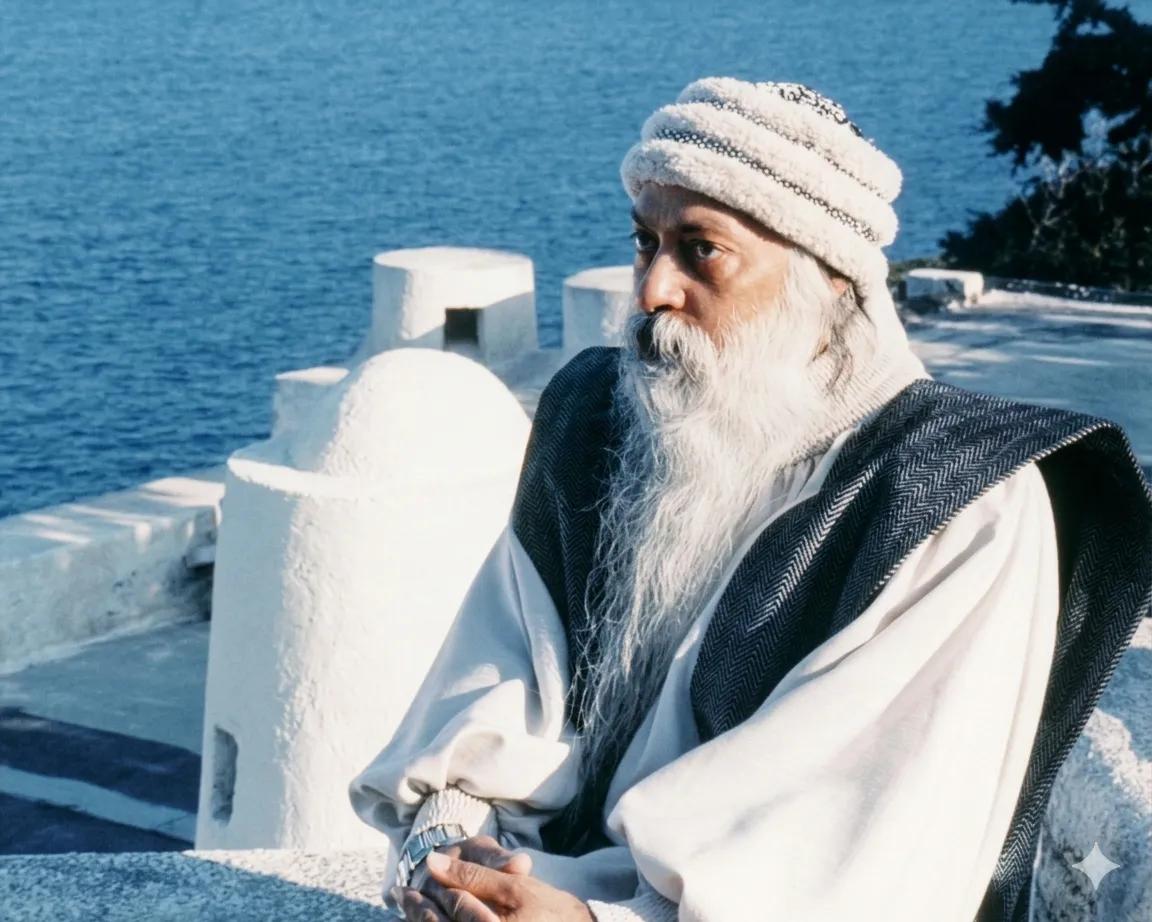
According to Osho, the feeling of detachment in non-doing is the fading of feverish, tense alertness, not a loss of real awareness. As you relax, the unhealthy glow subsides, seeming dull at first. If you stay passive, a balanced, natural awareness arises: inclusive, effortless, and refreshing. Then action happens spontaneously, without tension or goal-seeking, as an overflow of energy in the present.
Feeling detached is your mind’s noise settling so a calm, steady awareness can show up.
From the Discourses
Passages where Osho speaks to this question — each links to the complete discourse.
Sometimes I feel in a state of non-doing, very passive, but may awareness of what is happening around me seems less. In fact, I feel detached from things around me. This somehow means false passivity, as I imagine on-doing should be synonymous with increased awareness. Can you please define this state?
Ordinarily we are in a feverish state -- active, but feverishly. If you become passive the fever will be lost. If you become passive, non-doing, if you relax within yourself, activity will be lost, fever will be lost, and the intensity that comes through fever will not be there. You will feel a little dull, you will feel as if your awareness is decreasing. It is not decreasing; only the feverish glow is decreasing. And it is good, so don't be afraid of it, and don't think that this passivity is not real. This is being said by your mind which needs and wants the feverish activity and the glow that comes through fever. Fever is not awareness, but in fever you can have a very unhealthy awareness, alertness. That is diseased; don't hanker for it. Allow it to go, fall into passivity. In the beginning it will look like…
Meditation is always passive; the very essence of it is passive. It cannot be active because the very nature of it is non-doing. If you are doing something, your very doing disturbs the whole thing; your very doing, your very "activeness," creates the disturbance. Non-doing is meditation, but when I say non-doing is meditation I do not mean that you need not do anything. Even to achieve this non-doing, one has to do much. But this doing is not meditation. It is only a stepping stone, only a jumping board. All "doing" is just a jumping board, not meditation. You are just on the door, on the steps.... The door is non-doing, but to reach the non-doing state of mind one has to do much. But one should not confuse this doing with meditation. Life energy works in contradictions. Life exists as a dialectic: it is not a simple movement.
Osho, if it really sinks into the mind that all this is acting—if it does—then perhaps, in time...
Yes, it will come—little by little. It will come only if you keep it in awareness. But nonattachment does not mean that you do nothing. If you do nothing, you fall apart. Nonattachment means the sense of separateness while doing. One expression of this is the feeling of acting: that what we are doing has no more value than an act. And as this feeling deepens—that it is only acting—then it’s finished; once it is over, it is over, and we have nothing to do with it anymore. Someone makes a mistake; we tell him it is a mistake, we even explain it. And we remain outside it—because we were outside the whole time, even while we were speaking. So it means finding within yourself a point that always remains outside—that is what nonattachment means. To discover within a state that stands outside in every situation. You are walking; that…
No-mind is not mindlessness. No-mind is total mindfulness. It is having so much awareness that the mind cannot disturb it. The mind hums beautifully then. You can use it, and it is such a good slave. You cannot see the tremendous beauty of it. It goes on accumulating so many facts and is always ready to supply you whenever you need. Just a second's notice and it starts supplying. I will take care of your mind, don't be worried. Just leave it to me. [The Aum Marathon group is present. An assistant groupleader said: I feel neither happy nor sad.] That's good. Being neither happy nor sad is better than being happy, because if you are happy, you will become unhappy. The wheel goes on moving. It is just like day and night. If you are happy, you cannot avoid unhappiness.
Question: OSHO, EXACTLY HOW DO YOU NOT DO IT? I said, "This feeling is not from the awareness that you are, because your consciousness has remained the same. This sense of a new birth is coming from your ego; your ego is tremendously gratified, strengthened. That is your 'gain.' But according to those who know that is your loss." What is gain to the ego is loss to the soul. What is a blessing to the ego is a curse to the soul. What seems to be of tremendous importance to the ego is just sheer stupidity to the innermost core of your being. The logic of the ego is that it is never interested in the simple things, because if you say, "I can breathe!" that is not going to bring crowds to welcome you, to say, "Teertha, you are great! Your name will remain immortal because you breathe.