
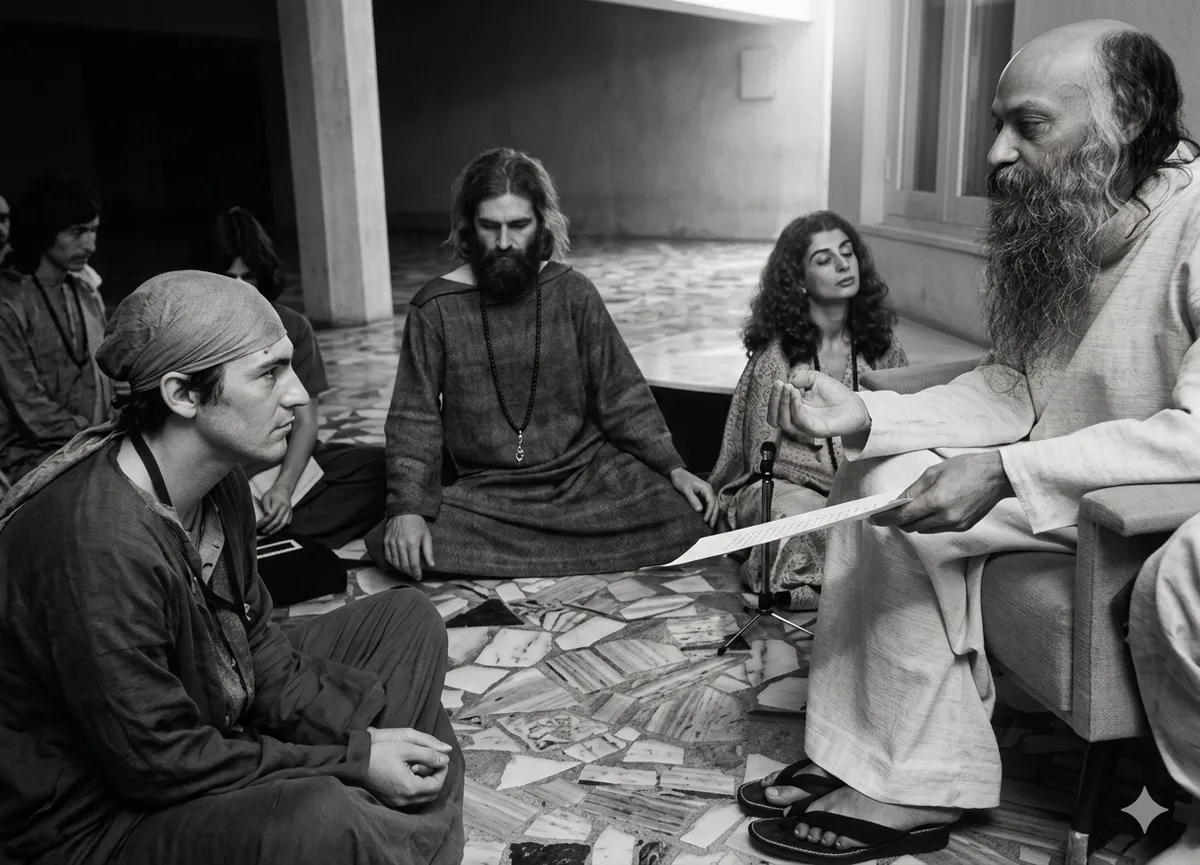
According to Osho, the idea of a 'fully enlightened' or 'perfect' master is an ego-driven fantasy: absolute perfection is death, while life—and enlightenment—remain an open, growing process. Even after awakening, one keeps learning and evolving. Seek not a flawless idol but a living, total presence that embodies aliveness, humility, and growth. Drop perfectionism; be human, be total, and allow continuous transformation.
There’s no perfect master—real wisdom stays alive and keeps growing, so look for a human, living guide, not a flawless statue.
From the Discourses
Passages where Osho speaks to this question — each links to the complete discourse.
Osho, what is the difference between surrender and blind imitation?
So be careful: the freedom you allow yourself, allow the other too. You have no right to judge another as blindly credulous or as a surrendered being. Drop that concern. You cannot judge anyway—how will you enter another’s heart? How will you know? Think only about yourself. See within whether, up to now, you have lived by blind belief or by surrender. Decide only there; leave worrying about others. Otherwise, all your judgments will be wrong. Jesus said: Judge not; do not set yourself up as a judge in relation to another. To the friend who has asked: if you are asking for yourself, good. Drop worrying about others. Look within and see: whatever I have been clinging to till now—have I ever staked my life to hold it? Have I meditated for it? Have I loved for it? Or am I just clutching what culture, society, civilization handed me?…
Being beyond the limits of time he is the master of masters. He is known as aum.
REPEAT AND MEDITATE ON AUM. REPEATING AND MEDITATING ON AUM BRINGS ABOUT THE DISAPPEARANCE OF ALL OBSTACLES AND AN AWAKENING OF A NEW CONSCIOUSNESS. Remember this -- desire and need -- these two words. Desire is of the mind; need is of the body. Desire and need, then you are a clock with hands. Only need, no desire, then you are a clock without hands, and when need also drops, you have gone beyond time. This is eternity; beyond time is eternity. For example: if I don't look at the watch -- and I have to look continuously the whole day -- if I don't look at the watch, I don't know what is the time. Even if I have seen it five minutes before, again I have to look because I don't know exactly, because now -- no time inside -- only the body is ticking. Consciousness has no…
A certain man decided that he would seek the perfect master.
HE READ MANY BOOKS, VISITED SAGE AFTER SAGE, LISTENED, DISCUSSED AND PRACTISED, BUT HE ALWAYS FOUND HIMSELF DOUBTING OR UNSURE. AFTER TWENTY YEARS HE MET A MAN WHOSE EVERY WORD AND ACTION CORRESPONDED WITH HIS IDEA OF THE TOTALLY REALIZED MAN. THE TRAVELER LOST NO TIME. "YOU," HE SAID, "SEEM TO ME TO BE THE PERFECT MASTER. IF YOU ARE, MY JOURNEY IS AT AN END." "I AM, INDEED, DESCRIBED BY THAT NAME," SAID THE MASTER. "THEN, I BEG OF YOU, ACCEPT ME AS A DISCIPLE." "THAT," SAID THE MASTER, "I CANNOT DO FOR WHILE YOU MAY DESIRE THE PERFECT MASTER, HE, IN TURN, REQUIRES ONLY THE PERFECT PUPIL." One man came to me and he said, "I used to think that Krishnamurti must be like a Buddha, but today I saw him in his discourse -- he became so angry. And for no reason at all!" I said, "You…
Osho, is it wrong to try to save somebody? Is it not part of compassion?
That reminds me again of Natthu Kaka. I was a regular visitor to his salon. I had no beard at that time -- I was a child -- and no mustache, so there was no fear, but I had to use a scarf because I had long hair, and if Natthu Kaka was in the mood he might start cutting. And once he had cut your hair you could not do anything. And he was such a nice man, he would say, "Why be worried? -- you need not pay." It was, every day, a problem that he had shaved somebody without asking him, and now the man was angry. Particularly in India, people shave if they become sannyasins; that means they are dying in a ritualistic way. When a person dies, he is shaved; it is just symbolic. Just as when a person dies he is shaved, in the…
Why do masters need directions from master of masters? Are they not enough in themselves when they have reached enlightenment? Or are there stages of enlightenment too?
In a way it is difficult because I have to work more. In a way it is very beautiful because I have to work more and I have to look from every standpoint possible. I come to know many things which ready-made instructions cannot do. And when the Master of Masters in Patanjali's ideology -- a god -- gives instructions, he gives no explanations; he gives simply instructions. He simply says, "Do this; don't do that." Those who follow these instructions, they will also look like ready-made. It is bound to be so because they will say, "Do this." They will not have the explanation. And very coded instructions are given. Explanations are very difficult -- and there is no need also for them, because when it is given from a higher standpoint it is okay. Just one has to be obedient. The Master is obedient to the Master of…