
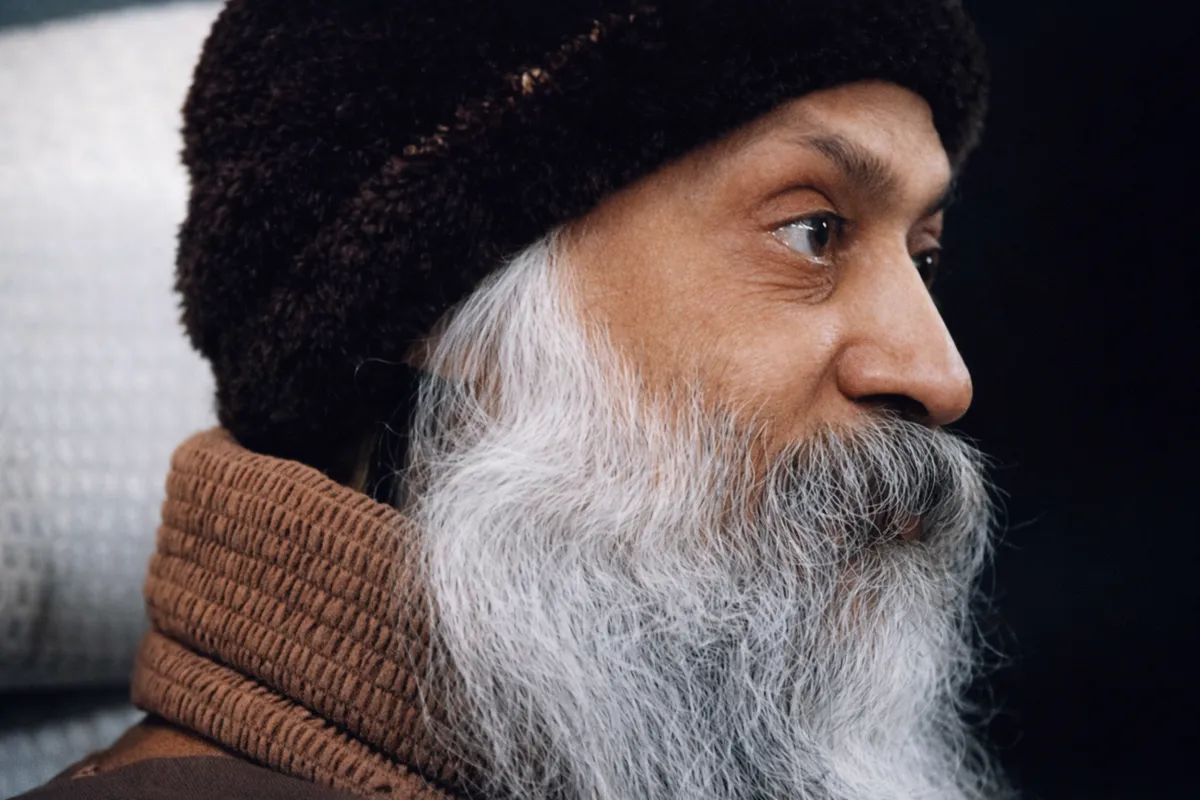
According to Osho, life itself is overflowing with bliss; man suffers because self-consciousness cuts his living contact with it. This self-centered awareness creates a barrier and leaves him suspended between unconscious nature and supraconscious being—neither animal nor Buddha. The tension of this in-between process (trying to remain 'just human') generates anguish. Happiness returns by transcending the self into pure consciousness.
Life is joyful, but we feel miserable because we overthink ourselves and stay stuck in the middle; relax the “me” and grow into clear awareness.
From the Discourses
Passages where Osho speaks to this question — each links to the complete discourse.
When life itself is so fulfilling, overflowing, so blissful, then what is that which makes a man miserable?
So an egoist remains miserable, because to be happy one has to be happy with that which one has. You cannot be happy with that which you don't have; you can only be unhappy with that. You can be happy only with that which you have. How can you be happy with that which you don't have? And ego is always interested only in that which you don't have. You have ten thousand rupees -- ego is no more interested in it. It is interested in twenty thousand. By the time you have twenty thousand, it is no more interested in it. It is interested only in thirty thousand. And so on, so forth... it goes on. The ego only gives you goals, but whenever those goals arrive, it does not allow you to celebrate. One becomes more and more miserable! As life passes, we go on gathering misery, we…
And you say that you don't know the meaning of it. That's one of the essential qualities of a sannyasin: to function from the state of not-knowing. If you don't know something, simply say "I don't know." If you know, if you really know, only the say "I know." Much of the misery of the world can disappear if people become a little more alert. People go on saying things which they don't know, they go on pretending, as if they know. Not only do they deceive others, they deceive themselves too. People talk about God and heaven and hell and the theory of karma and rebirth; they go on talking about these things as if they know. They go on believing in their own false knowledge and because of this false knowledge they will never be able to attain to true knowledge.
Beloved Osho, why don't we drop our miseries, our ignorance and unhappiness? How can a man be happy and blissful?
When you go outside in the sun your eyes become smaller, the window shrinks, because the sun is too much and there is no need to take that much light in. When you come home, slowly the eyes again open to their normal size. But when you see something beautiful, they become wider, wide open. It is not in your hands, it is not that you are doing it. Even a saint will have to do it because it is not a voluntary thing. It is non-voluntary, it happens on its own accord. It is biologically set up. You have this word in English, `respect'. People have destroyed its meaning. It does not mean `honor' -- or it means honor in a very different way than you understand. `Respect' means the desire to see again, re-spect -- spect means seeing. If it is honor, it is honor for beauty --…
Bliss is simple, misery is complex. Bliss is natural, misery is unnatural. To main the unnatural you have to put all your energy into it -- to be natural you need not put any energy into it. But millions of people are miserable, and it is very rare to find a person who is not. So what has happened? It is simple. To understand it is of immense significance. It is only through misery that the ego can exist, because you have to make an effort and you have to be constantly into it, creating it, maintaining it. Then the ego can remain. And if one loves the ego, then misery is necessary to keep the ego alive. In a state of bliss ego disappears because there is nothing left to do and ego can exist only as a doer.
Osho, I once read somewhere that when buddha was asked by a disciple to describe life briefly, the buddha replied 'misery'. Is this true?
What is misery? Misery is feeling separate from existence, feeling isolated from existence, feeling alienated from existence -- that is misery. And what is bliss? Feeling one with existence, orgasmically one with existence, organically one with existence. Having an ego is misery, and becoming egolessness is bliss. Both alternatives are open. The choice is yours. Zareen, listening to Buddha's answer that life is misery, don't settle there. His answer is to unsettle you. His answer is to shock you. His answer is to wake you up to the fact that your life is misery. But people are really cunning, very cunning; they listen only to that which they want to listen to. People are so cunning that listening to the statement that life is misery, they say, ''Then nothing can be done. If life is misery, then I have to live a miserable life, then this is all there is…