
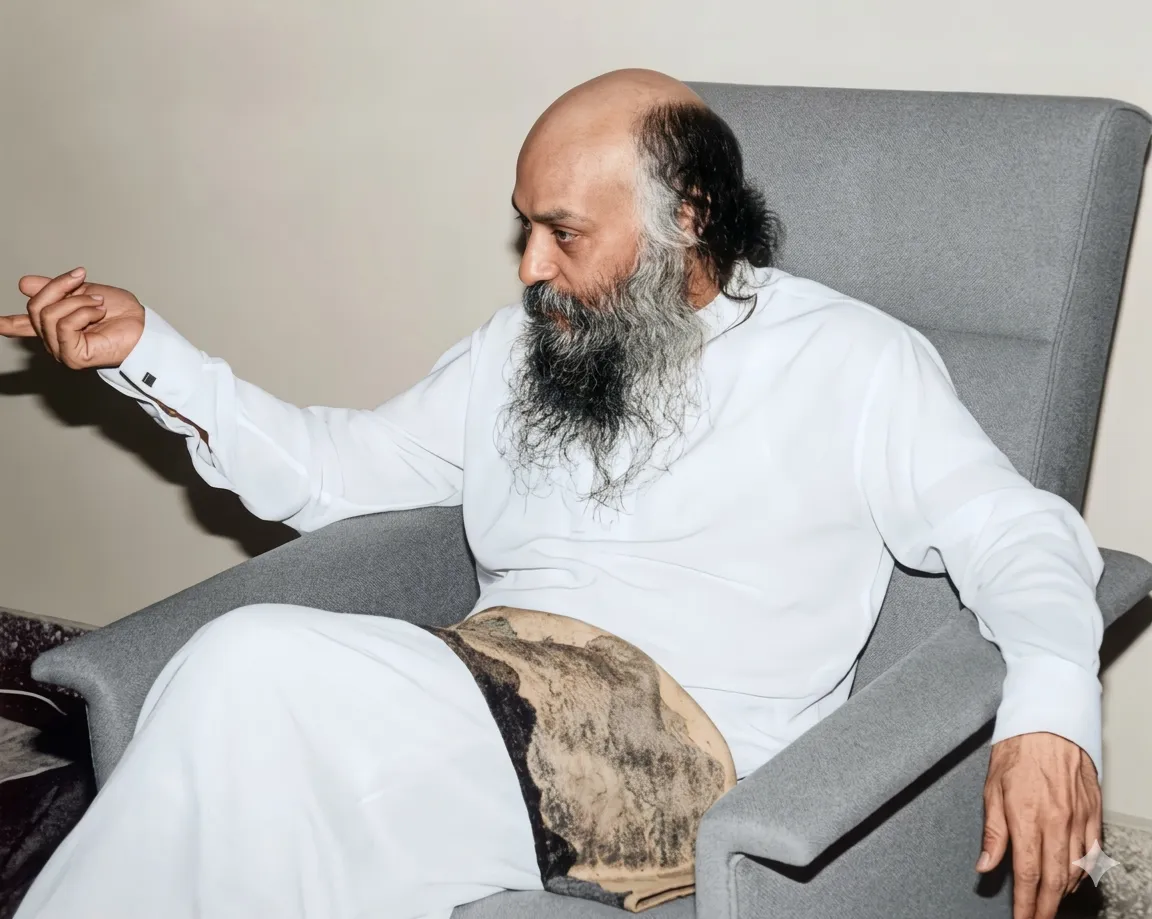
You don’t really have limits—only the fences your mind builds; drop them and you’ll discover you’re as vast as everything.
From the Discourses
Passages where Osho speaks to this question — each links to the complete discourse.
Osho, sometimes the mind deceives; it says, “Stay here.” It wants to stop even at the wrong thing—and it does. It says, “This is happiness.”
If this distinction begins to become clear—so subtle—but if we keep experimenting a little, and through the twenty-four hours maintain a small inner inquiry—“This act I just did, did it give me happiness or suffering? At this place the mind brought me—did I want to stay here or move away?”—if such a small test keeps running, in two to four months it will become so clear, so clear that as an event begins you will know whether it is bad or good. When this awareness arises, life changes. I do not say, “Drop the bad.” I don’t say that. I do not say, “Do the good.” I don’t say that either. I say: just recognize what is good and what is bad. And the bad will begin to drop, and the good will begin to happen. So the issue is not about “dropping.” (The audio recording of the question is…
But suppose the tree, the person, is basically handicapped? Then he cannot change. Not because he doesn't want to, but because he can't.
But now a new possibility has opened up. For the first time, particularly in the West, man is free from his day-to-day needs. Now we can experiment with new possibilities for the mind. It was impossible to do this in the past, because bodily needs were such a heavy burden, so unfulfilled. But now the possibility is there. We live on the threshold of a deep revolution, a revolution such as human history has never encountered. A revolution in consciousness is possible now. With more facilities to know and understand, we can change. Much time will be needed, but the possibility is open to us. If we dare, if we have courage, it can become an actuality. The whole humanity is at stake. Either we will go back to the past or to a new future. It is not a question of a third world war, not a question of…
That which brings us together sets us apart
For them there is no short-cut. And all that is great belongs to that category. Only small things can be attained quickly. Coffee can be instant -- -- love cannot be. Instant love cannot be love. Instant simply means you are not even ready to pay the little patience for it. One should learn to be patient -- to be ready to wait with open doors, with a welcoming heart, but not in a hurry, not demanding, not forcing things. And the miracle, the paradox, is that the less you force things, the more quickly they happen. The more you force them, the longer it takes. Because meditation has to be learned -- and meditation only means stilling of the mind, the silencing of the mind -- you cannot be in a hurry. If you are in a hurry your mind will remain in a turmoil. You will be jumping…
Osho, is a human only the body, or something more as well?
Ranjan! A human is the body—and not the body too. In the body is the bodiless; within the form, the formless hides; in matter, the divine remains concealed. Two kinds of ideologies have held sway in the world. Both are incomplete. One is the materialist tradition—Charvaka, Diderot, Marx, Freud, Epicurus, and the like—who said that a human is only the body, not a grain more, not different, not other. Just the body; a clay lamp with no other flame in it. A mere mechanism. While it runs, it runs; when it collapses, it collapses. When your watch stops, you don’t go to the watchmaker and ask, “Where did its soul go?” Mulla Nasruddin once bought a watch at a fair—cheap. A fair-watch, and very cheap; he came home delighted. But on the way home, the watch stopped. So Mulla opened it up. His wife protested, “You don’t know how to…
दूसरा प्रश्न: ओशो, क्या मनुष्य देह मात्र ही है या कुछ और भी?
दुनिया में दो तरह की विचारधाराएं प्रभावी रही हैं। दोनों अधूरी हैं। एक है भौतिकवादी की परंपरा--चार्वाक, दिदरो, मार्क्स, फ्रायड, एपिकुरस और इस तरह के लोग; जिन्होंने कहा कि मनुष्य केवल देह मात्र है, और रत्तीमात्र भी ज्यादा नहीं, भिन्न नहीं, अन्य नहीं। बस देह है; सिर्फ मिट्टी का दीया है, इसमें कोई और ज्योति नहीं। यंत्र मात्र है। जब तक चल रहा है, चल रहा है; जब गिर गया, गिर गया। जैसे तुम्हारी घड़ी बंद हो जाए, तो फिर तुम यह थोड़े ही पूछते हो घड़ीसाज से कि इसकी आत्मा कहां गई? मुल्ला नसरुद्दीन घड़ी खरीद कर लाया था। सस्ती मिल गई थी मेले में। अब मेले की घड़ी, और खूब सस्ती मिल गई थी, तो बहुत प्रसन्न घर तक आया था। लेकिन घर तक आते-आते घड़ी बंद हो गई! तो मुल्ला ने घड़ी खोली।
time consists only of two tenses, not of three ordinarily it is divided into three parts the past, the present and the future that is existentially wrong grammatically it may be right linguistically it may be right but i have no concern with language and grammar my concern is with existence as far as existence is concerned time only consists of past and future the present is not part of time it is part of existence existence is always now, it is never then it is never yesterday, never tomorrow it is this very moment and to go beyond time is the whole art of meditation meditation is the transcendence of time past and future both and the plunging into the now, the here.