
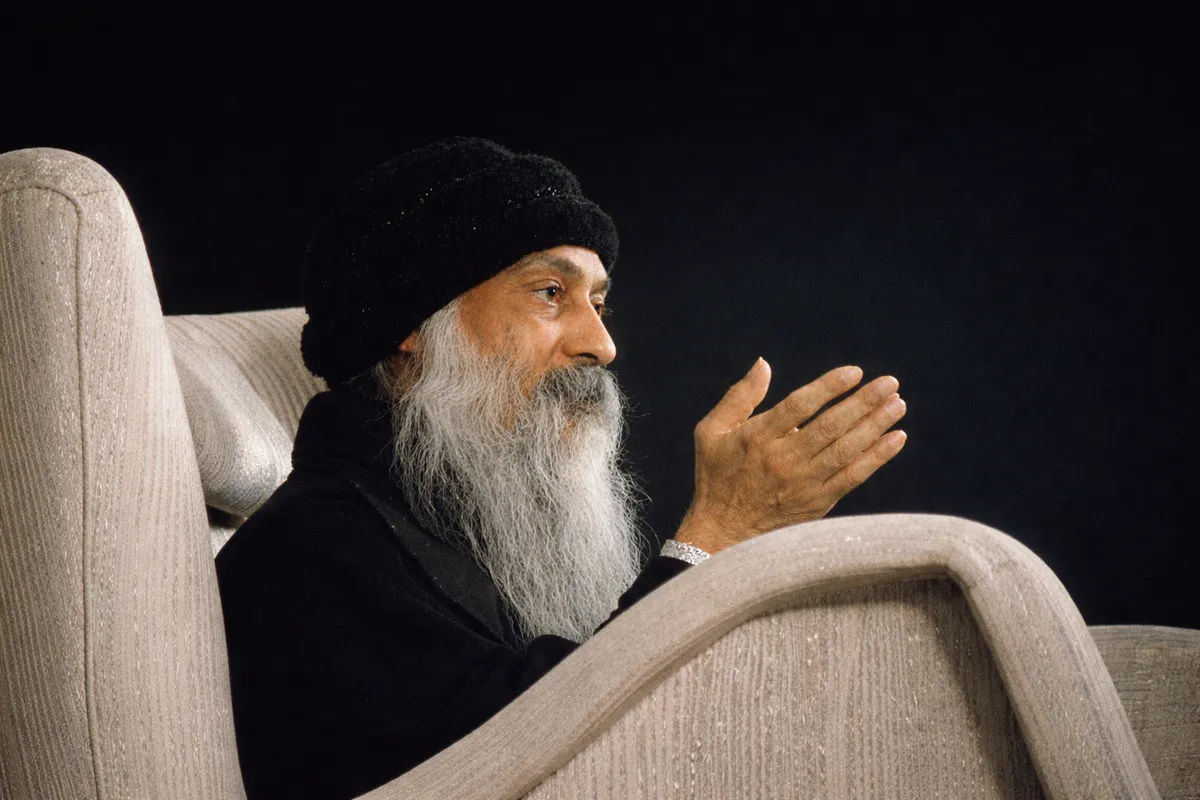
Don't hide what you feel; cry or speak it, and quietly watch inside to see the clinging behind it, so you heal and stop repeating the pain.
From the Discourses
Passages where Osho speaks to this question — each links to the complete discourse.
Osho, there is a great fear of death. Is there any way to be free of it?
I have heard that on his campaigns Alexander reached a place where he learned there was a spring whose water, if drunk, makes one immortal. He went in search of it. When he reached the spring, he rejoiced; never had he seen water so crystal clear. He was about to cup it in his palms when a crow perched on a branch said, “Stop, Alexander! You will regret it. First hear me.” Alexander was astonished—one marvel: water that grants immortality; another marvel: a speaking crow. “What do you want to say?” The crow said, “I too drank this water. I am no ordinary crow; as you are Alexander among men, I am Alexander among crows. I spent my life searching and found this spring. I drank—and now I writhe. I have been alive for thousands of years; I cannot die. I throw myself from cliffs, dash my head on rocks,…
Osho! While listening to you I start to weep. Now, even in the celebration of active meditation, tears burst forth. What is this? In the midst of meditation a feeling arises that this body is a hindrance now; how can it be shed—the feeling keeps growing more intense. Why? Please explain out of compassion.
Akshay Vivek! Human beings have been given such wrong conditioning that they have neither ever cried to their heart’s content nor laughed to their heart’s content. They have never really lived to their heart’s content. In no aspect, in no dimension, have they ever done anything totally; everything remains half-done! So many things hang inside, suspended like Trishanku. I say meditation is a celebration, but what is happening to you happens to others as well. While celebrating, suddenly tears arise from some unknown corner! They must have been suppressed somewhere—perhaps for lifetimes. Especially in men. Because from childhood we tell boys: Don’t cry! Girls cry. You are a man; crying is not for you. This is false. It is utterly false. Nature has made the tear glands in the eyes of men and women just the same. Men’s tear glands are not smaller than women’s. So one thing is certain—nature…
Osho, when I listen to you, every word sinks to the depths of my heart and stirs me. But when I read you, it remains a mental game. Please tell me why this happens.
It’s plain. The arithmetic is simple. When you read, only you are there; I am not. What you read is nothing but you. It becomes a game of the mind. When you listen to me, then sometimes—knowingly or unknowingly—I also slip into you. You seldom give such a chance, but now and then a lapse happens on your side. Unaware, you leave the door a little open—and I come in. So when you are hearing me, it’s a different matter. That is why truth has always been spoken, not written. It cannot be written. Even speaking it is very difficult, yet it can still be said—at least a little can be said, a little news can be given. Because in speaking, many elements are involved that are lost in writing. When you read a book, the book is dead. A book cannot create an atmosphere around you. A book has…
Osho, meditation increases sensitivity. But as sensitivity grows, living seems to become more difficult—because the mind’s reactions become sharp and intense, and it feels as if one’s whole life is at stake at every small turn. In such a state, how can one find and hold the point of balance?
Certainly: as meditation deepens, sensitivity will also deepen. And with heightened sensitivity, problems grow too. Sensitivity means you will experience everything—every event—in its full velocity, with full intensity. If someone insults you, the way that hurt reverberates inside a meditator will not be the same for a non-meditator. If a thorn pricks, the meditator’s awareness of that sting will be much clearer than that of the non-meditator—because the non-meditator lives in a kind of stupor, a haze of unawareness. The duller the awareness, the less the pain is consciously felt. Perhaps that is exactly why we reduce our awareness—so we can feel less pain. Ask a psychologist and he will say: every child learns early how to numb their awareness. All children are born sensitive. Then they begin to kill their sensitivity—because living with raw sensitivity is very difficult. A certain blunting of feeling becomes “necessary.” That is why, at…
Osho, while listening to your discourse, sometimes my eyes grow moist and tears begin to flow. Then the mind and its tensions feel lighter. At times I experience the same in active meditation. Both states feel blissful. Between prayer and meditation—resolve and surrender—of these two different paths, which path will shatter the mind? Into which should I dissolve? Please explain. Chittaranjan has asked!
I have heard: in one home, a boy got very angry with his mother. He was no more than nine. He locked himself in the bathroom and wouldn’t open the door. The mother panicked. She knocked and knocked—he wouldn’t answer. He stood inside in utter silence, as if in a trance. The mother’s anxiety grew. Her husband was at the office. What to do? She phoned him. He said, “Try to persuade him; get him out. Even if I come, what can I do if he won’t open?” With no other way, she remembered there was a policeman in the neighborhood. Perhaps he could frighten the boy into coming out. She called him. The policeman came. He asked the lady who it was and how old. She said, “My son, nine.” The policeman went up, knocked on the door and said, “Little girl, come out now.” The boy at once…