
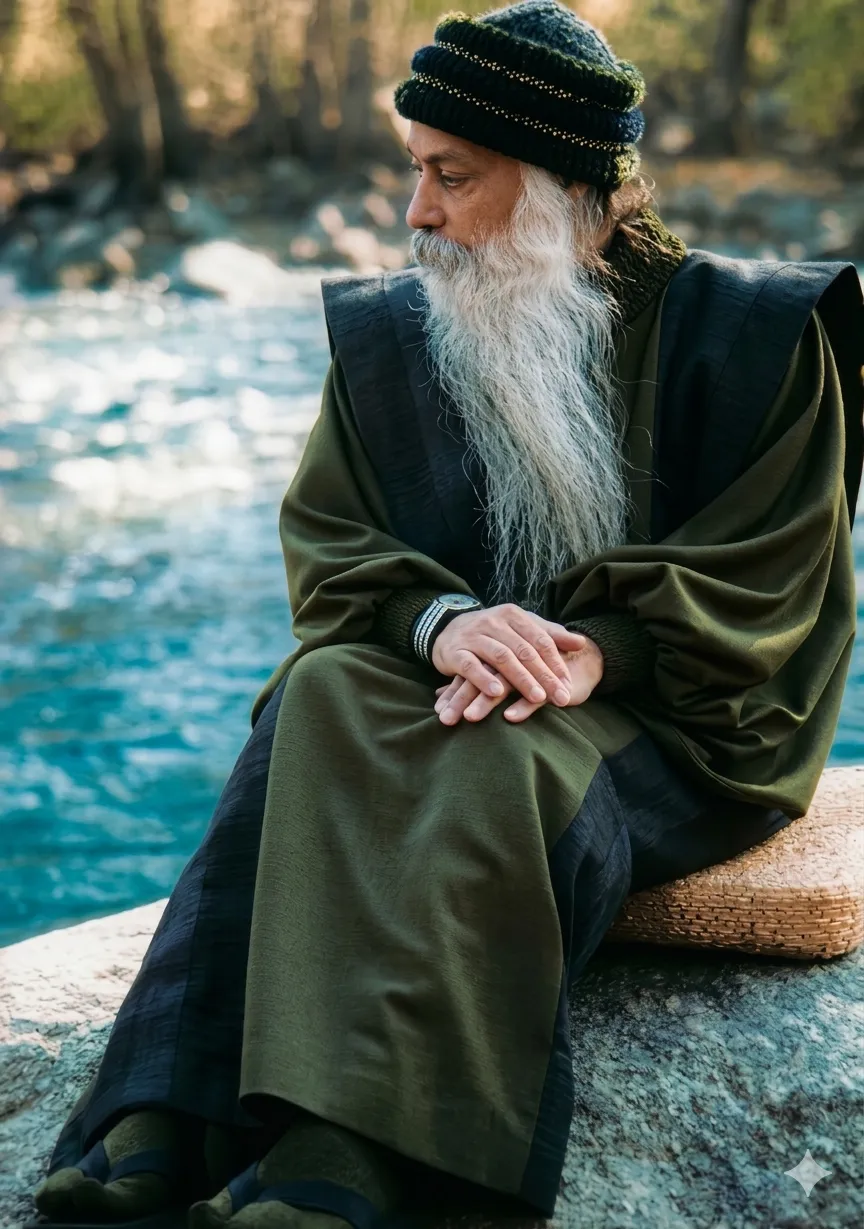
Words are like a finger showing the moon—look past the finger to the quiet sky it points to.
From the Discourses
Passages where Osho speaks to this question — each links to the complete discourse.
Question: Third question: Osho, isn’t expression nothing but a limitation? Certainly, expression is only a limitation. Whatever manifests has a boundary; the moment it appears, it is limited. That which remains unmanifest is the limitless. Creation has limits; the Creator has none. A poem has limits; the poet has none. A painting has limits, a frame; the painter has none. For the unmanifest is far more than what appears. It is infinitely more than what shows itself. What I have said to you has limits. What I will never be able to say to you has no limits. Buddha is walking through a forest. It is autumn; the forest floor is covered with dry leaves, and the wind is tossing them about with great clamor. Ananda asks, “Bhagwan, I have a question. Today we have a little privacy; no one else is here.
निश्चित ही, अभिव्यक्ति मात्र मर्यादा है। जो प्रकट होता है, उसकी सीमा है; प्रकट होते ही सीमित हो जाता है। जो अप्रगट रह जाता है, वही असीम है। सृष्टि की सीमा है, स्रष्टा की नहीं। कविता की सीमा है, कवि की नहीं। चित्र की सीमा है, फ्रेम है, चित्रकार की नहीं। क्योंकि जो अप्रगट है, वह बहुत है उससे, जो प्रकट हुआ। वह अनंत गुना है उससे, जो प्रकट हुआ। मैंने तुमसे जो कहा, उसकी सीमा है। जो मैं तुमसे कभी न कह पाऊंगा, उसकी कोई सीमा नहीं है। बुद्ध एक जंगल से गुजरते हैं; पतझड़ के दिन हैं, सूखे पत्तों से सारा वन-प्रांत भरा है, हवाएं उन सूखे पत्तों को जगह-जगह उड़ाए फिरती हैं; बड़ा शोरगुल है। आनंद ने पूछा, भगवान! एक बात पूछनी है। आज निजी एकांत मिल गया है, कोई और नहीं है। मैं पूछता हूं, कि आप जो जानते हैं, वह सभी मुझसे कह दिया है? बुद्ध ने अपनी मुट्ठी में सूखे पत्ते भर लिए और कहा, जो मैंने तुमसे कहा है, वह इस मुट्ठी में बंद पत्तों की भांति है; और जो नहीं कहा, वह इन सारे सूखे पत्तों की भांति है, जिनसे पूरी पृथ्वी भरी है।
Osho, awakened ones, considering place, time, circumstance, and the era-appropriate psychology of people, have expressed the same truth in very different forms. To the point that they appear mutually quite disputatious and even contradictory. Is an absolute expression of the ultimate truths of life and existence not possible? Will the limits of the age and the condition of the people always continue to be imposed upon truth?
Expression will always be limited. Expression will always be relative. The speaker and the listener—both create the boundaries of expression. I will say only what can be said. You will understand only what can be understood. Truth is vast. If I go to see the ocean and you say to me, “On your way back, bring a little of the ocean,” I will not be able to bring the whole ocean. I may bring a little water from it. But in that water much will be missing. There will be no storm of the ocean, no waves. And that was the real ocean: that tumultuous roar and fierce thunder! Waves crashing against cliffs! Those surges rising and spreading for miles! That swell! None of that will be there. I will bring a vessel filled with a little ocean water. Still, there will be something! If you taste it, it will…
तीसरा प्रश्न: ओशो, जाग्रत पुरुषों ने देश-काल-परिस्थिति और लोगों की युगानुकूल मनोदशा का खयाल रखकर एक ही सत्य को बड़े भिन्न-भिन्न रूप से अभिव्यक्त किया है। यहां तक कि वे परस्पर बिलकुल विवादास्पद तथा विरोधाभासी तक बन गये हैं। जीवन व अस्तित्व के परम सत्यों की क्या निरपेक्ष अभिव्यक्ति संभव नहीं है? क्या सदा ही युग व लोक-दशा की सीमा सत्य पर आरोपित होती रहेगी?
अगर मैं सागर के दर्शन करने जाऊं और तुम मुझसे कहो कि लौटते में थोड़ा सागर लेते आना, तो पूरा सागर तो न ला पाऊंगा। हो सकता है, थोड़ा-सा जल सागर का ले आऊं। लेकिन उस जल में बहुत कुछ बातें नहीं होंगी। सागर का तूफान न होगा, सागर की लहरें न होंगी। वही तो असली सागर था। वह तुमुल नाद और घोर गर्जन! शिलाखंडों पर टकराती हुई लहरें! वह उठती दूर-दूर मीलों तक फैले हुए विस्तार से भरी लहरें! वह उफान! वह सब तो न होगा। भरकर ले आऊंगा एक बर्तन में थोड़ा-सा सागर का जल। फिर भी थोड़ा तो होगा कुछ! स्वाद लोगे तो खारा होगा। सागर जैसा उस बर्तन में क्या होगा? थोड़ा खारापन का स्वाद आ जायेगा, बस।
The second and last question: Osho, after realizing God, why can one not express that experience?
But Krishnanand, why worry now? For now, worry about attaining. We are very strange people! We raise strange questions. You have not attained yet, and you are anxious about why, after attaining God, that experience cannot be expressed? This is a hypothetical question. It has no value. First attain, then you will know why it cannot be made known! You yourself will smile, you yourself will laugh. The question will not arise at all. It arises only because as yet you have no taste of the vastness within yourself. But even in life, if you explore a little, you will find experiences that cannot be told. You wake at dawn and watch the sun rise—the beauty of it. Can you convey it to someone? Yes, if you wish you can take a photograph, you can paint a picture of sunrise. But is a picture of the sunrise the sunrise? If…
A master got up to address a group seeking enlightenment and had only this to say: 'ha! Ha! Ha! What's all this? Go to the back of the hall and have some tea.' he then got down and departed.
That which cannot be said should not be said at all. One should keep silent. That's what this master is doing -- without saying anything he is making a gesture. First he says, 'Ha! ha! ha!' -- he laughs, a belly laughter. It must have been a shock for those who had come to seek enlightenment. You don't expect that, that you will be taken so non-seriously. Enlightenment-seekers are very serious people, long-faced people. And here comes this man, stands there on the stage and says, 'Ha! ha! ha!' What kind of sermon is this? But it is a Zen sermon. He laughs at the absurdity that you are trying to seek enlightenment. It cannot be sought -- that's what he is saying. He is ridiculing them. He is saying, 'You are ridiculous! Ha! ha! ha! You are foolish, you are stupid. Enlightenment cannot be sought; it is not something…
A puzzled monk once said to fuketsu, "you say truth can be expressed without speaking, and without keeping silent. How can this be?" fuketsu answered, "in southern china, in the spring, when I was only a lad, ah!. How the birds sang among the blossoms."
Zen brings the whole truth to the world. Zen is a great blessing to the world; it brings the whole truth. The whole truth is: Truth cannot be said, and yet can be said. If not said, then showed, indicated. The ordinary duality is transcended. We are always moving from one pole of the duality to the other. Sometimes we say, "Yes, it can be said"; this is one pole. Then we become aware, "How can it be said?" -- the other pole. Then we keep silent, but then again we become aware that there is something left: "Yes, it can be said." This way it goes on moving, it swings. Zen says truth is a transcendence, transcendence of all duality. The duality between the word and the silence is also to be transcended. The Bible says in the beginning there was the word. The Vedas say in the beginning…